In May of 2011 Codex meets in Quebec and labeling is still very alive on the table: "The federal policy on labelling foods derived from biotechnology remains under discussion with Canadians and international standards organizations such as Codex Alimentarius", Health Canada states. In fact at the Codex meeting this spring a significant Canadian retreat from the overt backing of the US position that GE food is substantially equivalent, was evident. No wonder ...its become clear that is both incorrect and only a piece of the problematic puzzle. We have 10 months to think about, talk, coalesce our strategies and ensure we get mandatory labeling of genetically engineered foods established next year in Canada.
Keep an eye on CBAN to help their ongoing campaign, which targets the pressuring of Health Canada.
But I think plural is best (strategieS) the debate must reach wider than the issues of toxicity and oontamination/transgene pollution to include the freedom of choice to live morally, a conscientious or religious objection.
It is amazing to me that this has never been challenged as a Charter issue, its not as if people aren't writing about it for eg. Could we mount a campaign that encompasses all of us who understand life has deep complexity, mystery, organization to engage in devotion and service to the sanctity of life one should be free to not eat transgenic, engineered food. Could we motivate spiritual communities to proclaim and demand that? the Council of Churches, Buddhist Sangas, Indigenous Councils, Muslim , Jew, Hindu, Pagan Urban dwellers and small lesbian farmers? I think so!
My brain today has been offering up quotes from sunday school lessons a very long time ago:
I am the bread of life
By the fruits shall ye know them
In the beginning was the Word, and the Word was with God, and the Word was God. It was in the beginning with God. All things were made through it and without it was not any thing made that was made.
July 8, 2010

Labeling GMOs closer: "Substantial Equivalence" faltering
From CBAN Press release
Canada & Codex: GM labeling – US Increasingly Isolated
May 12, 2010
Canada at the UN Codex meeting on GM food labeling: Negotiations continue, U.S. increasingly isolated
Your actions worked – again!
Thanks to your letters, the Canadian government delegation to the UN
Codex meeting last week did not boldly ally itself with the U.S.
position against GM food labeling. The U.S. failed in their attempts
to stop the negotiations.
The Canadian government did not speak up to support the nonsensical
position from the U.S. that GM foods are no different from foods
produced through conventional methods. Though not yet actively
supporting a positive position on GM labeling, Canada did not obstruct
the meeting and the U.S. was not able to put an end to the
negotiations. Out of the over 50 countries at the negotiations, the
U.S. was only supported in its position by Mexico, Costa Rica, and
Argentina.
Codex recommendations on GM labeling could protect developing
countries from challenges brought through the World Trade Organization.
The U.S. was trying to put an end to the UN Codex negotiations on GM
labeling but the negotiations will continue. There will be an
important Codex meeting in May 2011 in Quebec City – and we must
continue to pressure the Minister of Health. The Canadian
Biotechnology Action Network (CBAN) will continue to take action and
monitor this issue, as well as collaborate with U.S. groups. Please
see below from Consumers Union in the U.S.
For updates and more information: Cban
Canada & Codex: GM labeling – US Increasingly Isolated
May 12, 2010
Canada at the UN Codex meeting on GM food labeling: Negotiations continue, U.S. increasingly isolated
Your actions worked – again!
Thanks to your letters, the Canadian government delegation to the UN
Codex meeting last week did not boldly ally itself with the U.S.
position against GM food labeling. The U.S. failed in their attempts
to stop the negotiations.
The Canadian government did not speak up to support the nonsensical
position from the U.S. that GM foods are no different from foods
produced through conventional methods. Though not yet actively
supporting a positive position on GM labeling, Canada did not obstruct
the meeting and the U.S. was not able to put an end to the
negotiations. Out of the over 50 countries at the negotiations, the
U.S. was only supported in its position by Mexico, Costa Rica, and
Argentina.
Codex recommendations on GM labeling could protect developing
countries from challenges brought through the World Trade Organization.
The U.S. was trying to put an end to the UN Codex negotiations on GM
labeling but the negotiations will continue. There will be an
important Codex meeting in May 2011 in Quebec City – and we must
continue to pressure the Minister of Health. The Canadian
Biotechnology Action Network (CBAN) will continue to take action and
monitor this issue, as well as collaborate with U.S. groups. Please
see below from Consumers Union in the U.S.
For updates and more information: Cban
moral principles of informed consent
Thus far, the moral debate concerning genetically modified foods (GMF) has focused on extrinsic consequentialist questions about the health effects, environmental impacts, and economic benefits of such foods. This extrinsic approach to the morality of GMF is dependent on unsubstantiated empirical claims and fails to account for the intrinsic moral value of food and food choice and their connection to the agent's concept of the goodlife. I develop a set of objections to GMF grounded in the concept of integrity and maintain that food and food choice can be intimately connected to the agent's personal integrity. I argue that due to the constitution of GMF and the manner in which they are produced, such foods are incompatible with the fundamental values and integrity of certain individual moral agents or groups. I identify three types of integrity that are threatened by GMF: religious, consumer, and integrity based on certain other moral or metaphysical grounds. I maintain that these types of integrity are sufficiently important to provide justification for political and societal actions to protect the interests of those affected. I conclude by proposing specific steps for handling GMF consistent with the moral principles of informed consent, non-maleficence, and respect for the integrity of all members of society. They include mandatory labeling of GMF, the implementation of a system for control and regulations concerning such foods, and guaranteed provision of conventional foods.
Assya Pascalev
You Are What You Eat: Genetically Modified Foods, Integrity, and Society;
Journal of Agricultural and Environmental Ethics
The EU recognises the consumers' right to information and labelling as a tool for making an informed choice. Since 1997 Community legislation has made labelling of GM food mandatory for foods containing or are derived from GMO.
Canadians should not let up their demands to provide consumers their birthright as Canadians, protected in our charter. We have the right to choose the foods that are morally. spiritually and ethically acceptable to us. It is our responsibility to ensure the unobstructed enjoyment of these rights.
Assya Pascalev
You Are What You Eat: Genetically Modified Foods, Integrity, and Society;
Journal of Agricultural and Environmental Ethics
The EU recognises the consumers' right to information and labelling as a tool for making an informed choice. Since 1997 Community legislation has made labelling of GM food mandatory for foods containing or are derived from GMO.
Canadians should not let up their demands to provide consumers their birthright as Canadians, protected in our charter. We have the right to choose the foods that are morally. spiritually and ethically acceptable to us. It is our responsibility to ensure the unobstructed enjoyment of these rights.
July 7, 2010
negative results
Quite the Journal title I tripped into the other day:
Journal of Negative Results in BioMedicine. I'll look to see if there is an Agricultural Biotech equivalent. Oughta be
Journal of Negative Results in BioMedicine. I'll look to see if there is an Agricultural Biotech equivalent. Oughta be
July 3, 2010
a good market...
I love a good market. The crowd is full on and happy, the sun is shining and the plump lush piles of vegetables disappear in record time. After the rush I set back up quickly, in those sweet slower intervals, when conversation is possible. Until its inundation again: the pyramid of bagged peas and fluffy basil, the romaine towers, the glistening organized carrots...everything attacked lovingly and whisked away leaving a tablecloth to cover in bounty again. Then that last lonely dill bunch or radicchio hit the road and the wallet is plump. Tuck away the cash box, tidy up all the empty lugs, and go visit with happy people.
June 25, 2010
EU committee votes to further study nanofood
"The EU Parliament's Environment, Public Health and Food Safety Committee
has voted that food produced using nanotechnology should be "excluded from the novel food list, and thus the EU market, until the possible health effects of nano production can be fully assessed." link
has voted that food produced using nanotechnology should be "excluded from the novel food list, and thus the EU market, until the possible health effects of nano production can be fully assessed." link
June 23, 2010
Don't give up the good alfalfa fight
KANSAS CITY, June 23 (Reuters) - More than 50 U.S.
lawmakers are calling on the U.S. Agriculture Department to
keep Monsanto's (MON.N) biotech alfalfa out of farm fields,
despite a Supreme Court ruling this week that cleared the way
for limited planting pending environmental reviews.
The lawmakers said the biotech alfalfa presents too great a
risk to conventional and organic agriculture to ever allow it.
Here
lawmakers are calling on the U.S. Agriculture Department to
keep Monsanto's (MON.N) biotech alfalfa out of farm fields,
despite a Supreme Court ruling this week that cleared the way
for limited planting pending environmental reviews.
The lawmakers said the biotech alfalfa presents too great a
risk to conventional and organic agriculture to ever allow it.
Here
June 18, 2010
Monsanto vs Haitians
"On June 4th about ten thousand Haitian peasants marched to protest US-based Monsanto Company’s ‘deadly gift’ of seed to the government of Haiti. The march was seven kilometers from Papaye to Hinche, in a rural area on the central plateau, and was organized by several Haitian rural social movements that are proposing a development model based on food and seed sovereignty instead of industrial agriculture. Slogans for the march included “long live native maize seed” and “Monsanto’s GMO & hybrid seed violate peasant agriculture.”
Haitian peasants march against Monsanto Company for food and seed sovereignty Via Campesina
"On June 4th, 10,000 peasant farmers gathered in protest in Haiti to burn more than 400 tons of hybrid corn and vegetable seeds donated to the country by Monsanto. This was a hugely symbolic gesture and one that the rest of the world needs to listen to. Haiti is asking for our help in establishing a local, sustainable food system from the rubble that the country currently lies in. This is our opportunity to raise our voices in protest against Monsanto's involvement in the fragile beginnings of true food sovereignty in Haiti".
The Fight against Monsanto in Haiti Huffington Post
"Seeds are the center of food sovereignty. Without our seeds we cannot have food sovereignty. We want a system that relies as little as possible on any external products, like seeds or fertilizers. We want to produce something that is good and healthy for everyone. To be sovereign is to have control over seeds and land, techniques and knowledge—everything necessary for food."
Elias Freitas Mesquita, Creole Seed Project
Civil Eats
Five Questions Monsanto Needs to Answer about its Seed Donation to Haiti
Haitian peasants march against Monsanto Company for food and seed sovereignty Via Campesina
"On June 4th, 10,000 peasant farmers gathered in protest in Haiti to burn more than 400 tons of hybrid corn and vegetable seeds donated to the country by Monsanto. This was a hugely symbolic gesture and one that the rest of the world needs to listen to. Haiti is asking for our help in establishing a local, sustainable food system from the rubble that the country currently lies in. This is our opportunity to raise our voices in protest against Monsanto's involvement in the fragile beginnings of true food sovereignty in Haiti".
The Fight against Monsanto in Haiti Huffington Post
"Seeds are the center of food sovereignty. Without our seeds we cannot have food sovereignty. We want a system that relies as little as possible on any external products, like seeds or fertilizers. We want to produce something that is good and healthy for everyone. To be sovereign is to have control over seeds and land, techniques and knowledge—everything necessary for food."
Elias Freitas Mesquita, Creole Seed Project
Civil Eats
Five Questions Monsanto Needs to Answer about its Seed Donation to Haiti
June 16, 2010
Lilbuddy Macteeth gets a flock
I picked up four orphan lambs day before yesterday, almost weaned but I found an old goat to keep them company and provide a bit of refreshment. When they are done I'll have a bit of milk for my tea and possibly collect up enough to make cheese, which I haven't done for a very long time. Giving the lambs a bit of diluted milk twice a day is building intimacy between the lambs, the goat and I but Lilbuddy was nowhere to be seen this morning for chores. He hit the wire yesterday and I think he associates that pain with those creatures. This evening he joined us, trembling, then barking then whimpering as I milked the goat and fed the lambs. I think he understands we all belong and the little farm is a full circle now that we have some critters again.
Here they are!


Here they are!


June 11, 2010
remay tales
I had a tragic comedy here last night on the farm involving remay, or agricultural fabric...for non-gardeners that is a lightweight woven fabric that covers crop to prevent insect from landing and feasting or spreading disease and is an organic farmer's standby for salad greens and other sensitive things (carrots if rust fly is troublesome, for eg). It also speeds growth.
The remay on my old farm came in the long roll of 500 feet and we had these length of beds. One day coming home from market I witnessed a small wind tunnel that had grabbed an end and sucked it high (100 feet) into the air. I had a good view on the road above the valley where the fields lay as the tractor with loader full of rocks raced to the scene and helpers jumped and ran and tugged to get the long white sheet out of the wee tornado and constrained from whipping out the wee seedings.
Wind plays havoc here too, but have yet to see a tornado (just hurricane remnants), and yesterday's show was just my own damn fault: I was in hurry, it was late and I hungry and little Buddy was barking at the birds down in the creek - poised for trouble. It was time for dinner and the evening dog excursion...but I had one last task to do and I was rushing. I had weeded all day and the last task task was to till up the old salad and spinach beds to free up some space to plant. The garden is getting tight now for the tractor, so I eased into position, let down the tiller and set the pto in gear. I was focused on steering my old rig clear of the dill and beets in the beds on either side of the wheels, but I misjudged where the tiller dropped - I caught the remay end of the adjacent bed. I didn't notice for a good 20 feet. It had yanked the fabric off the turnips, lifting the little roots with it and rolled up neat on the shaft of the tiller. Amazing it rolled up clean and even and only tore where the tines ripped it the first few turns.
The turnips (Hakurai japanese salad)were ready to pick and were surprisingly undamaged. Buddy had to wait whilst I cussed and laughed and unrolled remay from the tiller (and then dealt with the turnips). On retrospect designing a tool that winds up a roll could be inspired here. Ditto with harvesting.
The remay on my old farm came in the long roll of 500 feet and we had these length of beds. One day coming home from market I witnessed a small wind tunnel that had grabbed an end and sucked it high (100 feet) into the air. I had a good view on the road above the valley where the fields lay as the tractor with loader full of rocks raced to the scene and helpers jumped and ran and tugged to get the long white sheet out of the wee tornado and constrained from whipping out the wee seedings.
Wind plays havoc here too, but have yet to see a tornado (just hurricane remnants), and yesterday's show was just my own damn fault: I was in hurry, it was late and I hungry and little Buddy was barking at the birds down in the creek - poised for trouble. It was time for dinner and the evening dog excursion...but I had one last task to do and I was rushing. I had weeded all day and the last task task was to till up the old salad and spinach beds to free up some space to plant. The garden is getting tight now for the tractor, so I eased into position, let down the tiller and set the pto in gear. I was focused on steering my old rig clear of the dill and beets in the beds on either side of the wheels, but I misjudged where the tiller dropped - I caught the remay end of the adjacent bed. I didn't notice for a good 20 feet. It had yanked the fabric off the turnips, lifting the little roots with it and rolled up neat on the shaft of the tiller. Amazing it rolled up clean and even and only tore where the tines ripped it the first few turns.
The turnips (Hakurai japanese salad)were ready to pick and were surprisingly undamaged. Buddy had to wait whilst I cussed and laughed and unrolled remay from the tiller (and then dealt with the turnips). On retrospect designing a tool that winds up a roll could be inspired here. Ditto with harvesting.
June 2, 2010
farmers are old
I can no longer think of my self as an exception: the young farmer! I am now part of the depressing statistic - farmers are old
See also The Greying of Farmers
I'm 50 tomorrow; Its neither old nor young but it is a half century.
My get cold quick feet may be the harbinger of a slow accumulation of creaks and complaints. I see the suffering of others I know and love and wonder when and if it will change. Can I slog on until....its sustainable bodily, socially.
Irony is, these pockets of fertility and bounty dotted everywhere in rural Canada seem to be ever more hitting the button of "safe haven" for local communities come some immanent disaster, market collapse, corporate crop failures, etc.
Its the wisdom of the land's perspective that keep these ancients hugged close, hanging on for dear life to these small farms knowing it will inevitably, tragically have to change.
See also The Greying of Farmers
I'm 50 tomorrow; Its neither old nor young but it is a half century.
My get cold quick feet may be the harbinger of a slow accumulation of creaks and complaints. I see the suffering of others I know and love and wonder when and if it will change. Can I slog on until....its sustainable bodily, socially.
Irony is, these pockets of fertility and bounty dotted everywhere in rural Canada seem to be ever more hitting the button of "safe haven" for local communities come some immanent disaster, market collapse, corporate crop failures, etc.
Its the wisdom of the land's perspective that keep these ancients hugged close, hanging on for dear life to these small farms knowing it will inevitably, tragically have to change.
May 28, 2010
"sheet" compost
I've got two styles of compost going this year, one of which I've never done and I'm excited by it.
My compost is the heart of the farm, in a lovely interface between the plants and animals and soil organisms; potent elements come together and weave me nostalgic and at ease...perhaps its the beneficial organisms and the atmospheres they create.
Anyway, I pile layers of materials intuiting balances of texture, nitrogen, carbon, moisture and I turn it with the bucket of my tractor every so ofte...it gets hot and turns a lovely black.

This year I decided to use some of my neighbours free horse manure and am sheet composting down the center of a new field that is in buckwheat and oats (not interplanted). I layered manure, sawdust from a woodworking friend's shop and ditch muck which was beside this new field. Let it sit and I confess, ran the rototiller to incorporate the material. I guess its not true sheet composting. I may incorporate it when I disk in the buckwheat( the oats I hope to harvest) but its tempting to plant bush squash in it now and indeed I may do that.

My compost is the heart of the farm, in a lovely interface between the plants and animals and soil organisms; potent elements come together and weave me nostalgic and at ease...perhaps its the beneficial organisms and the atmospheres they create.
Anyway, I pile layers of materials intuiting balances of texture, nitrogen, carbon, moisture and I turn it with the bucket of my tractor every so ofte...it gets hot and turns a lovely black.

This year I decided to use some of my neighbours free horse manure and am sheet composting down the center of a new field that is in buckwheat and oats (not interplanted). I layered manure, sawdust from a woodworking friend's shop and ditch muck which was beside this new field. Let it sit and I confess, ran the rototiller to incorporate the material. I guess its not true sheet composting. I may incorporate it when I disk in the buckwheat( the oats I hope to harvest) but its tempting to plant bush squash in it now and indeed I may do that.
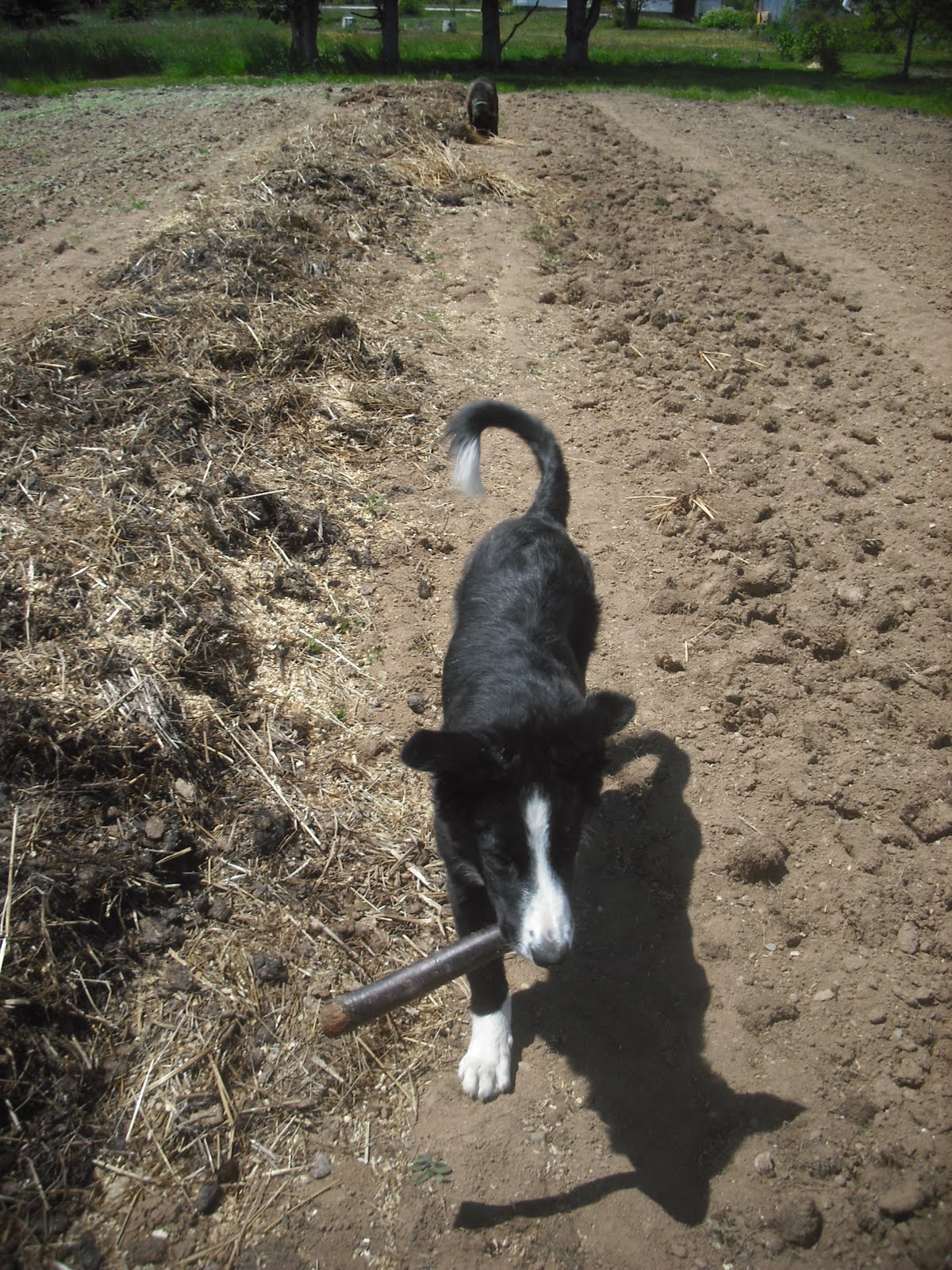
May 27, 2010
Spring farm photos


Lil bud shaking dirt off the grass clods, peas in background.

he has lots of sticks to choose from as I have a scrap fence in progress


Notice Bud's skill on path walking, here garlic and onions sets visible, seeds just up. Jumping over beds is still a work in progress as exemplified below (broad beans).


Click the pic to enlarge the spinach, salads, turnip and radish under the row cover.


the early starts are out and transplanted from the hoophouse and its now planted to basil.
May 6, 2010
A look at the Land Grab
Found a very valuable surce of information on the corporate octopus's consumption of land in a collection of daily stories from a range of sources. Food Crisis and Global Land Grab is worth checking out.
This week an article from Grain on the World Banks stalling and readying seven principles for “socially responsible” land grabs, and another on the double punch to Africa: From bleeding Africa to grabbing the land.
This week an article from Grain on the World Banks stalling and readying seven principles for “socially responsible” land grabs, and another on the double punch to Africa: From bleeding Africa to grabbing the land.
Subscribe to:
Posts (Atom)


