A U.S. District Court hearing in downtown New York today could determine the eventual fate of several organic farmers from across the country, including some in upstate New York.
The hearing centered on a "pre-emptive" suit led by the Organic Seed Growers and Trade Association (OSGTA), against agricultural giant Monsanto. In it, OSGTA says it brought "this action to protect [farmers] from ever being accused of infringing patents on transgenic seed." Monsanto filed to dismiss the case, and today lawyers for both sides made their arguments in front of U.S. District Judge Naomi Buchwald.
Read more in today's Village Voice
And at OSGATA Organic Seed Growers and Trade Association
And Occupy Big Food
Showing posts with label gmo`s. Show all posts
Showing posts with label gmo`s. Show all posts
January 31, 2012

January 15, 2012
India to charge Monsanto for biopiracy
An Indian government agency has agreed to sue the developers of genetically modified (GM) eggplant for violating India's Biological Diversity Act of 2002. India's National Biodiversity Authority (NBA) is alleging that the developers of India's first GM food crop—Jalna-based Maharashtra Hybrid Seeds Company (Mahyco) partnered with St. Louis–based seed giant Monsanto and several local universities—used local varieties to develop the transgenic crop, but failed to gain the appropriate licenses for field trials. At the same time, activists in Europe are claiming that patents on conventionally bred plants, including a melon found in India, filed by biotech companies violate farmers' rights to use naturally occurring breeds. Both these pending legal cases could set important precedents for biopiracy in India and Europe.
read more at Nature Biotechnology
Video from France24 on the Biopiracy suit
read more at Nature Biotechnology
Video from France24 on the Biopiracy suit
April 13, 2011
very creepy milk

felt sculptor Stephanie Metz from the Over bred series
CBC and others reported last week on the Chinese success in engineering and cloning milk cows with human genes to express human milk proteins. Today the Chinese authorities have approved it for testing. Is this not the final straw? Oh its just China. Or is it?
Recent progress in recombinant DNA technology as well as in embryo manipulation and transfer has made the introduction of specific genes into the germline of animals relatively commonplace. With appropriate genetic constructs expression of the inserted genes in transgenic animals can be controlled in a tissue-specific and in a differentiation- specific manner; thus, it is now possible to consider alteration of the composition of milk produced by a lactating animal in any of a variety of ways. There is a growing list of foreign milk proteins that have been expressed, and one can envisage placing almost any protein gene of interest under the control of the cis-acting promoter and enhancer elements of a milk protein gene. Modification of milk composition can be extended not only to the proteins of commodity value but also, by manipulation of key metabolic enzymes, to fat, lactose, and other minerals in milk.
Here from American researchers.
The U.S. and Australia and interestingly, the Netherlands, have been researching transgenic livestock for over 20 years, including mammary gland secretions. But, as this story mentions, after all the hard work, public repudiation has prevented its fruition. That is a lot of research dollars (our money) and profits haven`t been taken. China is one of many places where that is going (to start) being done. The Netherlands food bio is actively involved in Sabre and is a key sponsor of innovative food tweaking and and wish we were all as malleable as our Chinese comrades. The scientist in charge of China's gmo bovines, Ning Li, is the Sabre coordinator for China. Expertise, decades of research and probably funding...who knows what other favours, are visible in those transgenes.
But we can't keep ordering double doubles and make milk mustaches ...can we? When is enough?
My suggestion for humanizing milk?
Lay off our cows; their genes belong first to cows or cow divas and second to farmer's and milk drinkers due to the century old traditions of breeding, nuturing and naming, continuously, said beast: it is common property. Common trust. Common interest.
Imbue milk with human kindness. That way. Not mother's milk coming out of industrial bioreactors. Not that definition of who we are. Mother's didn't give up the name of their milk...its called Mother's Milk and it belongs to women. (God would I love to be in a room with some old feminists farmers right now).
This will only happen (good milk) if there is a tradition and deep cultural acceptance of physical work and discipline to farm on human scales communities around small farms and homesteads cooperating, ecological and numerous.
March 4, 2011
Poll tells us what we know: we want labels
An MSNBC poll is asking “Do you believe genetically modified foods should be labeled?”
41,000 people have participated as of today with 96% answering “Yes. It’s an ethical issue — consumers should be informed so they can make a choice.”
You can vote here
One argument used to resist genetically modified organism/genetically engineered (GMO/GE) labeling sounds an awful lot like nanny-state thinking: “We must not allow labeling of GMOs because, given a choice, people would make the wrong choice.”
.... Forbes published a column insisting that we must not have GMO labeling. Why? Because then people would avoid such products.
Take a moment to absorb that interesting proposition, from a magazine which is supposed to be about business and economics. Not merely economics, but free market economics.
Can there be a “free market” when consumers are denied the right to make their own choices?
Can there be a “free market” when taxpayer subsidies are used to shore up a product which consumers don't want to buy?
GMO crops would have no place in an agriculture economy based on sound, free-market principles. As in, cost of production should not exceed market-value of end-product.
Fact: GMO crops cost more to grow than they are worth in the market.
Read more of Deb Baumann's great revelation of the obvious in Let the free market decide, Lake County News
41,000 people have participated as of today with 96% answering “Yes. It’s an ethical issue — consumers should be informed so they can make a choice.”
You can vote here
One argument used to resist genetically modified organism/genetically engineered (GMO/GE) labeling sounds an awful lot like nanny-state thinking: “We must not allow labeling of GMOs because, given a choice, people would make the wrong choice.”
.... Forbes published a column insisting that we must not have GMO labeling. Why? Because then people would avoid such products.
Take a moment to absorb that interesting proposition, from a magazine which is supposed to be about business and economics. Not merely economics, but free market economics.
Can there be a “free market” when consumers are denied the right to make their own choices?
Can there be a “free market” when taxpayer subsidies are used to shore up a product which consumers don't want to buy?
GMO crops would have no place in an agriculture economy based on sound, free-market principles. As in, cost of production should not exceed market-value of end-product.
Fact: GMO crops cost more to grow than they are worth in the market.
Read more of Deb Baumann's great revelation of the obvious in Let the free market decide, Lake County News
Smoking mirrors will shatter
Monsanto's press release, Statement About Alleged Plant Pathogen Potentially Associated with Roundup Ready Crops asserts:
"Monsanto is not aware of any reliable studies that demonstrate Roundup Ready® crops are more susceptible to certain diseases or that the application of glyphosate to Roundup Ready crops increases a plant’s susceptibility to diseases".
Yet this statement can be shown as evidently false by following the (reliable) research listed here:
Glyphosate effects on diseases of plants (G.S. Johal�, D.M. Huber)
Some diseases increased in glyphosate weed control programs. (pathogen noted in bold. disease in italics, researcher and date of study)
Apple: Canker Botryosphaeriadothidea; Rosenbergerand Fargione(2004)
Banana: Panamadisease Fusariumoxysporumf. sp. cubense Harper(2007)
Barley: Root rot Magnaporthegrisea Smileyetal. (1992)
Bean: Anthracnose Colletotrichumlindemuthianum; JohalandRahe(1984, 1988, 1990)
Bean: Damping off, Pythiumspp. ; JohalandRahe(1984)
Bean: Root rot Fusariumsolanif. sp. phaseoli; Harper(2007)
Bean: Hypocotylrot Phytophthoramegasperma; Keenetal. (1982)
Canola: Crownrot Fusariumspp. Harper(2007)
Canola: Wilt Fusariumoxysporum ; Harper(2007), LargeandMcLaren(2002)
Citrus: Citrusvariegatedchlorosis Xylellafastidiosa ; Yamada(2006)
Citrus: Crownrot Phytophthoraspp; Yamada(2006)
Cotton: Dampingoff Pythiumspp. Harper(2007)
Cotton: Bunchytop Manganese deficiency ; Harper(2007)
Cotton: Wilt F. oxysporumf. sp. vasinfectum Harper(2007)
Grape: Blackgoo Phaeomoniellachlamydospora; Harper(2007)
Soybeans: Root rot Corynesporacassiicola; Huberetal. (2005)
Soybeans Targetspot Corynesporacassiicola; Huberetal. (2005)
Soybeans: Sudden Death Syndrome Fusariumsolanif. sp. glycines ; Keen et al. (1982)
Soybeans: Root rot Phytophthoramegasperma ; Keen et al. (1982)
Soybeans: Cystnematode Heteroderaglycines Geisleretal; Kremer et al. (2000)
Soybeans: Whitemold Sclerotiniasclerotiorum; Harper(2007)
Sugarbeet: Yellows Fusariumoxysporumf. sp. beta ; Larson et al. (2006)
Sugarbeet: Root rot Rhizoctoniasolani ; Larson et al. (2006)
Tomato: Crownrootrot Fusarium; Bramhall and Higgins(1988)
Tomato: Wilt Fusariumoxysporumf. sp. pisi; Harper(2007)
Various: Canker Phytophthoraspp. Harper(2007)
Wheat: Barepatch Rhizoctoniasolani; Harper(2007)
Wheat: Glumeblotch Septoriaspp. ; Harper(2007)
Wheat: Root rot Fusariumspp. Fernandez et al. (2005, 2007), Harper(2007)
Wheat: Headscab Fusariumgraminearum ; Fernandez et al. (2005)
Wheat: Take-all Gaeumannomycesgraminis; Hornby et al. (1998)
"Monsanto is not aware of any reliable studies that demonstrate Roundup Ready® crops are more susceptible to certain diseases or that the application of glyphosate to Roundup Ready crops increases a plant’s susceptibility to diseases".
Yet this statement can be shown as evidently false by following the (reliable) research listed here:
Glyphosate effects on diseases of plants (G.S. Johal�, D.M. Huber)
Some diseases increased in glyphosate weed control programs. (pathogen noted in bold. disease in italics, researcher and date of study)
Apple: Canker Botryosphaeriadothidea; Rosenbergerand Fargione(2004)
Banana: Panamadisease Fusariumoxysporumf. sp. cubense Harper(2007)
Barley: Root rot Magnaporthegrisea Smileyetal. (1992)
Bean: Anthracnose Colletotrichumlindemuthianum; JohalandRahe(1984, 1988, 1990)
Bean: Damping off, Pythiumspp. ; JohalandRahe(1984)
Bean: Root rot Fusariumsolanif. sp. phaseoli; Harper(2007)
Bean: Hypocotylrot Phytophthoramegasperma; Keenetal. (1982)
Canola: Crownrot Fusariumspp. Harper(2007)
Canola: Wilt Fusariumoxysporum ; Harper(2007), LargeandMcLaren(2002)
Citrus: Citrusvariegatedchlorosis Xylellafastidiosa ; Yamada(2006)
Citrus: Crownrot Phytophthoraspp; Yamada(2006)
Cotton: Dampingoff Pythiumspp. Harper(2007)
Cotton: Bunchytop Manganese deficiency ; Harper(2007)
Cotton: Wilt F. oxysporumf. sp. vasinfectum Harper(2007)
Grape: Blackgoo Phaeomoniellachlamydospora; Harper(2007)
Soybeans: Root rot Corynesporacassiicola; Huberetal. (2005)
Soybeans Targetspot Corynesporacassiicola; Huberetal. (2005)
Soybeans: Sudden Death Syndrome Fusariumsolanif. sp. glycines ; Keen et al. (1982)
Soybeans: Root rot Phytophthoramegasperma ; Keen et al. (1982)
Soybeans: Cystnematode Heteroderaglycines Geisleretal; Kremer et al. (2000)
Soybeans: Whitemold Sclerotiniasclerotiorum; Harper(2007)
Sugarbeet: Yellows Fusariumoxysporumf. sp. beta ; Larson et al. (2006)
Sugarbeet: Root rot Rhizoctoniasolani ; Larson et al. (2006)
Tomato: Crownrootrot Fusarium; Bramhall and Higgins(1988)
Tomato: Wilt Fusariumoxysporumf. sp. pisi; Harper(2007)
Various: Canker Phytophthoraspp. Harper(2007)
Wheat: Barepatch Rhizoctoniasolani; Harper(2007)
Wheat: Glumeblotch Septoriaspp. ; Harper(2007)
Wheat: Root rot Fusariumspp. Fernandez et al. (2005, 2007), Harper(2007)
Wheat: Headscab Fusariumgraminearum ; Fernandez et al. (2005)
Wheat: Take-all Gaeumannomycesgraminis; Hornby et al. (1998)
March 3, 2011
transparency for risk assessment of Trangenic Salmon
CBAN PRESS RELEASE
Parliament Under Pressure to Stop Genetically Modified Fish: Motion in
the House of Commons requests transparency
Thursday, March 3, 2011.
Ottawa - Today in the House of Commons, New Democratic Party Fisheries
and Oceans Critic Fin Donnelly tabled a motion asking for transparency
and more study before genetically modified (GM) Atlantic salmon are
approved for human consumption.
US company AquaBounty has genetically modified a faster growing
Atlantic salmon by inserting a growth hormone gene from Chinook salmon
and genetic material from ocean pout.
AquaBounty has asked the US Food and Drug Administration to approve
the GM Atlantic salmon for human consumption but the status of any
requests for approvals from the company to the Canadian government are
unknown because our federal departments refuse to disclose this
information.
“Why won’t the government tell us if they are doing a risk
assessment?” asked Leo Broderick of PEI and Vice-Chair of the Council
of Canadians, “AquaBounty wants to supply the market with genetically
modified salmon eggs from PEI but Canadians have no clue if the
company has asked for approval here.”
AquaBounty is not planning to produce GM salmon in the US but is
instead proposing to produce all the GM salmon eggs on Prince Edward
Island and then ship the eggs for grow out and processing in Panama,
for selling into the US consumer market.
Today’s motion asks the government to explain its regulations and to
set up a system to notify Canadians about any requests for approval
and approval decisions. The motion also asks the government to
“prevent the introduction of genetically modified salmon destined for
human consumption into the Canadian food system until further
scientific studies are concluded by the relevant departments to
determine the impact of genetically modified salmon on human health
and on the health of marine species, ecosystems and habitats.”
“We call on all Members of Parliament to support the motion. It is a
request for basic transparency,” said Lucy Sharratt of the Canadian
Biotechnology Action Network. "This cloak of secrecy is unjustifiable
and, frankly, ridiculous."
“DFO’s own scientists have acknowledged that genetically modified
salmon pose a real risk to our wild fish stocks,” said Catherine
Stewart of Living Oceans Society in B.C. “Any debate on this issue,
any scientific research informing the debate, must be made available
to all concerned citizens.”
Sixty fisheries and oceans conservation, environmental and social
justice groups released a joint statement in December 6, 2010,
opposing GM fish.
For more information:
www.cban.ca/fish
Parliament Under Pressure to Stop Genetically Modified Fish: Motion in
the House of Commons requests transparency
Thursday, March 3, 2011.
Ottawa - Today in the House of Commons, New Democratic Party Fisheries
and Oceans Critic Fin Donnelly tabled a motion asking for transparency
and more study before genetically modified (GM) Atlantic salmon are
approved for human consumption.
US company AquaBounty has genetically modified a faster growing
Atlantic salmon by inserting a growth hormone gene from Chinook salmon
and genetic material from ocean pout.
AquaBounty has asked the US Food and Drug Administration to approve
the GM Atlantic salmon for human consumption but the status of any
requests for approvals from the company to the Canadian government are
unknown because our federal departments refuse to disclose this
information.
“Why won’t the government tell us if they are doing a risk
assessment?” asked Leo Broderick of PEI and Vice-Chair of the Council
of Canadians, “AquaBounty wants to supply the market with genetically
modified salmon eggs from PEI but Canadians have no clue if the
company has asked for approval here.”
AquaBounty is not planning to produce GM salmon in the US but is
instead proposing to produce all the GM salmon eggs on Prince Edward
Island and then ship the eggs for grow out and processing in Panama,
for selling into the US consumer market.
Today’s motion asks the government to explain its regulations and to
set up a system to notify Canadians about any requests for approval
and approval decisions. The motion also asks the government to
“prevent the introduction of genetically modified salmon destined for
human consumption into the Canadian food system until further
scientific studies are concluded by the relevant departments to
determine the impact of genetically modified salmon on human health
and on the health of marine species, ecosystems and habitats.”
“We call on all Members of Parliament to support the motion. It is a
request for basic transparency,” said Lucy Sharratt of the Canadian
Biotechnology Action Network. "This cloak of secrecy is unjustifiable
and, frankly, ridiculous."
“DFO’s own scientists have acknowledged that genetically modified
salmon pose a real risk to our wild fish stocks,” said Catherine
Stewart of Living Oceans Society in B.C. “Any debate on this issue,
any scientific research informing the debate, must be made available
to all concerned citizens.”
Sixty fisheries and oceans conservation, environmental and social
justice groups released a joint statement in December 6, 2010,
opposing GM fish.
For more information:
www.cban.ca/fish
February 27, 2011
New pathogen connected to Glyphosate: "an emergency"
Reuters
Questions about the safety of a popular herbicide made by Monsanto Co have resurfaced in a warning from a U.S. scientist that claims top-selling Roundup may contribute to plant disease and health problems for farm animals.
Plant pathologist and retired Purdue University professor Don Huber has written a letter to U.S. Agriculture Secretary Tom Vilsack warning that a newly discovered and widespread "electron microscopic pathogen appears to significantly impact the health of plants, animals, and probably human beings." He said the pathogen appears to be connected to use of glyphosate, the key ingredient in Roundup.
Huber coordinates a committee of the American Phytopathological Society as part of the USDA National Plant Disease Recovery System. He is a long-standing critic of biotech crops, such as Monsanto's "Roundup Ready" soybean and corn, which have been genetically altered to withstand treatments of Roundup herbicide.
In his letter to the U.S. Department of Agriculture, Huber said the organism has been found in high concentrations of Roundup Ready soybean meal and corn, which are used in livestock feed. He said laboratory tests have confirmed the presence of the organism in pigs, cattle and other livestock that have experienced spontaneous abortions and infertility.
The organism is also prolific in corn and soybean crops stricken by disease, according to Huber.
"I believe the threat we are facing from this pathogen is unique and of a high risk status," Huber wrote. "In layman's terms, it should be treated as an emergency."
Read the whole Reuter's story
The extensive use of glyphosate, and the rapid adoption of genetically modified glyphosate-tolerant crops such as soybean, corn, cotton, canola, sugar beets, and alfalfa; with their greatly increased application of glyphosate for simplified weed control, have intensified deficiencies of numerous essential micronutrients and some macronutrients......Lost yield, reduced quality, and increased disease are the unfortunate consequences of untreated micronutrient deficiency.
Plant pathogens stimulated by glyphosate:
Botryospheara dothidea Gaeumannomyces graminis
Corynespora cassicola Magnaporthe grisea
Fusarium species Marasmius spp.
F. avenaceum Monosporascus cannonbalus
F. graminearum Myrothecium verucaria
F. oxysporum f.sp. cubense Phaeomoniella chlamydospora
F. oxysporum f.sp. (canola) Phytophthora spp.
F. oxysporum f.sp. glycines Pythium spp.
F. oxysporum f.sp. vasinfectum Rhizoctonia solani
F. solani f.sp. glycines Septoria nodorum
F. solani f.sp. phaseoli Thielaviopsis bassicola
F. solani f.sp. pisi Xylella fastidiosa
From AG CHEMICAL AND CROP NUTRIENT INTERACTIONS – CURRENT UPDATE
Don M. Huber, Emeritus Professor, Purdue University
Dr. Huber's letter
Dear Secretary Vilsack:
A team of senior plant and animal scientists have recently brought to my attention the discovery of an electron microscopic pathogen that appears to significantly impact the health of plants, animals, and probably human beings. Based on a review of the data, it is widespread, very serious, and is in much higher concentrations in Roundup Ready (RR) soybeans and corn—suggesting a link with the RR gene or more likely the presence of Roundup. This organism appears NEW to science!
This is highly sensitive information that could result in a collapse of US soy and corn export markets and significant disruption of domestic food and feed supplies. On the other hand, this new organism may already be responsible for significant harm (see below). My colleagues and I are therefore moving our investigation forward with speed and discretion, and seek assistance from the USDA and other entities to identify the pathogen’s source, prevalence, implications, and remedies.
We are informing the USDA of our findings at this early stage, specifically due to your pending decision regarding approval of RR alfalfa. Naturally, if either the RR gene or Roundup itself is a promoter or co-factor of this pathogen, then such approval could be a calamity. Based on the current evidence, the only reasonable action at this time would be to delay deregulation at least until sufficient data has exonerated the RR system, if it does.
For the past 40 years, I have been a scientist in the professional and military agencies that evaluate and prepare for natural and manmade biological threats, including germ warfare and disease outbreaks. Based on this experience, I believe the threat we are facing from this pathogen is unique and of a high risk status. In layman’s terms, it should be treated as an emergency.
................
Sincerely,
COL (Ret.) Don M. Huber
Emeritus Professor, Purdue University
Monsanto's press release, Statement About Alleged Plant Pathogen Potentially Associated with Roundup Ready Crops asserts:
"Monsanto is not aware of any reliable studies that demonstrate Roundup Ready® crops are more susceptible to certain diseases or that the application of glyphosate to Roundup Ready crops increases a plant’s susceptibility to diseases".
Yet this statement can be shown as evidently false by following the research listed here:
Glyphosate effects on diseases of plants (G.S. Johal, D.M. Huber)
Questions about the safety of a popular herbicide made by Monsanto Co have resurfaced in a warning from a U.S. scientist that claims top-selling Roundup may contribute to plant disease and health problems for farm animals.
Plant pathologist and retired Purdue University professor Don Huber has written a letter to U.S. Agriculture Secretary Tom Vilsack warning that a newly discovered and widespread "electron microscopic pathogen appears to significantly impact the health of plants, animals, and probably human beings." He said the pathogen appears to be connected to use of glyphosate, the key ingredient in Roundup.
Huber coordinates a committee of the American Phytopathological Society as part of the USDA National Plant Disease Recovery System. He is a long-standing critic of biotech crops, such as Monsanto's "Roundup Ready" soybean and corn, which have been genetically altered to withstand treatments of Roundup herbicide.
In his letter to the U.S. Department of Agriculture, Huber said the organism has been found in high concentrations of Roundup Ready soybean meal and corn, which are used in livestock feed. He said laboratory tests have confirmed the presence of the organism in pigs, cattle and other livestock that have experienced spontaneous abortions and infertility.
The organism is also prolific in corn and soybean crops stricken by disease, according to Huber.
"I believe the threat we are facing from this pathogen is unique and of a high risk status," Huber wrote. "In layman's terms, it should be treated as an emergency."
Read the whole Reuter's story
The extensive use of glyphosate, and the rapid adoption of genetically modified glyphosate-tolerant crops such as soybean, corn, cotton, canola, sugar beets, and alfalfa; with their greatly increased application of glyphosate for simplified weed control, have intensified deficiencies of numerous essential micronutrients and some macronutrients......Lost yield, reduced quality, and increased disease are the unfortunate consequences of untreated micronutrient deficiency.
Plant pathogens stimulated by glyphosate:
Botryospheara dothidea Gaeumannomyces graminis
Corynespora cassicola Magnaporthe grisea
Fusarium species Marasmius spp.
F. avenaceum Monosporascus cannonbalus
F. graminearum Myrothecium verucaria
F. oxysporum f.sp. cubense Phaeomoniella chlamydospora
F. oxysporum f.sp. (canola) Phytophthora spp.
F. oxysporum f.sp. glycines Pythium spp.
F. oxysporum f.sp. vasinfectum Rhizoctonia solani
F. solani f.sp. glycines Septoria nodorum
F. solani f.sp. phaseoli Thielaviopsis bassicola
F. solani f.sp. pisi Xylella fastidiosa
From AG CHEMICAL AND CROP NUTRIENT INTERACTIONS – CURRENT UPDATE
Don M. Huber, Emeritus Professor, Purdue University
Dr. Huber's letter
Dear Secretary Vilsack:
A team of senior plant and animal scientists have recently brought to my attention the discovery of an electron microscopic pathogen that appears to significantly impact the health of plants, animals, and probably human beings. Based on a review of the data, it is widespread, very serious, and is in much higher concentrations in Roundup Ready (RR) soybeans and corn—suggesting a link with the RR gene or more likely the presence of Roundup. This organism appears NEW to science!
This is highly sensitive information that could result in a collapse of US soy and corn export markets and significant disruption of domestic food and feed supplies. On the other hand, this new organism may already be responsible for significant harm (see below). My colleagues and I are therefore moving our investigation forward with speed and discretion, and seek assistance from the USDA and other entities to identify the pathogen’s source, prevalence, implications, and remedies.
We are informing the USDA of our findings at this early stage, specifically due to your pending decision regarding approval of RR alfalfa. Naturally, if either the RR gene or Roundup itself is a promoter or co-factor of this pathogen, then such approval could be a calamity. Based on the current evidence, the only reasonable action at this time would be to delay deregulation at least until sufficient data has exonerated the RR system, if it does.
For the past 40 years, I have been a scientist in the professional and military agencies that evaluate and prepare for natural and manmade biological threats, including germ warfare and disease outbreaks. Based on this experience, I believe the threat we are facing from this pathogen is unique and of a high risk status. In layman’s terms, it should be treated as an emergency.
................
Sincerely,
COL (Ret.) Don M. Huber
Emeritus Professor, Purdue University
Monsanto's press release, Statement About Alleged Plant Pathogen Potentially Associated with Roundup Ready Crops asserts:
"Monsanto is not aware of any reliable studies that demonstrate Roundup Ready® crops are more susceptible to certain diseases or that the application of glyphosate to Roundup Ready crops increases a plant’s susceptibility to diseases".
Yet this statement can be shown as evidently false by following the research listed here:
Glyphosate effects on diseases of plants (G.S. Johal, D.M. Huber)
December 22, 2010
The Common Interest vs Big Ag
Consulting with the people for a roadmap to sustainable development; this is what all the fuss is over.
"We’ve been saying for years that the United States government is joined at the hip with Monsanto and pushing GMOs as part of Monsanto’s agenda on the rest of the world. This lays bare the mechanics of that effort. We have Craig Stapleton, the former ambassador to France, specifically asking the U.S. government to retaliate and cause some harm throughout the European Union."
Jeffery Smith in Democracy Now interview
From the Wikileak cable
Subject: France and the WTO AG BIOTECT CASE
1. (C) Summary: Mission Paris recommends that that the USG reinforce
our negotiating position with the EU on agricultural biotechnology by
publishing a retaliation list when the extend "Reasonable Time
Period" expires. In our view, Europe is moving backwards not
forwards on this issue with France playing a leading role, along with
Austria, Italy and even the Commission. In France, the "Grenelle"
environment process is being implemented to circumvent science-based
decisions in favor of an assessment of the "common interest."
Combined with the precautionary principle, this is a precedent with
implications far beyond MON-810 BT corn cultivation. Moving to
retaliation will make clear that the current path has real costs to
EU interests and could help strengthen European pro-biotech voices.
In fact, the pro-biotech side in France -- including within the farm
union -- have told us retaliation is the only way to begin to begin
to turn this issue in France. End Summary.
More
November 30, 2010
Can't argue with this apple?

photo of the cisgenic apple from: Researcher bites into forbidden fruit
Also see here for background story
A central theme of biotech public relations is, in their words to " placate the misinformed public opinion by using clever technologies to circumvent traditional unfounded criticisms of biotechnology."
Enter Cisgenics, where the industry contends that
" most of their (the public's) weak arguments are disabled via these techniques. Unfortunately, the end product is the same, maybe even less effective, than if traditional transgenic approaches were used, and it takes a lot more time and money to make it happen.
This is just one example of how scientists are cleverly working around warped public perception problems to solve real issues, and enhance sustainable production. Cisgenics will be at least a stop-gap solution in the European Union until public education and perception refocus real problems in sustainable agriculture. For now, the practices of cisgenics may be the central means of introducing traits to plants that can benefit the consumer and environment without the lengthy breeding process, and most of all without raising the ire of those that seek to stop transgenic technology.".
quoted from cisgenics-transgenics without the transgene
July 8, 2010
label genetically engineered food cause we are what we eat
In May of 2011 Codex meets in Quebec and labeling is still very alive on the table: "The federal policy on labelling foods derived from biotechnology remains under discussion with Canadians and international standards organizations such as Codex Alimentarius", Health Canada states. In fact at the Codex meeting this spring a significant Canadian retreat from the overt backing of the US position that GE food is substantially equivalent, was evident. No wonder ...its become clear that is both incorrect and only a piece of the problematic puzzle. We have 10 months to think about, talk, coalesce our strategies and ensure we get mandatory labeling of genetically engineered foods established next year in Canada.
Keep an eye on CBAN to help their ongoing campaign, which targets the pressuring of Health Canada.
But I think plural is best (strategieS) the debate must reach wider than the issues of toxicity and oontamination/transgene pollution to include the freedom of choice to live morally, a conscientious or religious objection.
It is amazing to me that this has never been challenged as a Charter issue, its not as if people aren't writing about it for eg. Could we mount a campaign that encompasses all of us who understand life has deep complexity, mystery, organization to engage in devotion and service to the sanctity of life one should be free to not eat transgenic, engineered food. Could we motivate spiritual communities to proclaim and demand that? the Council of Churches, Buddhist Sangas, Indigenous Councils, Muslim , Jew, Hindu, Pagan Urban dwellers and small lesbian farmers? I think so!
My brain today has been offering up quotes from sunday school lessons a very long time ago:
I am the bread of life
By the fruits shall ye know them
In the beginning was the Word, and the Word was with God, and the Word was God. It was in the beginning with God. All things were made through it and without it was not any thing made that was made.
Keep an eye on CBAN to help their ongoing campaign, which targets the pressuring of Health Canada.
But I think plural is best (strategieS) the debate must reach wider than the issues of toxicity and oontamination/transgene pollution to include the freedom of choice to live morally, a conscientious or religious objection.
It is amazing to me that this has never been challenged as a Charter issue, its not as if people aren't writing about it for eg. Could we mount a campaign that encompasses all of us who understand life has deep complexity, mystery, organization to engage in devotion and service to the sanctity of life one should be free to not eat transgenic, engineered food. Could we motivate spiritual communities to proclaim and demand that? the Council of Churches, Buddhist Sangas, Indigenous Councils, Muslim , Jew, Hindu, Pagan Urban dwellers and small lesbian farmers? I think so!
My brain today has been offering up quotes from sunday school lessons a very long time ago:
I am the bread of life
By the fruits shall ye know them
In the beginning was the Word, and the Word was with God, and the Word was God. It was in the beginning with God. All things were made through it and without it was not any thing made that was made.
Labeling GMOs closer: "Substantial Equivalence" faltering
From CBAN Press release
Canada & Codex: GM labeling – US Increasingly Isolated
May 12, 2010
Canada at the UN Codex meeting on GM food labeling: Negotiations continue, U.S. increasingly isolated
Your actions worked – again!
Thanks to your letters, the Canadian government delegation to the UN
Codex meeting last week did not boldly ally itself with the U.S.
position against GM food labeling. The U.S. failed in their attempts
to stop the negotiations.
The Canadian government did not speak up to support the nonsensical
position from the U.S. that GM foods are no different from foods
produced through conventional methods. Though not yet actively
supporting a positive position on GM labeling, Canada did not obstruct
the meeting and the U.S. was not able to put an end to the
negotiations. Out of the over 50 countries at the negotiations, the
U.S. was only supported in its position by Mexico, Costa Rica, and
Argentina.
Codex recommendations on GM labeling could protect developing
countries from challenges brought through the World Trade Organization.
The U.S. was trying to put an end to the UN Codex negotiations on GM
labeling but the negotiations will continue. There will be an
important Codex meeting in May 2011 in Quebec City – and we must
continue to pressure the Minister of Health. The Canadian
Biotechnology Action Network (CBAN) will continue to take action and
monitor this issue, as well as collaborate with U.S. groups. Please
see below from Consumers Union in the U.S.
For updates and more information: Cban
Canada & Codex: GM labeling – US Increasingly Isolated
May 12, 2010
Canada at the UN Codex meeting on GM food labeling: Negotiations continue, U.S. increasingly isolated
Your actions worked – again!
Thanks to your letters, the Canadian government delegation to the UN
Codex meeting last week did not boldly ally itself with the U.S.
position against GM food labeling. The U.S. failed in their attempts
to stop the negotiations.
The Canadian government did not speak up to support the nonsensical
position from the U.S. that GM foods are no different from foods
produced through conventional methods. Though not yet actively
supporting a positive position on GM labeling, Canada did not obstruct
the meeting and the U.S. was not able to put an end to the
negotiations. Out of the over 50 countries at the negotiations, the
U.S. was only supported in its position by Mexico, Costa Rica, and
Argentina.
Codex recommendations on GM labeling could protect developing
countries from challenges brought through the World Trade Organization.
The U.S. was trying to put an end to the UN Codex negotiations on GM
labeling but the negotiations will continue. There will be an
important Codex meeting in May 2011 in Quebec City – and we must
continue to pressure the Minister of Health. The Canadian
Biotechnology Action Network (CBAN) will continue to take action and
monitor this issue, as well as collaborate with U.S. groups. Please
see below from Consumers Union in the U.S.
For updates and more information: Cban
moral principles of informed consent
Thus far, the moral debate concerning genetically modified foods (GMF) has focused on extrinsic consequentialist questions about the health effects, environmental impacts, and economic benefits of such foods. This extrinsic approach to the morality of GMF is dependent on unsubstantiated empirical claims and fails to account for the intrinsic moral value of food and food choice and their connection to the agent's concept of the goodlife. I develop a set of objections to GMF grounded in the concept of integrity and maintain that food and food choice can be intimately connected to the agent's personal integrity. I argue that due to the constitution of GMF and the manner in which they are produced, such foods are incompatible with the fundamental values and integrity of certain individual moral agents or groups. I identify three types of integrity that are threatened by GMF: religious, consumer, and integrity based on certain other moral or metaphysical grounds. I maintain that these types of integrity are sufficiently important to provide justification for political and societal actions to protect the interests of those affected. I conclude by proposing specific steps for handling GMF consistent with the moral principles of informed consent, non-maleficence, and respect for the integrity of all members of society. They include mandatory labeling of GMF, the implementation of a system for control and regulations concerning such foods, and guaranteed provision of conventional foods.
Assya Pascalev
You Are What You Eat: Genetically Modified Foods, Integrity, and Society;
Journal of Agricultural and Environmental Ethics
The EU recognises the consumers' right to information and labelling as a tool for making an informed choice. Since 1997 Community legislation has made labelling of GM food mandatory for foods containing or are derived from GMO.
Canadians should not let up their demands to provide consumers their birthright as Canadians, protected in our charter. We have the right to choose the foods that are morally. spiritually and ethically acceptable to us. It is our responsibility to ensure the unobstructed enjoyment of these rights.
Assya Pascalev
You Are What You Eat: Genetically Modified Foods, Integrity, and Society;
Journal of Agricultural and Environmental Ethics
The EU recognises the consumers' right to information and labelling as a tool for making an informed choice. Since 1997 Community legislation has made labelling of GM food mandatory for foods containing or are derived from GMO.
Canadians should not let up their demands to provide consumers their birthright as Canadians, protected in our charter. We have the right to choose the foods that are morally. spiritually and ethically acceptable to us. It is our responsibility to ensure the unobstructed enjoyment of these rights.
June 23, 2010
Don't give up the good alfalfa fight
KANSAS CITY, June 23 (Reuters) - More than 50 U.S.
lawmakers are calling on the U.S. Agriculture Department to
keep Monsanto's (MON.N) biotech alfalfa out of farm fields,
despite a Supreme Court ruling this week that cleared the way
for limited planting pending environmental reviews.
The lawmakers said the biotech alfalfa presents too great a
risk to conventional and organic agriculture to ever allow it.
Here
lawmakers are calling on the U.S. Agriculture Department to
keep Monsanto's (MON.N) biotech alfalfa out of farm fields,
despite a Supreme Court ruling this week that cleared the way
for limited planting pending environmental reviews.
The lawmakers said the biotech alfalfa presents too great a
risk to conventional and organic agriculture to ever allow it.
Here
April 28, 2010
Monsanto moves up the food chain claiming meat.
"The global coalition "No Patents on Seeds" has issued an alert. It pertains to the latest patent filed by Monsanto. In a pending patent application (filed on Jan 29, 2009) from Monsanto even bacon and steaks are claimed: Patent application WO2009097403 is claiming meat stemming from pigs being fed with the patented genetically engineered plants of Monsanto.
I looked at the patent claim, and found it to be simply absurd. The patent is filed for an invention: "Method for Feeding Pigs and Products comprising Beneficial Fatty Acids." To me, this looks to be a simple improvement in the feeding process, but if you read the claims carefully you realise how cleverly Monsanto has drafted it to include almost everything under the sun. Which means, Monsanto (which already has a patent on pig breeding) actually now lays claim over the entire production cycle of pig rearing -- from what goes into the feed, to pig breeding processes and finally to the production of pork."
Read more from Devinder Sharma at Ground Reality; Understanding the politics of food, agriculture and hunger
The "No Patents on Seeds" alert where you can link to the absurd patent.
I looked at the patent claim, and found it to be simply absurd. The patent is filed for an invention: "Method for Feeding Pigs and Products comprising Beneficial Fatty Acids." To me, this looks to be a simple improvement in the feeding process, but if you read the claims carefully you realise how cleverly Monsanto has drafted it to include almost everything under the sun. Which means, Monsanto (which already has a patent on pig breeding) actually now lays claim over the entire production cycle of pig rearing -- from what goes into the feed, to pig breeding processes and finally to the production of pork."
Read more from Devinder Sharma at Ground Reality; Understanding the politics of food, agriculture and hunger
The "No Patents on Seeds" alert where you can link to the absurd patent.
February 22, 2010
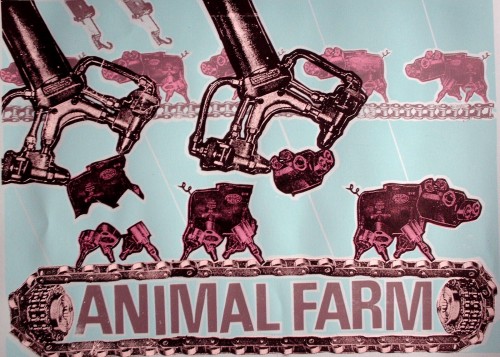
Post-humus porker
The Enviropig, the freakin franken porker that should only be a cartoon character, appears to be close to government approval, a Canwest News Service reported on Friday and confirmed here.
"The technology is simple, if you know how to raise pigs, you know how to raise Enviropigs!"
uh...depends on how ya raise a pig.
I'd compost that phosphorousy manure, feed the crops - let the oinkers have a bit of grass even.
But Enviropig is engineered to shit minimal phosphorous so the waste can get flushed (and not pollute waterways). Factory farming steps out of the circle of the farm.
From a 1999 Globe story on the lab chops: "After they get a handle on phosphorus, the scientists want to take a look at nitrogen, the other major pollutant found in pig manure and the one associated with its rank odour."
This kind of treason to our farm animal genome meets with so little pause, alarm or resistance because there are too many other distractions: wars, earthquakes, famine, olympics. We have no ethical roadmaps drawn out for the designers of our food. We as consumers and farmers need to start excercising our rights to choose what we eat.
The pig might help us do it. Who wants to eat it? 10-30% of Canadians? That isn't enough stakeholder to excite profits to the lifescience pioneers.

artist Nathan Meltz
A perfect factory pig is no surprise and has been talked about for awhile now. Water pollution and stink are the sticky bits in public interfaces and so the genes spliced in Ecopig are logical. But what else are they up to? Monsanto lurks in the wings and has patents on pigs. With declining numbers of small farms and pig breeds fewer and further between, the road ahead could look like porkicide.
Have we lost the right to eat food as god/goddess/motherearth made it, or shall we ride this ugly piggy to the courts before it goes to market?
We need to mobilize and take to the Supreme Court, the right to choose what we eat (labeling) as a matter of conscience and religion.
"The technology is simple, if you know how to raise pigs, you know how to raise Enviropigs!"
uh...depends on how ya raise a pig.
I'd compost that phosphorousy manure, feed the crops - let the oinkers have a bit of grass even.
But Enviropig is engineered to shit minimal phosphorous so the waste can get flushed (and not pollute waterways). Factory farming steps out of the circle of the farm.
From a 1999 Globe story on the lab chops: "After they get a handle on phosphorus, the scientists want to take a look at nitrogen, the other major pollutant found in pig manure and the one associated with its rank odour."
This kind of treason to our farm animal genome meets with so little pause, alarm or resistance because there are too many other distractions: wars, earthquakes, famine, olympics. We have no ethical roadmaps drawn out for the designers of our food. We as consumers and farmers need to start excercising our rights to choose what we eat.
The pig might help us do it. Who wants to eat it? 10-30% of Canadians? That isn't enough stakeholder to excite profits to the lifescience pioneers.
artist Nathan Meltz
A perfect factory pig is no surprise and has been talked about for awhile now. Water pollution and stink are the sticky bits in public interfaces and so the genes spliced in Ecopig are logical. But what else are they up to? Monsanto lurks in the wings and has patents on pigs. With declining numbers of small farms and pig breeds fewer and further between, the road ahead could look like porkicide.
Have we lost the right to eat food as god/goddess/motherearth made it, or shall we ride this ugly piggy to the courts before it goes to market?
We need to mobilize and take to the Supreme Court, the right to choose what we eat (labeling) as a matter of conscience and religion.
January 21, 2010
Trails of the Triffid
"If you're going to play around with [genetically modified] crops, once the genie's out of the bottle, once it's in the environment, you can't control it,"
"Mysteriously, Triffid has reappeared in commercial crops".
Flax is mainly self-pollinated but around five percent of pollination occurs through insects. There are no prolific wild relatives in Canada that cross with flax.
Yet it spreading through the prairies and ending up overweight in the inspector's samples, and in organic fields? Like transgenic corn in Mexico, flax has been prohibited and yet contamination is widespread and significant in both countries, both crops. Is this a covert policy to slip in genes in the genome and win compliance with inevitability of its spread?
Alan McHughen (read about him in Brewster's Kneen's book Farmageddon, which if you cannot find in your library is available here www.ramshorn.ca. McHughen is the designer of the GMO flax and apparently promoted his book with a big mail out of packages of Triffid flax.
And then there is this:
GRAIN COMPANIES EXPLOIT FLAX SITUATION TO
TIGHTEN VISE ON FARMER SEED SAVING
SASKATOON, SK—Grain company Viterra wants to force all farmers wishing to grow flax in 2010 to purchase certified seed. A Viterra spokesman delivered that message in a presentation on January 11 at the Crop Production Show in Saskatoon.
Viterra and others are pushing the requirement for certified seed as a purported solution to the problem of the Triffid contamination in flax shipments to Europe. Triffid is a genetically modified variety not approved in Europe. But the NFU believes that the proposed certified seed cure is the wrong one, and that there will be long-lasting and negative side effects.
“The best solution is to test the seed supply, both farm-saved seed and certified seed,” said NFU President and flax producer Terry Boehm. He continued: “It is false to simply assume that certified seed is safer than farm-saved. For one thing, it is almost certain that the certified seed system is the source of the Triffid contamination farmers are now facing. Furthermore, it has now been determined that two varieties of flax are contaminated with Triffid at the breeder seed level".
More from the NFU
"Mysteriously, Triffid has reappeared in commercial crops".
Flax is mainly self-pollinated but around five percent of pollination occurs through insects. There are no prolific wild relatives in Canada that cross with flax.
Yet it spreading through the prairies and ending up overweight in the inspector's samples, and in organic fields? Like transgenic corn in Mexico, flax has been prohibited and yet contamination is widespread and significant in both countries, both crops. Is this a covert policy to slip in genes in the genome and win compliance with inevitability of its spread?
Alan McHughen (read about him in Brewster's Kneen's book Farmageddon, which if you cannot find in your library is available here www.ramshorn.ca. McHughen is the designer of the GMO flax and apparently promoted his book with a big mail out of packages of Triffid flax.
And then there is this:
GRAIN COMPANIES EXPLOIT FLAX SITUATION TO
TIGHTEN VISE ON FARMER SEED SAVING
SASKATOON, SK—Grain company Viterra wants to force all farmers wishing to grow flax in 2010 to purchase certified seed. A Viterra spokesman delivered that message in a presentation on January 11 at the Crop Production Show in Saskatoon.
Viterra and others are pushing the requirement for certified seed as a purported solution to the problem of the Triffid contamination in flax shipments to Europe. Triffid is a genetically modified variety not approved in Europe. But the NFU believes that the proposed certified seed cure is the wrong one, and that there will be long-lasting and negative side effects.
“The best solution is to test the seed supply, both farm-saved seed and certified seed,” said NFU President and flax producer Terry Boehm. He continued: “It is false to simply assume that certified seed is safer than farm-saved. For one thing, it is almost certain that the certified seed system is the source of the Triffid contamination farmers are now facing. Furthermore, it has now been determined that two varieties of flax are contaminated with Triffid at the breeder seed level".
More from the NFU
December 10, 2009
Transgenic Organics?
Watch as the rationalizations for violating the simple ethics of the precautionary principle erodes into the organic industry. Surely we are brighter than this.
http://www.metrofarm.com/mf_Food_Chain_Radio.php
http://www.metrofarm.com/mf_Food_Chain_Radio.php
December 6, 2009
symbionts and gene transfer
Symbionts helps in the transfer of genes between organisms.
"Although common among bacteria, lateral gene transfer—the movement of genes between distantly related organisms—is thought to occur only rarely between bacteria and multicellular eukaryotes. However, the presence of endosymbionts, such as Wolbachia pipientis, within some eukaryotic germlines may facilitate bacterial gene transfers to eukaryotic host genomes".
Read Widespread Lateral Gene Transfer from Intracellular Bacteria to Multicellular Eukaryotes
"Although common among bacteria, lateral gene transfer—the movement of genes between distantly related organisms—is thought to occur only rarely between bacteria and multicellular eukaryotes. However, the presence of endosymbionts, such as Wolbachia pipientis, within some eukaryotic germlines may facilitate bacterial gene transfers to eukaryotic host genomes".
Read Widespread Lateral Gene Transfer from Intracellular Bacteria to Multicellular Eukaryotes
transgenic dna persists in the food web.: Guelph research
This is some more evidence for what others (and here) have been saying for quite some time: gmo dna sequences transfer to other organisms.
In the case of this study, Monsanto's cp4 epsps genes moved on through the soil ecosystem to arthropods, nematodes, and earthworms. I wonder if they are round-up ready (the soil life) and if monsanto owns them now.
Detection of transgenic cp4 epsps genes in the soil food web .
Miranda M. Hart1, Jeff R. Powell1, Robert H. Gulden2, David J.
Levy-Booth3, Kari E. Dunfield4, K. Peter Pauls2, Clarence J. Swanton2,
John N. Klironomos1 and Jack T. Trevors.
University of Guelph
Abstract - The persistence and movement of transgenic DNA in
agricultural and natural systems is largely unknown. This movement poses
a threat of horizontal gene transfer and possible proliferation of
genetically modified DNA into the general environment. To assess the
persistence of transgenic DNA in a field of Roundup Ready
corn, we quantified the presence of the transgene for glyphosate
tolerance within a soil food web. Using quantitative real-time PCR, we
identified the cp4 epsps transgene in bulk soil microarthropods,
nematodes, macroarthropods and earthworms sampled within the corn
cropping system. We found evidence of the transgene at all dates and in
all animal groups. Transgenic DNA concentration in animal was
significantly higher than that of background soil, suggesting the
animals were feeding directly on transgenic plant material. It remains
to be tested whether this DNA was still within the plant residues,
present as free, extracellular DNA or had already undergone genetic
transformation into competent bacterial cells. These results are the
first to demonstrate the persistence of transgenic crop DNA residues
within a food web.
Here
In the case of this study, Monsanto's cp4 epsps genes moved on through the soil ecosystem to arthropods, nematodes, and earthworms. I wonder if they are round-up ready (the soil life) and if monsanto owns them now.
Detection of transgenic cp4 epsps genes in the soil food web .
Miranda M. Hart1, Jeff R. Powell1, Robert H. Gulden2, David J.
Levy-Booth3, Kari E. Dunfield4, K. Peter Pauls2, Clarence J. Swanton2,
John N. Klironomos1 and Jack T. Trevors.
University of Guelph
Abstract - The persistence and movement of transgenic DNA in
agricultural and natural systems is largely unknown. This movement poses
a threat of horizontal gene transfer and possible proliferation of
genetically modified DNA into the general environment. To assess the
persistence of transgenic DNA in a field of Roundup Ready
corn, we quantified the presence of the transgene for glyphosate
tolerance within a soil food web. Using quantitative real-time PCR, we
identified the cp4 epsps transgene in bulk soil microarthropods,
nematodes, macroarthropods and earthworms sampled within the corn
cropping system. We found evidence of the transgene at all dates and in
all animal groups. Transgenic DNA concentration in animal was
significantly higher than that of background soil, suggesting the
animals were feeding directly on transgenic plant material. It remains
to be tested whether this DNA was still within the plant residues,
present as free, extracellular DNA or had already undergone genetic
transformation into competent bacterial cells. These results are the
first to demonstrate the persistence of transgenic crop DNA residues
within a food web.
Here
December 4, 2009
let them eat cottonseed cakes
Biotech scientists have worked for decades to produce a gossypol-free cotton plant by silencing the gene that produces a toxin, gossypol, throughout the plant and with little success as insects and diseases do not like gossypol either and are ravaged by them..
The breakthrough came as genetic engineers have managed to inhibit gossypol production in the seeds.
why?
So the poor people can eat the fruits of industrial farming.
This as a land grab has been thieving through vast tracts of farmlands in Africa and Asia. Industrial crops for fuel and gadgets, clothes, food.
It is a blessing to have a bit of land to plant our food and not worry about the need to to eat stuff like cottonseed meal.
Genetic engineering turns 'Fabric of Our Lives' into edible cottonseed that may feed millions
The breakthrough came as genetic engineers have managed to inhibit gossypol production in the seeds.
why?
So the poor people can eat the fruits of industrial farming.
This as a land grab has been thieving through vast tracts of farmlands in Africa and Asia. Industrial crops for fuel and gadgets, clothes, food.
It is a blessing to have a bit of land to plant our food and not worry about the need to to eat stuff like cottonseed meal.
Genetic engineering turns 'Fabric of Our Lives' into edible cottonseed that may feed millions
Subscribe to:
Posts (Atom)


