Project Censored top 25 underreported stories includes:
Nanotech Particles Pose Serious DNA Risks to Humans and the Environment
Story links to a number of studies indicating genetic damage caused by atom sized nanoparticles.
Showing posts with label nanotech. Show all posts
Showing posts with label nanotech. Show all posts
October 20, 2010

September 24, 2010
U.S. getting more 'local" as a response to regulatory gap(ing holes) in nano regulation?
"the nanotechnology industry played a central role in driving states toward taking on nanotechnology oversight, because industry's principal stance on the issue has been to urge the federal government to "slow-walk" nanotechnology regulation. Denison presents examples of industry blocking or slowing down even modest proposals by the U.S. Environmental Protection Agency (EPA) to obtain better information about nanomaterials over the last several years, and how it continues to do so, even though no EPA action to date would actually regulate, or place any restriction on the production, or use of, any nanomaterial."
Richard Denison
Environmental Defense Fund.
Richard Denison
Environmental Defense Fund.
June 25, 2010
EU committee votes to further study nanofood
"The EU Parliament's Environment, Public Health and Food Safety Committee
has voted that food produced using nanotechnology should be "excluded from the novel food list, and thus the EU market, until the possible health effects of nano production can be fully assessed." link
has voted that food produced using nanotechnology should be "excluded from the novel food list, and thus the EU market, until the possible health effects of nano production can be fully assessed." link
December 7, 2009
regulating the nanoelephant in the room
Whether you've transported them up into Pacific Coast glaciers on your moisture wicking nanosilver ski pants, or are unwittingly participating in nanoencapsulation studies on a populous scale...the consequences will be fodder for future thesis and peer review. We are the field trials.
“Nobody Told Me I was a Nano-Consumer:” How Nanotechnologies Might Challenge the Notion of Consumer Rights
"Regarding nanotechnologies and the consumer, a central paradox is the absence of a regulatory framework while more than 1,000 nano-enabled products are already available on the consumer markets. This represents a serious challenge for the consumer interest".
read it here
“Nobody Told Me I was a Nano-Consumer:” How Nanotechnologies Might Challenge the Notion of Consumer Rights
"Regarding nanotechnologies and the consumer, a central paradox is the absence of a regulatory framework while more than 1,000 nano-enabled products are already available on the consumer markets. This represents a serious challenge for the consumer interest".
read it here
November 28, 2009
swine flu lager and nanothermite: good TV on CBC last night
Thanks Rick Mercer...finally a chance to laugh at Swine Flu vaccines.
Not funny but also noteworthy last night on CBC was The Fifth Estate`s The Unofficial Story, a documentary about the growing number of people unsatisfied with illogical explanations for the events of 911. Its the first mention of nano-thermite I`ve seen in the main media (as well as free-fall buildings, molten metal, iron-rich microspheres, lateral ejections, and pulverized concrete) You can watch it on their website here.
The comments are of interest as well, including this one from Rob Tamaki:
`As one of first Professional Engineers to have signed on to the AE911Truth petition (approx. no. 38 out of 970 presently), I stand firmly behind the science demonstrating that the collapses of WTC 1, 2, and 7 can only be explained by Controlled Demolition.
I only caught the last few minutes of the program this evening, and I am pleased that the issue of the finding of nanothermite was introduced. However, it really needed more time to be able to develop the details behind this research more carefully. It needs to be stressed that this was no ordinary material. It is of a highly processed composition that is capable of being developed only within the most advanced research or military laboratories in the world.
Brent Blanchard tried to argue that because there was no seismic signature, the buildings could not be brought down by controlled demolition. But this is exactly the relevance of nanothermite. Nanothermite does not produce the kind of seismic shock wave that C4 or RDX might. It would not produce a seismic signature. Blanchard's supposed clincher is really completely irrelevant.``
Not funny but also noteworthy last night on CBC was The Fifth Estate`s The Unofficial Story, a documentary about the growing number of people unsatisfied with illogical explanations for the events of 911. Its the first mention of nano-thermite I`ve seen in the main media (as well as free-fall buildings, molten metal, iron-rich microspheres, lateral ejections, and pulverized concrete) You can watch it on their website here.
The comments are of interest as well, including this one from Rob Tamaki:
`As one of first Professional Engineers to have signed on to the AE911Truth petition (approx. no. 38 out of 970 presently), I stand firmly behind the science demonstrating that the collapses of WTC 1, 2, and 7 can only be explained by Controlled Demolition.
I only caught the last few minutes of the program this evening, and I am pleased that the issue of the finding of nanothermite was introduced. However, it really needed more time to be able to develop the details behind this research more carefully. It needs to be stressed that this was no ordinary material. It is of a highly processed composition that is capable of being developed only within the most advanced research or military laboratories in the world.
Brent Blanchard tried to argue that because there was no seismic signature, the buildings could not be brought down by controlled demolition. But this is exactly the relevance of nanothermite. Nanothermite does not produce the kind of seismic shock wave that C4 or RDX might. It would not produce a seismic signature. Blanchard's supposed clincher is really completely irrelevant.``
November 1, 2009
really scarey
I was surprised to see a major swell of traffic coming to my blog from Egypt, all finding their way here with the google search phrase "new elements around us" - hundreds of hits. Perhaps there was an article in an Egyptian journal that sparked an interest in this spooky topic. I'm hoping an Egyptian will write and enlighten us.
What a terrifying concept though: that the spaces between the elements on the periodic table could be tweeked nanotechnologically to make new elements : "isolated crystals of existing elements can be made to turn on or off characteristics of neighboring elements of the periodic table". here.
I hope I'm not alone in feeling goosepimples over that.
What a terrifying concept though: that the spaces between the elements on the periodic table could be tweeked nanotechnologically to make new elements : "isolated crystals of existing elements can be made to turn on or off characteristics of neighboring elements of the periodic table". here.
I hope I'm not alone in feeling goosepimples over that.
September 12, 2009
CBC reports on Nanotech ignorance
CBC's Kelly Crowe reports on the Nanotechnology revolution and looks at some of the work done tracking the risks and the toxicology of the nanoscale.
Problem is the tools to observe and measure the particles haven't been invented yet! And although Canadian scientist believe key risks are probable, "Ottawa isn't taking action on the advice of its expert panel".
Watch the video.
Problem is the tools to observe and measure the particles haven't been invented yet! And although Canadian scientist believe key risks are probable, "Ottawa isn't taking action on the advice of its expert panel".
Watch the video.
August 17, 2009
fruit flies carry industrial nanoparticles

A new study shows that insects like fruit flies can pick up nanomaterials, disperse them in their ecosystem and be harmed by them. Carbon nanoparticles were the focus of this study in the Aug. 15 issue of ACS' Environmental Science & Technology ('Differential Toxicity of Carbon Nanomaterials in Drosophila: Larval Dietary Uptake Is Benign, but Adult Exposure Causes Locomotor Impairment and Mortality')"
Here
July 13, 2009
road map for the nanotsunami
Another example of the scramble to measure and control the nano experiments being trialed now on our planet.
Review article calls for measures to enable safe design of nanomaterials
By Jennifer Marcus
6/19/2009 9:55:00 AM
"The recent explosion in the development of nanomaterials with enhanced performance characteristics for use in commercial and medical applications has increased the likelihood of people coming into direct contact with these materials.
There are currently more than 800 products on the market — including clothes, skin lotions and cleaning products — claiming to have at least one nanocomponent, and therapeutic nanocarriers have been designed for targeted drug delivery inside the human body. Human exposure to nanomaterials, which are smaller than one one-thousandth the diameter of a human hair, raises some important questions, including whether these "nano-bio" interactions could have adverse health effects.
Now, researchers at UCLA and the California NanoSystems Institute (CNSI), along with colleagues in academia and industry, have taken a proactive role in examining the current understanding of the nano-bio interface to identify the potential risks of engineered nanomaterials and to explore design methods that will lead to safer and more effective nanoparticles for use in a variety of treatments and products".
Read more of the review which acknowledges that: "relatively little is known about the intracellular activity and function of engineered nanomaterials" and its time to stop "waiting for for knowledge to unfold randomly".
Review article calls for measures to enable safe design of nanomaterials
By Jennifer Marcus
6/19/2009 9:55:00 AM
"The recent explosion in the development of nanomaterials with enhanced performance characteristics for use in commercial and medical applications has increased the likelihood of people coming into direct contact with these materials.
There are currently more than 800 products on the market — including clothes, skin lotions and cleaning products — claiming to have at least one nanocomponent, and therapeutic nanocarriers have been designed for targeted drug delivery inside the human body. Human exposure to nanomaterials, which are smaller than one one-thousandth the diameter of a human hair, raises some important questions, including whether these "nano-bio" interactions could have adverse health effects.
Now, researchers at UCLA and the California NanoSystems Institute (CNSI), along with colleagues in academia and industry, have taken a proactive role in examining the current understanding of the nano-bio interface to identify the potential risks of engineered nanomaterials and to explore design methods that will lead to safer and more effective nanoparticles for use in a variety of treatments and products".
Read more of the review which acknowledges that: "relatively little is known about the intracellular activity and function of engineered nanomaterials" and its time to stop "waiting for for knowledge to unfold randomly".
July 3, 2009
Not just Ok, but partnered? .. Nano and Organic
The Organic Agriculture Centre has a "select business partner" in Nano-Gro a product of Agro Nanotechnology Corporation.
It is an Omri approved product because they are "just really small particles made naturally and work like homeopathy". OMRI does acknowledges though (in an email, where I heard the previous sentence) that there is confusion and lack of consensus on a definition for nanotechnology.
The company website offers little help in describing Nano Gro:
"Nano-Gro™ is an organic plant growth regulator and immunity enhancer which stands apart from any product in the market.
Unlike a fertilizer, Nano-Gro™ is not a source of nutrients for plants. And unlike other primers it is not composed of proteins derived from bacteria or other pathogens.
Nano-Gro™ does not contain hormones and does not, in any way, change the genetic structure of plants.
Nano-Gro™ helps plants naturally experience improved growth and health.
Nano-Gro™ is a systemic acquired resistance inducer that works unlike any other primer on the market. It works by delivering information to the plant. Using our proprietary formula, when a plant comes into contact with Nano-Gro™ it is compelled to activate a series of natural processes that help the plant achieve its maximum potential".
OK so what is it?
We can't know because it is "proprietary". We have to trust the word of those thus partnered. I guess.
Or not!
Unlike Canada, the Soil Association (Organic Certifying Body) in Britian has banned nanoparticles from Organic Production.
I think its just a matter of time before the economic argument will hold sway.
It is an Omri approved product because they are "just really small particles made naturally and work like homeopathy". OMRI does acknowledges though (in an email, where I heard the previous sentence) that there is confusion and lack of consensus on a definition for nanotechnology.
The company website offers little help in describing Nano Gro:
"Nano-Gro™ is an organic plant growth regulator and immunity enhancer which stands apart from any product in the market.
Unlike a fertilizer, Nano-Gro™ is not a source of nutrients for plants. And unlike other primers it is not composed of proteins derived from bacteria or other pathogens.
Nano-Gro™ does not contain hormones and does not, in any way, change the genetic structure of plants.
Nano-Gro™ helps plants naturally experience improved growth and health.
Nano-Gro™ is a systemic acquired resistance inducer that works unlike any other primer on the market. It works by delivering information to the plant. Using our proprietary formula, when a plant comes into contact with Nano-Gro™ it is compelled to activate a series of natural processes that help the plant achieve its maximum potential".
OK so what is it?
We can't know because it is "proprietary". We have to trust the word of those thus partnered. I guess.
Or not!
Unlike Canada, the Soil Association (Organic Certifying Body) in Britian has banned nanoparticles from Organic Production.
I think its just a matter of time before the economic argument will hold sway.
June 1, 2009
maybe really naughty chocolate
Mars is fingering women in a new line of chocolate and has grabbed the initiative of the EPA`s recent approval of titanium dioxide-coated mica-based pearlescent pigments in food, to make it glimmer. As I wrote in an earlier post, Mars (which now owns Seeds of Change), has a patent for nanoscale coatings. Unfortunately, there is no requirement to inform the consumer about nanoscale ingredients in food (or other products). Is this glimmering mica coating a nanoscale mica-based titanium dioxide pigment?
See Emerging ingredients Good as Gold, for this and other naughty nosh.
Note: Nano-mica is used in organic electronics (Organic Field Effect Transistors, Organic Solar Cells, Bio sensing, Large area electronics, Nano patterning, Nano electronics, Molecular self assembly, and
Soft lithography for example)
Here`s a picture of nano-mica lattice

See Emerging ingredients Good as Gold, for this and other naughty nosh.
Note: Nano-mica is used in organic electronics (Organic Field Effect Transistors, Organic Solar Cells, Bio sensing, Large area electronics, Nano patterning, Nano electronics, Molecular self assembly, and
Soft lithography for example)
Here`s a picture of nano-mica lattice

April 10, 2009
Resistance not disease; bogus science
Livable futures blog describes the lunacy of some agricultural research in a post about an Op Ed in the NY Times regarding a study of pathogens in free range (324 pigs) vs. confinement pigs (298 pigs) where two free-range pigs were found to carry "the parasite trichinia".
Actually, what they carried was the where-with-all to fight the pathogens naturally - i.e. antibodies. What was also left out of the NY Times piece was that the "research" was paid for by the national pork board.
This is one of a growing waste heap of studies that are unabashedly biased, sloppy and becoming more transparently so. What kind of science is this? The aim is clearly to protect market share, and carry new products to market - they'll find what they need from the studies they pay for.
We are at a cusp now in the very perception of what is safe food.
Why the hyper focus on eradicating pathogenic bacteria "from farm to fork".
Why doesn't the pork board study antibiotics role in assisting to create a super bug? Or the consequences of residual bombardment of antibiotics on our inner family of friendly bacteria?
Having antibodies is a healthy part of being alive. We have many species of bacteria living symbiotically within. This study shows soil bacteria throws off the low down blues, and helps fight allergies.
What about the other urgent aspects of food safety?
Antibiotics in factory meat, hormones in milk, chemical residues, nano transmission, even perhaps slip-ups from engineered phages sprayed on meat or fresh veg.
There is growing public concern for real food safety and the veneer of propaganda is glaring but very thin. Let's use the opportunity to voice our other food safety concerns; I have yet to see discussion of the question of transgenic, chemical or nanoparticle toxicity in the news regarding the food safety bills - are they not mentioned? Where is this discussion?
The real momentum of cause, lobby and money toward food safety appears to be fo traceability. This would entitle government bodies and industry, presumably, insight to what is traveling to our "fork", but without labeling, the consumer would still be in the dark. That is absurdly and profoundly outrageous.
Hat tip to Jill Richardson.

hospital themed restaurant
Actually, what they carried was the where-with-all to fight the pathogens naturally - i.e. antibodies. What was also left out of the NY Times piece was that the "research" was paid for by the national pork board.
This is one of a growing waste heap of studies that are unabashedly biased, sloppy and becoming more transparently so. What kind of science is this? The aim is clearly to protect market share, and carry new products to market - they'll find what they need from the studies they pay for.
We are at a cusp now in the very perception of what is safe food.
Why the hyper focus on eradicating pathogenic bacteria "from farm to fork".
Why doesn't the pork board study antibiotics role in assisting to create a super bug? Or the consequences of residual bombardment of antibiotics on our inner family of friendly bacteria?
Having antibodies is a healthy part of being alive. We have many species of bacteria living symbiotically within. This study shows soil bacteria throws off the low down blues, and helps fight allergies.
What about the other urgent aspects of food safety?
Antibiotics in factory meat, hormones in milk, chemical residues, nano transmission, even perhaps slip-ups from engineered phages sprayed on meat or fresh veg.
There is growing public concern for real food safety and the veneer of propaganda is glaring but very thin. Let's use the opportunity to voice our other food safety concerns; I have yet to see discussion of the question of transgenic, chemical or nanoparticle toxicity in the news regarding the food safety bills - are they not mentioned? Where is this discussion?
The real momentum of cause, lobby and money toward food safety appears to be fo traceability. This would entitle government bodies and industry, presumably, insight to what is traveling to our "fork", but without labeling, the consumer would still be in the dark. That is absurdly and profoundly outrageous.
Hat tip to Jill Richardson.

hospital themed restaurant
March 29, 2009
nanotech to grease China's economic engine?
If only for another toxic blip in human ecological history.
Or shall we create something new in the way of sustainable communities instead of grey goo?
China's Giant Step into Nanotech
China is positioning itself to be the world leader in nanotechnology, seeing its potential to reenvigor its global competitiveness.
Here is the March 26th Guardian story
Or shall we create something new in the way of sustainable communities instead of grey goo?
China's Giant Step into Nanotech
China is positioning itself to be the world leader in nanotechnology, seeing its potential to reenvigor its global competitiveness.
Here is the March 26th Guardian story
March 28, 2009
EU members: cloned meat and nanocaution
Members of the EU want cloned meat prohibited and nanoparticles labeled in the just released report on Novel food rules.
Novel foods, MEPs set new rules Food safety 25-03-2009
"In a legislative report dealing with an update of the EU rules on novel foods, the European Parliament calls on the Commission to interdict the placing on the market of food derived from cloned animals and their descendants. MEPs also want food being produced by nanotechnology processes to undergo a specific risk assessment before being approved for use and be labelled. The report was adopted with 658 votes in favour, 15 against and 11 abstentions"....
..."Food derived from cloned animals to be excluded - new Commission proposal demanded
The Parliament wants to exclude food derived from cloned animals from the scope of this Regulation. MEPs ask the Commission to present a legislative proposal to prohibit the placing on the market of food derived from cloned animals and their offspring.
Food produced with nanotechnology processes must be safe and labelled
MEPs want that foods which have been produced by nanotechnology processes, and which will need specific risk assessment methods, may not be included in the Community list until those risk assessment methods have been approved for use.
The risk assessment methods must not imply the use of vertebrate animals; underline the MEPs, who also support the use of non-animal tests and the intelligent testing strategies.
Furthermore, all ingredients present in the form of nanomaterials shall be clearly indicated in the list of ingredients. The names of the ingredients shall be followed by the word 'nano' in brackets".
Read the report
Novel foods, MEPs set new rules Food safety 25-03-2009
"In a legislative report dealing with an update of the EU rules on novel foods, the European Parliament calls on the Commission to interdict the placing on the market of food derived from cloned animals and their descendants. MEPs also want food being produced by nanotechnology processes to undergo a specific risk assessment before being approved for use and be labelled. The report was adopted with 658 votes in favour, 15 against and 11 abstentions"....
..."Food derived from cloned animals to be excluded - new Commission proposal demanded
The Parliament wants to exclude food derived from cloned animals from the scope of this Regulation. MEPs ask the Commission to present a legislative proposal to prohibit the placing on the market of food derived from cloned animals and their offspring.
Food produced with nanotechnology processes must be safe and labelled
MEPs want that foods which have been produced by nanotechnology processes, and which will need specific risk assessment methods, may not be included in the Community list until those risk assessment methods have been approved for use.
The risk assessment methods must not imply the use of vertebrate animals; underline the MEPs, who also support the use of non-animal tests and the intelligent testing strategies.
Furthermore, all ingredients present in the form of nanomaterials shall be clearly indicated in the list of ingredients. The names of the ingredients shall be followed by the word 'nano' in brackets".
Read the report
March 27, 2009
What do you get if you divide science by god?

For those that are considering the widespread release of nanotechnology and the actions of quantum mechanics these nanoparticles create in our ecologies, some interesting reading.
BBC News UK Magazine. What do you get if you divide science by God?
"A prize-winning quantum physicist says a spiritual reality is veiled from us, and science offers a glimpse behind that veil. So how do scientists investigating the fundamental nature of the universe assess any role of God, asks Mark Vernon.
The Templeton Prize, awarded for contributions to "affirming life's spiritual dimension", has been won by French physicist Bernard d'Espagnat, who has worked on quantum physics with some of the most famous names in modern science".
Read more
Hat tip to Rob
March 21, 2009
The fullerene patent landscape
I love tripping into interesting websites; this one lists some wild patents on fullerenes, buckyballs, spherical building blocks of a nanoscale, and what they can get up to.
Any holy shit! These patents are from the 90s: One can only imagine how things have developed.
Food and farming applications, you're fair to ask?
1. the timed release of chemicals
2. the targeting delivery of chemicals
3. mark, sense and trace a food item from source to "destination" ..isn't this our slogan: "farm to table"
4. Encapsulate phages so they are delivered "appropriately"
4.I'm sure there are tons more.
I'll get links on these soon.
Can anyone add to it?

"Fullerenes, spherical clusters of carbon atoms, are one of the more mature “building blocks” in nanoscience and nanotechnology. Potential commercial applications of fullerenes range from therapeutics to displays to solar cells. Over the last two decades, substantial investments in research and development of fullerenes and fullerene-based products have resulted in large numbers of patents and patent applications." The Fullerene Patent Landscape in Europe.
And lets not forget:
"The properties of nanoparticles are not governed by the same physical laws as larger particles, but by quantum mechanics. The physical and chemical properties of nanoparticles – for example, colour, solubility, strength, chemical reactivity and toxicity - can therefore be quite different from those of larger particles of the same substance"
Nanofoe
Any holy shit! These patents are from the 90s: One can only imagine how things have developed.
Food and farming applications, you're fair to ask?
1. the timed release of chemicals
2. the targeting delivery of chemicals
3. mark, sense and trace a food item from source to "destination" ..isn't this our slogan: "farm to table"
4. Encapsulate phages so they are delivered "appropriately"
4.I'm sure there are tons more.
I'll get links on these soon.
Can anyone add to it?

"Fullerenes, spherical clusters of carbon atoms, are one of the more mature “building blocks” in nanoscience and nanotechnology. Potential commercial applications of fullerenes range from therapeutics to displays to solar cells. Over the last two decades, substantial investments in research and development of fullerenes and fullerene-based products have resulted in large numbers of patents and patent applications." The Fullerene Patent Landscape in Europe.
And lets not forget:
"The properties of nanoparticles are not governed by the same physical laws as larger particles, but by quantum mechanics. The physical and chemical properties of nanoparticles – for example, colour, solubility, strength, chemical reactivity and toxicity - can therefore be quite different from those of larger particles of the same substance"
Nanofoe
March 14, 2009
More on Experimental Weapons - Amnesty International findings
A while ago I posted about the experimental weapons Israel used in Gaza during "End Game" and how one of them, DIME appears to utilize nano-shrapnel.
Amnesty"s report mentions mm sized cubes. Is this a third type of new weapon? (Phosphorus being the third).
"They also found remnants of a new type of missile, seemingly launched from unmanned drones, which explodes large numbers of tiny sharp-edged metal cubes, each between 2mm and 4mm square in size. These lethal purpose-made shrapnel had penetrated thick metal doors and were embedded deep in concrete walls, and are clearly designed to maximize injury".
Israel/Occupied Palestinian Territories: Evidence of misuse of US-weapons reinforces need for arms embargo. Amnesty International Report.
Amnesty"s report mentions mm sized cubes. Is this a third type of new weapon? (Phosphorus being the third).
"They also found remnants of a new type of missile, seemingly launched from unmanned drones, which explodes large numbers of tiny sharp-edged metal cubes, each between 2mm and 4mm square in size. These lethal purpose-made shrapnel had penetrated thick metal doors and were embedded deep in concrete walls, and are clearly designed to maximize injury".
Israel/Occupied Palestinian Territories: Evidence of misuse of US-weapons reinforces need for arms embargo. Amnesty International Report.
March 5, 2009
generational transmission of nanoparticles
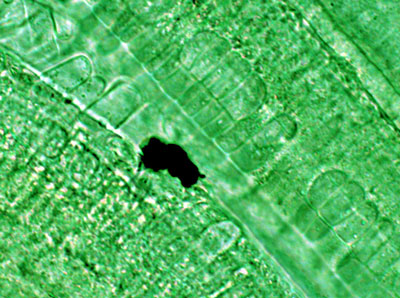
nano carbon fullerenes transmitted to the next generation plant (from the seed).
``A team of scientists at Clemson University has undertaken an effort to shed light on the impact of nanomaterials on high plants, filling a significant knowledge gap in the current literature. They showed how nanoparticles above certain concentrations could clog the vascular systems of plants. They also showed how these nanoparticles above certain concentrations could impact on seed setting``.
Read about Dr. Pu Chun Ke`s study here
February 28, 2009
nanomaterials named as key threat to future
Named: 25 environmental threats of the future
by Catherine Brahic, New Scientist
"..the great environmental concerns of the future should be nanomaterials, manmade viruses and biomimetic robots.
So say researchers, policymakers and environmental campaigners, who have identified 25 potential future threats to the environment in the UK, which they say researchers should focus on".
read the article here
by Catherine Brahic, New Scientist
"..the great environmental concerns of the future should be nanomaterials, manmade viruses and biomimetic robots.
So say researchers, policymakers and environmental campaigners, who have identified 25 potential future threats to the environment in the UK, which they say researchers should focus on".
read the article here
February 27, 2009
more on nanoginger
A few weeks ago I wrote about the ginger that didn't seem right and I called President's Choice to inquire about its origin, and if it was "milled" to nanoparticle scale. They hummed and hawed and put me off until today.
They called today to say the company (an Indian manufacturer) has a new processing regime and will not divulge the scale of the particle.
?
My suspicion is that President's Choice ginger is nanoginger! If you follow the links in my previous post, you'll see it exists. I don't worry so much about the molecules involved with ginger being nanoscale, rather, I'd be concerned about the residues of chemicals associated with the ginger (herbicides). These nanomaterials behave VERY peculiarly on a nanoscale.
Just another interesting example of how the world of our food is transforming before our very eyes...and not too many people saying...
hey! leave our ginger (etc) alone!
They called today to say the company (an Indian manufacturer) has a new processing regime and will not divulge the scale of the particle.
?
My suspicion is that President's Choice ginger is nanoginger! If you follow the links in my previous post, you'll see it exists. I don't worry so much about the molecules involved with ginger being nanoscale, rather, I'd be concerned about the residues of chemicals associated with the ginger (herbicides). These nanomaterials behave VERY peculiarly on a nanoscale.
Just another interesting example of how the world of our food is transforming before our very eyes...and not too many people saying...
hey! leave our ginger (etc) alone!
Subscribe to:
Posts (Atom)


