Showing posts with label Sustainable farming resources. Show all posts

November 15, 2010

symbiosis in the garden


I love growing covercrops, and have experimented with several over the years. I like to interplant clover in tomatoes and peppers, and have grown asparagus in a permaculture system with dutch clover. I have used field peas and austrian winter peas in a mix with oats for a summer green manure, but apart from those examples, I have not been very adventurous with legumous cover crops.

Rhizobium bacteria live in the cells of legume root nodules of and are estimated to carry out 50-70% of the world's biological nitrogen fixation.

"The nodulation process is a series of events in which rhizobia interact with the roots of legume plants to form a specialised structure called a root nodule.
The process involves complicated signals between the bacteria and the roots. In the first stages, the bacteria multiply near the root and then adhere to it. Next, the small hairs on the root's surface curl around the bacteria and they enter the root. Alternatively, the bacteria may enter directly through points on the root surface. The method of entry of the bacteria into the root depends on the type of plant. Once inside the root, the bacteria multiply within thin threads. Signals stimulate cell multiplication of both the plant's cells and the bacteria and this repeated division results in a mass of root cells containing many bacterial cells. Some of these bacteria then change into a form that is able to convert gaseous nitrogen into ammonium nitrogen (that is, they can "fix" nitrogen). These bacteria are then called bacteroids." source

In return, the microbes get high-energy carbohydrates produced by photosynthesis in the host plant. There are different species of rhizobia and they are associated with different plants: the soil bacteria that is a symbiont of clover is different than the species engaged with lupines, for example.

I have many nitrogen fixers growing wild in the pasture, and expect that soil conditions for these are better suited for my soil and climate conditions; there is vetch, red clover, white clovers and lupine for example, but no alfalfa. I expect that because these plants are thriving there is a healthy community of the soil bacteria that each of these plants require to provide the symbiotic relationship necessary to fix nitrogen in the plant. I value these natural precedents and try to take my cue from the pasture ecosystem in my garden.

Blue Lupin is good plant for nitrogen, phosphorus and deep soil
penetration. It is a very good at extracting and concentrating minerals in the soil so when the plant material decomposes it made available for the next generation of plants. Hairy and common vetch are excellent for nitrogen fixation, although they won't produce as much biomass as clover,so seeding with a mix of rye or oats will add this bulk.

White dutch clover, once established provides an excellent hardy cover for paths in the garden and will withstand foot and even tractor traffic down the beds.

Here are some great resources

Organic Ag Center; Green Manure Options
Attra Overview of Cover Crops and Green Manures

September 5, 2009

I think this is just innocent parody; it is a bit weird, but they have a great website with designs to build that swell tractor..

August 16, 2009

sod good

I had to post this video in response to the "eureka" scientists have recently published : healthy soil bacteria can absorb methane...at rates greater than can be produced by the beasts grazing upon the blessed sod... uh, yah. Now lets see them scientists declare the whole a symbiotic system!

Ecological farmers may seem weird, but they can teach a scientist a thing or two.

June 28, 2009

saskatchewan settlement experience


I happened upon this wonderful website with some great photographs of the Saskachewan Settlement Experience.

There are even some silent movies.

February 18, 2009

small scale grain; not if, but how.

When I farmed in BC on a 126 acre homestead, we had a neighbour who sharecropped several neighbourhood farms in the area. He could work magic on his old John Deere combine and was a sight for 21st century eyes taking up the road with his big antique beauty. He took on about 60 acres of our land to grow wheat, spelt and oats. It worked out beautifully with our vegetable and pasturing rotations. Having a really handy guy with an old combine and all the other equipment necessary to grow grain is a rare honour; Not always easy to find.

If you are handy and live in an area where old agricultural equipment rots in fields or goes through auctions cheap, you could find an old combine like this farmer has.

But what are the other options?

The potential for intimate relationship with food is a thing seen clearly when a year's supply of grain is grown, harvested and cleaned by hand. This intimacy approaches oppressiveness when it is done for more than one's own bread...unless of course there are many of us doin it! (and then it becomes intimate again!)
Patience, perseverance and modest needs indicate a good scythe and a fan or very windy day. Dan Jason in Grain in the Garden (PDF) has an excellent essay on how to do just that.

To be self-sufficient in grain for a large family and their animals or a csa it would be good to look at equipment that is suited for that scale.
Small scale binders, threshers or combines are certainly not a mass produced commodity item and are difficult to find and usually jaw droppingly expensive.
Asia and eastern europe have produced some of these great little machines - some days I day dream of traveling and buying small farm equipment and then I realize ..we have to build them! What a time as the present for small scale local equipment fabrication; lets get to work manufacturing and importing implements for small and 2 wheel tractors (like the BCS) or small stationary units- recycled biodiesel, or ox, or horse - what ever each of our sustainable farming communities decide - and get the workshops humming in community colleges. To get the tools that we need (while we still can) maybe a multi-community effort to import together would be useful as well.

Here are a few links to combines and threshers for two wheel tractors or stand alone.

(A combine cuts and threshes in one operation. A thresher is fed (one would use a sythe or a sickle bar mower to cut the stalks).

Cicoria mobile thresher
http://www.cicoria.it/uk/plot375.html

thresher made from converted chipper shredder


Small scale corn thresher


Ferrari has here everything to fit a 2 wheel tractor but a combine. But in an article about small scale grains they mention a number of models.

Gene Logsdon's book Raising Small Grains is still arguably the bible on whole topic of grain growing - and its just back in print! http://www.chelseagreen.com/bookstore/item/smallscale_grain_raising

February 14, 2009

mechanical weeding equipment

I have been thinking about midsized farms after reading about how they are disappearing. Very large farms are surviving and there is resurgence of small farms of 5 acres or less. But the midsized farm and the old "general" farm where a practically closed loop system existed and a living made on a quarter section or so, is disappearing. It is the mid size farms which are the bread and butter of our food security. My first farm was this size and our vegetables fields was 20 acres. We utilized tractors with some very ingenious mechanical weeder regimes that I'd like to describe.

The book Steel in the Field is online at SARE, covering a wide variety of tools that weed, from finger weeders to Kongsgilde s tine cultivators, basketweeders to lely blind tine weeder. The 3 weeding tools that we used on my old farm were:


lilliston rolling cultivators


A heavy tool bar needed for these solid gangs: with several spiked spider wheels on each unit that can angle at 2 points to throw a little or a lot of soil out or into the row. They are ground driven and fabulous at uprooting perennials and useful to hill potatoes. We bought a big unit with a bunch of other farmers and divider up the cultivators because one 3 on a tool bar is ideal for small tractors in vegetable fields.


My favorite machine was an old farmall Super C that had this baby set up on the under belly hydraulics.


Made by a small company in the states the buddingh basket weeder eliminated hoeing in all the 4 row beds (carrots, onions, spinach, etc) for the first 6 weeks. It rolls like a hamster cage scuffing out small annual weeds - not so good with the perennials but they are easier to hand weed out after loosening up with the basketweeder. Ten years ago they cost 1,500 - not sure what they go for today, but it can pay for itself pretty quick if one has over 10 acres of vegetables.
They can be found at Buddingh Weeder Co

The underbelly mount tractors were made with with sweeps and shares, which are useful for 2 row crops like corn and beans. I found it more useful to have a basket weeder under the farmall and use this S-tine cultivator for the pathes and 2 row beds, the tines can be moved along the tool bar to adjust spacing.

Tools I haven't used that look interesting:

I see this tool in action in strawberry fields here in the Annapolis Valley. Buddingh makes fingerweeders that fit on a tool bar that goes under the hydraulics (like the basketweeder) that has similar action to the Ecoweeder. With this tool you need a friend and have greater precision with your weeding.

Here is a link to a slide show


I'm hoping to get over to Willsie equipment sales in Ontario one of these years. They have 10 acres of used vegetable equipment. There are some very inventive machines built over the past century and I'd be as happy as a calf in clover given a chance to wander through the old iron.

The BCS is a great machine

I had a wonderful blue Italian walk behind tractor at my old farm that tilled, pulled a wagon, a lister plow and a sickle bar mower. A grand machine that powers itself, adjustable handles so the PTO can be at front and the machine in reverse, wheels adjusted. I even used it to pull logs out of the brush.

They make diesel BCS as well, its a machine I am currently looking for, because I can make biodiesel from waste grease. I'll post about that soon.

Earth Tools has a number of implements for the BCS and sells several models.

And a video of a combine in use on a walk behind tractor. BCS sells a reaper binder for harvesting grain in Europe and Asia. Not sure if this is available in North America.

Here is another Italian walk behind tractor with implements for the small farm

January 12, 2009

electric tractor


I posted about an electric conversion of an Allis Chalmers G a while back and stumbled upon some modern electric tractors. Yes that is a solar panel mounted like a canopy. Check out the video on the company's website. They have a model that runs on tracks with 3 point hitch and PTO...and can be set up with a loader or an excavator.

Here is another site that discusses some older garden tractors and if you're interested in smaller electric equipment (tillers, chainsaws) this site has a good list of stuff.

December 26, 2008

Organic farming combats global warming … big time

New Findings, from Rodale New Farm Institute.
Data from The Rodale Institute’s long-running comparison of organic and conventional cropping systems confirms that organic methods are far more effective at removing the greenhouse gas, carbon dioxide, from the atmosphere and fixing it as beneficial organic matter in the soil. Watch this great video

Fast Facts

If only 10,000 medium sized farms in the U.S. converted to organic production, they would store so much carbon in the soil that it would be equivalent to taking 1,174,400 cars off the road, or reducing car miles driven by 14.62 billion miles.

Converting the U.S.’s 160 million corn and soybean acres to organic production would sequester enough carbon to satisfy 73 percent of the Kyoto targets for CO2 reduction in the U.S.

U.S. agriculture as currently practiced emits a total of 1.5 trillion pounds of CO2 annually into the atmosphere. Converting all U.S. cropland to organic would not only wipe out agriculture's massive emission problem. By eliminating energy-costly chemical fertilizers, it would actually give us a net increase in soil carbon of 734 billion pounds.
read more

December 18, 2008

The lowly seed cleaner


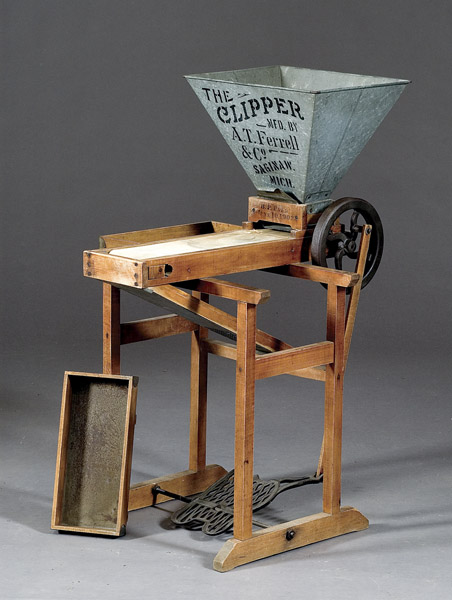
Not content with owning the majority of the planet's key food patents, seed companies and contractual farmers, Monsanto is going after the lowly seed cleaners; those essential but unrecognized stalwarts of agricultural efficiency. Now's the time to dig out of the neighbour's grass, haunt the rural auction houses, liberate the lawn ornaments or cobble together your own.


"Take my yoke upon you, and learn of me; for I am meek and lowly in heart: and ye shall find rest unto your souls". Matthew 11:29

December 16, 2008

The miracle of parsley and comfrey

I had a three legged dog who is now long gone after a long happy life of chasing coyotes, digging for voles and terrorizing marmots. In her later years she developed arthritis in her single front limb and I consulted The Complete Herbal Handbook for Farm and Stable for treatment advice. It was with some scepticism that I began to follow Levy's advice of a tablespoon parsley and tablespoon comfry leaves in a bit of meat for palatability. Juliette de Bairacli Levy, Jewish Turkish-Egyptian, friend of the gypsy and collector of peasant herb wisdom. Her advice was a miracle to my dear dog Tri-pod. After a few weeks she was back to her tri-hippity-skip self. I lapsed after awhile after she recovered, and it set back in, so as long as I kept up the parsley/comfry in her diet the arthritis was kept at bay. I highly recommend Levy's book for farm animal care and the parsley/comfry treatment to anyone suffering arthritis (Dad).

December 9, 2008

A few multi-purpose cows: milk, meat and draught


From top clockwise: canadianne, kärntner blondvieh,
aure et saint-girons, lourdais, and milking devon.


Diversity in cattle has diminished at a rapid rate over the past 100 years. Many breeds that fit in well on a small self-sufficient farm are now classified as rare breeds, or have disappeared altogether. Some like the pineywoods and dexter are making a comeback. Often these breeds were tough and bred for local conditions as well as utility. The uniformity of the super breeds may be well suited for industrial farming milieus, but like plant biodiversity, sustainable farms would do well to research and breed livestock that represent some of the oldest and most robust genes for ecological farming.

Getting ready for seed starts

A blizzard blew in early yesterday morning, took the power out and froze the ground up hard. Now it is an icy white world with a few inches of snow. My hoophouse project is buried and I'm still awaiting the arrival of the pvc pipe so I'm hoping we don't get much more snow for a few days. The foundation is all set for these ribs and I want to get ready so all I need to do is wing up the plastic in the early spring. I have my potting soil curing ready for the seedling starts that will commence next month. I thought I'd share my recipe for those of you that are looking to make their own. I don't sterilize the soil, as I've never had big problems with damping off, given the right moisture, airflow and microbial balance. I don't want to kill the mycorrhizae and other beneficial microbes. So I like a good compost as the basis of the mix, to provide that community of organisms that keep things healthy. We had a problem with mold in the greenhouse once and solved the problem with a horsetail and chamomile spray. (mix 1/8 cup of dried horsetail, and 1/8 cup chamomile in 1 gallon of boiled water, let steep for a couple hours. strain.)

Here is the recipe for potting soil mix:

2 parts screened, mature (2/3 year old) compost
2 part peat
1/2 - 1 part soil
1 part vermiculite
lime

I pile up these ingredients onto a large plywood sheet in my shed, mix with a shovel, make an indentation in the center and add water into this bowl. When absorbed I mix again and repeat until the soil balls up and crumbles without any water squeezing out. If it doesn't hold together adequately I'll adjust the materials (more compost) until I get it right.

I like a mix with some plasticity as I use a blockmaker rather than flats or plastic for most of my starts. They come in several sizes and the blocks fit into one another in an ingenious way so fine roots are not as disturbed as traditional transplanting. Johnny's Select Seeds carries them. The challenge is in achieving a plastic soil without it being too heavy. I do broadcast some seeds densly in flats and transplant later (parsley for e.g) to save on space under the lights.
For fertility I rely on my good compost and soil, and use kelp, fish bonemeal, foliar fish and have used bloodmeal in the past but have given this up.

I've started my seedling under florescent lights hanging from ropes on tiered shelves... . but I like the idea of this simple design and may set up this system. Its important that air circulation isn't compromised and that the room is warm to maximize quick growth. Once the early starts: onions and leeks are up, healthy and have a few inches of growth, I'll transfer them to the hoophouse to free up space for brassicas, parsley, basil, tomatoes, etc, under the lights. The hoophouse in march and april will keep the killing frost off of the hardier starts and provide warmth for growth when its sunny. I'll start lettuce right in the hoophose.

December 7, 2008

cows love turnips


If you were wondering what I was meaning by a mangle chopper in my post the other day, my friend Isabelle found a picture of one. The roots ( fodder beet or carrot or turnip) get dumped on those tines, fall down onto an iron drum with blades that cut them to pieces so the cows won't choke. Click on it to go to a series of old farm equipment from the Cottonwood House Historic Site of Pioneer Farming in B.C

I have my turnips all loaded up for the cows and they got a few tonight and seem to like them better than carrots but not quite up there with apples. My chopper doesn't have that elaborate wheel on the side, just a big iron handle. I suppose you could use it to make coleslaw, or chop potatoes too if you had a really big crowd for dinner; a farm grrl food processor.

December 6, 2008

Food Sovereignty Can Cool Down the Earth!

Via Campesina's position on NFCCC (United Nation Framework Convention on Climate Change)

"Small-farmers and peasant communities are among the first victims of climate change. Everywhere, in our fields, amongst the plants we cultivate and the animals we raise, the consequences of climate change are palpable. ....

However, it seems that farming communities are more threatened now by the so-called solutions to climate change promoted by corporate interests, G8 countries, the World Trade Organization and the World Bank, than by climate change in itself. Industrial agrofuels, climate-ready seeds, fertilization of oceans and carbon-trading schemes, both deepen and widen the privatization of all natural resources on Earth and thus exclude local communities from access to those resources which where once called the Commons: land, water, seeds and now, perhaps, even the air we breathe" read it here

November 24, 2008

Historic Agricultural Literature

I collect a few things like stones, tools, puppets and agricultural books. My favorites are those published before the "Green Revolution" when fertilizer meant manure or soiling crops and pest control were chickens and field rotations. Some of my favorites:

Farmers of Forty Centuries; Permanent Agriculture in China, Korea and Japan; FH King 1911 and the The Culture of Vegetables and Flowers. Sutton, 1913.
The Small Farmers's Journal often lists booksellers of Farm Literature and has reprinted some treasures within its own pages.
I'll post a list of some great old farming books on the sidebar soon. In the meanwhile, and its not as satisfying as having those beautiful old pages sliding through your fingers, here are a couple of sites online that have great digitalized collections:

http://chla.library.cornell.edu
"The Core Historical Literature of Agriculture (CHLA) is a core electronic collection of agricultural texts published between the early nineteenth century and the middle to late twentieth century. Full-text materials cover agricultural economics, agricultural engineering, animal science, crops and their protection, food science,forestry, human nutrition, rural sociology, and soil science".

http://soilandhealth.org
Free digitalized library on line with a collection of books on holistic agriculture, health and self-sufficient homestead living.

http://journeytoforever.org/farm_library.html
An excellent online collection of classic small farm books