A photo essay by GRAIN
"The International Rice Research Institute (IRRI) is one of the 15 international agricultural research centres that come under the Consultative Group on International Agricultural Research (CGIAR). It was set up in 1960 in the Philippines with funds from the Ford and Rockefeller Foundation. GRAIN staff visited IRRI in March 2009 at a time when it is at the crossroads. It was set up to support 'poor rice farmers' in Asia, build capacity of the national agricultural research centres (NARS) in various 'developing' countries and then fade away. Turning 50 in 2010 it is still very much alive though its beginning to show shades of grey. After a mid-life funding crisis, it has set about doing its 'make-over' with much closer ties to the private sector."
Showing posts with label seeds. Show all posts
Showing posts with label seeds. Show all posts
May 6, 2009

January 26, 2009
Mars Inc and Seeds of Change.
Seeds of Change (in case I'm not the only one that didn't know) is owned by Mars Inc. the largest Candy Corporation in the world now that Birkshire's Warren Buffet has helped finance the scoop up of Wriggly's.
One of the largest privately owned Corporations, the Mars family is reclusive and worth tens of Billions. I'll have to find my purple dragon carrots elsewhere, as I won't support Mars Inc. and their appalling chocolate trade, exploitation of southern hemisphere farmers and the pushing of the nanofood front. They have pioneered nanotechnology in packaging and sensors:
"Nanotechnology will dramatically extend food shelf life. Mars Inc. already has a patent on an invisible, edible, nano wrapper which will envelope foods, preventing gas and moisture exchange. ‘Smart’ packaging (containing nano-sensors and anti-microbial activators) is being developed that will be capable of detecting food spoilage and releasing nano-anti-microbes to extend food shelf life, enabling supermarkets to keep food for even greater periods before its sale. Nano-sensors, embedded into food products as tiny chips that were invisible to the human eye, would also act as electronic barcodes. They would emit a signal that would allow food, including fresh food, to be tracked from paddock to factory to supermarket and beyond." see Nano foe
They also have patents on nano material additives for food flavour enhancement and preservation.
"Mars Inc. US Patent US5741505 nanoscale inorganic coatings: Inorganic nano-coating applied directly to a food product to provide moisture or oxygen barrier to
improve shelf life and/or flavour impact. Coating materials include permitted additives silicon dioxide (E551), magnesium oxide (MgO, E530) and titanium
dioxide (E171). Applications include hard sugar confectionery, ready-to-eat cereals, biscuits, crisps" see
Note: these metalic nanomaterials are used for sensors as well as antimicrobials and studies have shown that they are toxic.

One of the largest privately owned Corporations, the Mars family is reclusive and worth tens of Billions. I'll have to find my purple dragon carrots elsewhere, as I won't support Mars Inc. and their appalling chocolate trade, exploitation of southern hemisphere farmers and the pushing of the nanofood front. They have pioneered nanotechnology in packaging and sensors:
"Nanotechnology will dramatically extend food shelf life. Mars Inc. already has a patent on an invisible, edible, nano wrapper which will envelope foods, preventing gas and moisture exchange. ‘Smart’ packaging (containing nano-sensors and anti-microbial activators) is being developed that will be capable of detecting food spoilage and releasing nano-anti-microbes to extend food shelf life, enabling supermarkets to keep food for even greater periods before its sale. Nano-sensors, embedded into food products as tiny chips that were invisible to the human eye, would also act as electronic barcodes. They would emit a signal that would allow food, including fresh food, to be tracked from paddock to factory to supermarket and beyond." see Nano foe
They also have patents on nano material additives for food flavour enhancement and preservation.
"Mars Inc. US Patent US5741505 nanoscale inorganic coatings: Inorganic nano-coating applied directly to a food product to provide moisture or oxygen barrier to
improve shelf life and/or flavour impact. Coating materials include permitted additives silicon dioxide (E551), magnesium oxide (MgO, E530) and titanium
dioxide (E171). Applications include hard sugar confectionery, ready-to-eat cereals, biscuits, crisps" see
Note: these metalic nanomaterials are used for sensors as well as antimicrobials and studies have shown that they are toxic.

Avoiding Monsanto in the garden
You may want to avoid purchasing and planting vegetable seed varieties that belong to Monsanto, and because they bought up Seminis, the list is extensive. Varieties like red sails lettuce, bush butternut, packman and green goliath broccoli, ceddar cauliflower. Because Seminis sells to most seed companies (not Fedco) and licenses its varieties to third parties for organic seed production, their business is sown extensively throughout the seed world. If you want to navigate around these varieties seedsandseedsaving.blogspot.com has a good list to help out.
January 19, 2009
A great Interview with Alan Kapuler
Over at Bishop's Homegrown Alan has a fabulous interview with Alan Kapuler of Peace Seeds, molecular biologist, organic farmer, painter and pioneer of the organic seed movement. The interview is here.
Check out Kapuler's paintings here
Check out Kapuler's paintings here
January 18, 2009
hello mudder- hello fadder - how is it - your just madder
 Spelt is third from left.
Spelt, quinoa, kamut are not "grains", so sayeth the Canadian Grain Commission. No, the food stuff of the ancients and lucrative crop for organic farmers are "matter other than cereal grain". The CGC is mandated (by the people of Canada) to ensure the fair treatment of farmers, assisting in the infrastructure to get the grain to market. see. Spelt which is higher in protein and minerals than wheat was grown in Iran 5,000 years ago. Quinoa, "the Mother grain" has been cherished in the Andes for 6,000 years...and its my favorite grain.
Country Guide
Spelt, quinoa, Kamut not "grains": CGC
Staff
1/17/2009
Don't count on protection from the Canadian Grain Commission if you're growing Kamut, spelt or quinoa.
The CGC on Friday ruled that the three crops, often described as "heritage" or "ancient" grains, are not considered "grain" as defined in the Canada Grain Act.
Thus, the CGC will not set up a grade schedule for the crops, nor will a farmer selling any of those crops be eligible for payment security coverage on deliveries, if a CGC licensee doesn't pay the farmer. Those commodities won't be included when the CGC calculates its security requirements for its licensees.
This also means farmers who grow any of the three crops will not have the right to refer to the CGC to determine grade and/or dockage.
read the whole article
January 16, 2009
The value of locally bred varieties

I'm getting excited for the coming season now that I'm hunkering down to plan my new garden and order the seeds that I'll need. The problem is I`ve ordered a lot of seed catalogues and they are still trickling in. William Dam came yesterday and I am waiting in particular for a couple of smaller, local, seed company catalogues. Those of you who have been following my blog for a while know that I moved to my new farm in Nova Scotia from BC in late spring last year. I focused on plowing and cover cropping last summer to prepare for this season and the small house garden I did plant were sown with seeds brought with me from BC. Some of the varieties that I have had great success within in BC, didn`t thrive in my new garden. So this is why I look forward to trialing varieties from Hope Seeds. They are a small seed company in New Brunswick and key to their philosophy is `"that the future of sustainable agriculture lies with small, local, organic farmers and that much work is needed to develop a top-quality, decentralised seed bank of varieties that best meet their needs". They are working to develop varieties with natural resistance to pests and diseases, that are adapted to maritime conditions and organic growing methods. This is well worth the wait.
Check out this article about this wonderful small business in Small Farm Canada
December 18, 2008
Bloggers Seed Savers Network
Patrick at Bifurcated carrot has started a blogger's seed network that I think is another terrific way to share the diversity from our gardens. I've linked with this network. Having sorted through my bin of seeds, I am just offering those that I have saved myself and ask that if you would like some seed, contact me, send a stamped envelope and I'll send you some seed. If you have seed to trade, great!
Rainbow indian corn, short season (6 colour...saved in B.C. in remote location away from GMO)
Purple dragon carrot
scarlett nantes carrot
yellowstone carrot
arugula
red mustard
Rainbow indian corn, short season (6 colour...saved in B.C. in remote location away from GMO)
Purple dragon carrot
scarlett nantes carrot
yellowstone carrot
arugula
red mustard
December 15, 2008
Coexistence? Maybe not...get the bully off the playground
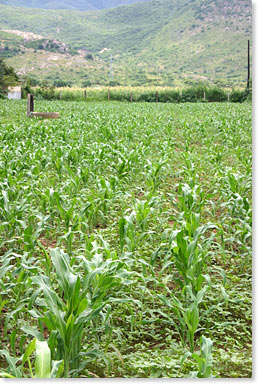
Despite a Mexican Government moratorium on transgenic corn, corn fields deep in the State of Oaxaca and in the corn belt of the south have been contaminated with GMO. It is possible the contamination arrived via the corn seed of Pioneer, a large seed distributor which was found to contain 1/3 transgenic contaminates. Monsanto has succeeded in lobbying to prevent labeling this seed.
Read about it in the Organic Consumer Association. Or in the translation of the Le Monde article.
How realistic is it to keep our planet's corn and canola genetic heritage free of transgenic contamination? What far flung corner of it would one have to farm in, or save seed in. Is the contamination intentional? Will this happen systematically to all our food? This is significant. We're not talking crossing between varieties or species. This is cross phylum, cross domain. It is tragic because we don't know the long term health and environmental consequences of viral, bacterial, fish, etc genes in our basic food plants. An earlier similar study was met with an industry attack that discredited the research and quickly silenced public debate. I believe the full out attack on this kind of research conceals the real motive - profit through control of food and genetic resources. It is vigorously imperialistic, deviously clever and certainly not ignorant of the fact that many of the world's food crops cannot coexist with transgenics.
Biosecurity means taking the power away from the Big Gene companies. A handful of Western Governments with Canada, the US and Australia particularly culpable, have so complicitly bestowed ridiculous license to bully, harass, contaminate and control the bread of life and those who produce it. Perhaps the economic tsunami will provide the opportunity to resculpt the free trade agreements that have penalized small indigenous farmers in favour of industrial corn for feed or ethanol. Perhaps Obama will have the wisdom and independence to appoint a new Ag Secretary that has some integrity and objectivity. Perhaps a coalition of the left and willing will sweep Canada in the new year. My sinking feeling is however, that the alienation of the masses from the life of the land, of sun and rain, soil and seed, buries deeper those human genes that understand the horror of a food supply composed of intertwined domains, and mourn the loss of a right to grow what has been our human heritage for thousands of years.
photo from: Revolution of the New Commons
November 21, 2008
Seeds Are for Soil
I have an unsatisfied curiousity with The Islands of Svalbard (Sovereign Territory of Norway) in the Arctic and have written a poem about some of those perplexities. You can find it here.
I was thinking about Svalbard today as I have ordered a selection of seed catalogues for my new address and was imagining all their comrades in sproutablity, packaged up and locked away in state of the art stone tombs, against the arctic cold and polar bear breaths. I have ordered catalogues which carry heirloom, rare and exquisitely unique varieties of vegetables and they are unique because they have been both saved and passed down through the generations - they have been planted and have evolved to become what they are in the very act of being planted, tended and reproducing in situ. I have a few of my own farm saved seed but it is quite a complex skill, to prevent cross-pollination, harvest at the right stage, dry and fend off mold and insects. The realities of other farm needs have often prevented conscientious seed savings. I hope to change that this season. To save seed is a to be a bit of an heirloom itself: to value a living legacy of hope for the next year's garden, the next season's bounty; to see diversity as a gift of many hands, planting many genes, in many places. For seed security we need much more of that kind of succession. Not a vault but a community of seed savers. This is a good place to start
I was thinking about Svalbard today as I have ordered a selection of seed catalogues for my new address and was imagining all their comrades in sproutablity, packaged up and locked away in state of the art stone tombs, against the arctic cold and polar bear breaths. I have ordered catalogues which carry heirloom, rare and exquisitely unique varieties of vegetables and they are unique because they have been both saved and passed down through the generations - they have been planted and have evolved to become what they are in the very act of being planted, tended and reproducing in situ. I have a few of my own farm saved seed but it is quite a complex skill, to prevent cross-pollination, harvest at the right stage, dry and fend off mold and insects. The realities of other farm needs have often prevented conscientious seed savings. I hope to change that this season. To save seed is a to be a bit of an heirloom itself: to value a living legacy of hope for the next year's garden, the next season's bounty; to see diversity as a gift of many hands, planting many genes, in many places. For seed security we need much more of that kind of succession. Not a vault but a community of seed savers. This is a good place to start
Subscribe to:
Posts (Atom)


