"Most suicide cases relate to those farming families which have run up huge debts because of the high cost in using the expensive genetically-modified cotton seeds, which have to be bought every year."
Times of India, All in a Day
This is the type of quote you see in the Indian press very frequently, the suicides of farmers and the attribution of debt related to GMOs as the cause of this despair.
In a report commissioned by Monsanto and others in the biotech industry (the latter of which is getting thin because Monsanto is buying them up) this causal link is debunked.
But according to Dr. Vandana Shiva in, Toxic Genes and Toxic Papers : IFPRI covering up the link between Bt. Cotton and Farmers Suicides (PDF) the methodology, review and processes are false. It is pseudo-science spun to distract. This is not surprising.
When you hear the argument that Indian farmers just need access to more loans, more indebtedness and therein lies the cause of farmer despair, it would be good to sift through the Indian press on it and read Dr Shiva.
"There are similar “toxic papers” being generated in the defense of GM crops,
especially Bt. Cotton. Like the toxic papers of Wall Street they have no grounding
in reality. They assume false number crunching can be a substitute for truth. And
they are deadly for food and agriculture security, and farmers livelihoods.
A recent paper from IFPRI “Bt Cotton and Farmers Suicides in India” falls in this
category of a doubly toxic paper because it covers up the risks of toxic genes
and is detached from reality. Yet it is aimed at shaping public opinion about GM
crops by using every trick in the trade to separate the impact of GM crops on
farmers from the seed monopoly and the technology of producing nonrenewable,
toxic seeds through genetic engineering".
Follow the link above for the complete article.
March 31, 2009

truth needs no prop
Some people you just don't want to talk to; that has been an ongoing realization for me and it's sometimes a difficult task. I like a good argument. I like to see learning taking place. I've made a little progress in the work of holding my tongue, but it takes discipline and resolve not to engage. I especially don't want to be used, slid somehow surreptiously into the deceptions.
I'm thinking here of the NEW BLOG by (Mon.....) which I won't link to (you'll find it). It seems just another opportunity for propaganda, indoctrination and denial. There are many strategies that farm industrialists are using to win over the masses. They have had the advantage of a passive media and goons in governement and I guess see blogging as yet another of their P.R. schemes.
The comments within the posts have some decent counter argument, at the moment, I must say, and it will be interesting to see where that goes...but my bets are
an inept, mean, censorial farce-up.
But I will not engage the big chemical gene corp in it's blogging indoctrination program. There is no question that it might be an amusing or a stimulating challenge. Slay the dragon with undeniable truthes ... make them say uncle.
But it's not going to happen.
I will, however, step forward in my own space here, on occasion, and write about subjects they eviscerate. But I won't fess up my (final) motivation to post.
Truth needs no propoganda; It is clearly seen. One needs examples of it it before one. This is why I believe communities working toward food sovereignty are so powerful and frightening to food industrialists. The profit is found in centralized, monopolized systems. not in small scale diverse regions. But this type of farming (local, diverse, small, self suficient) has and will continue to be shown to be productive, regenerative, and contribute toward healthy communities.
I'm thinking here of the NEW BLOG by (Mon.....) which I won't link to (you'll find it). It seems just another opportunity for propaganda, indoctrination and denial. There are many strategies that farm industrialists are using to win over the masses. They have had the advantage of a passive media and goons in governement and I guess see blogging as yet another of their P.R. schemes.
The comments within the posts have some decent counter argument, at the moment, I must say, and it will be interesting to see where that goes...but my bets are
an inept, mean, censorial farce-up.
But I will not engage the big chemical gene corp in it's blogging indoctrination program. There is no question that it might be an amusing or a stimulating challenge. Slay the dragon with undeniable truthes ... make them say uncle.
But it's not going to happen.
I will, however, step forward in my own space here, on occasion, and write about subjects they eviscerate. But I won't fess up my (final) motivation to post.
Truth needs no propoganda; It is clearly seen. One needs examples of it it before one. This is why I believe communities working toward food sovereignty are so powerful and frightening to food industrialists. The profit is found in centralized, monopolized systems. not in small scale diverse regions. But this type of farming (local, diverse, small, self suficient) has and will continue to be shown to be productive, regenerative, and contribute toward healthy communities.
March 29, 2009
nanotech to grease China's economic engine?
If only for another toxic blip in human ecological history.
Or shall we create something new in the way of sustainable communities instead of grey goo?
China's Giant Step into Nanotech
China is positioning itself to be the world leader in nanotechnology, seeing its potential to reenvigor its global competitiveness.
Here is the March 26th Guardian story
Or shall we create something new in the way of sustainable communities instead of grey goo?
China's Giant Step into Nanotech
China is positioning itself to be the world leader in nanotechnology, seeing its potential to reenvigor its global competitiveness.
Here is the March 26th Guardian story
Digging in the hoophouse and the seedlings find new homes
The seagulls wouldn't pose for me this morning, although they were out and about next door. They must be following something up the river because I have to hope the gmo corn didn't draw them up this far. The geese are back too and there are a number of them in the corn too. Yesterday the seagulls stood along the peak of my house, one on the stovepipe...I'll try to get them to cooperate later. Thankfully the fly over the garden is limited.
I have a view from it through my hoophouse, its still too wet to work.
I was seeding lettuce, broccoli, cauliflower and cabbage last couple of days (I'll post on my varieties soon) and digging over some beds for ruby chard and beets. I applied lime before the cover-crop (2 times buckwheat followed by rye) last season, so I amended the beds this spring with compost, ashes and phosphate rock.
The onions were started under lights and moved a week ago. I lost about 15% to a freeze.
Its warmer over in the potting house where the lights are and peppers. tomatoes, flowers and basil are up and spilling over.

I have had to move some of these warmer things on to my sun porch (which isn't insulated so lets hope it stays warm) whose foundation I shored up last fall. I'm going to have the cherry tomatoes (sweet cluster from Hope Seeds see sidebar link) in pots there, eventually.
Lots more pictures in the appendix
I have a view from it through my hoophouse, its still too wet to work.
I was seeding lettuce, broccoli, cauliflower and cabbage last couple of days (I'll post on my varieties soon) and digging over some beds for ruby chard and beets. I applied lime before the cover-crop (2 times buckwheat followed by rye) last season, so I amended the beds this spring with compost, ashes and phosphate rock.
The onions were started under lights and moved a week ago. I lost about 15% to a freeze.
Its warmer over in the potting house where the lights are and peppers. tomatoes, flowers and basil are up and spilling over.

I have had to move some of these warmer things on to my sun porch (which isn't insulated so lets hope it stays warm) whose foundation I shored up last fall. I'm going to have the cherry tomatoes (sweet cluster from Hope Seeds see sidebar link) in pots there, eventually.
Lots more pictures in the appendix
baa baa blurred sheep
My genes are determined not by
rain on clover
or the smell of march wool
nor the ways of the organisms burrowing in the soil
not of the ram's passion
or the bumble bees' good works
I am made in the image of efficiency and profit
I am monetized and capitalized and idolized
my genes are set and known
and preferable
to a pesky little thing called natural selection.
baa baa,
whatever.
rain on clover
or the smell of march wool
nor the ways of the organisms burrowing in the soil
not of the ram's passion
or the bumble bees' good works
I am made in the image of efficiency and profit
I am monetized and capitalized and idolized
my genes are set and known
and preferable
to a pesky little thing called natural selection.
baa baa,
whatever.
March 28, 2009
EU members: cloned meat and nanocaution
Members of the EU want cloned meat prohibited and nanoparticles labeled in the just released report on Novel food rules.
Novel foods, MEPs set new rules Food safety 25-03-2009
"In a legislative report dealing with an update of the EU rules on novel foods, the European Parliament calls on the Commission to interdict the placing on the market of food derived from cloned animals and their descendants. MEPs also want food being produced by nanotechnology processes to undergo a specific risk assessment before being approved for use and be labelled. The report was adopted with 658 votes in favour, 15 against and 11 abstentions"....
..."Food derived from cloned animals to be excluded - new Commission proposal demanded
The Parliament wants to exclude food derived from cloned animals from the scope of this Regulation. MEPs ask the Commission to present a legislative proposal to prohibit the placing on the market of food derived from cloned animals and their offspring.
Food produced with nanotechnology processes must be safe and labelled
MEPs want that foods which have been produced by nanotechnology processes, and which will need specific risk assessment methods, may not be included in the Community list until those risk assessment methods have been approved for use.
The risk assessment methods must not imply the use of vertebrate animals; underline the MEPs, who also support the use of non-animal tests and the intelligent testing strategies.
Furthermore, all ingredients present in the form of nanomaterials shall be clearly indicated in the list of ingredients. The names of the ingredients shall be followed by the word 'nano' in brackets".
Read the report
Novel foods, MEPs set new rules Food safety 25-03-2009
"In a legislative report dealing with an update of the EU rules on novel foods, the European Parliament calls on the Commission to interdict the placing on the market of food derived from cloned animals and their descendants. MEPs also want food being produced by nanotechnology processes to undergo a specific risk assessment before being approved for use and be labelled. The report was adopted with 658 votes in favour, 15 against and 11 abstentions"....
..."Food derived from cloned animals to be excluded - new Commission proposal demanded
The Parliament wants to exclude food derived from cloned animals from the scope of this Regulation. MEPs ask the Commission to present a legislative proposal to prohibit the placing on the market of food derived from cloned animals and their offspring.
Food produced with nanotechnology processes must be safe and labelled
MEPs want that foods which have been produced by nanotechnology processes, and which will need specific risk assessment methods, may not be included in the Community list until those risk assessment methods have been approved for use.
The risk assessment methods must not imply the use of vertebrate animals; underline the MEPs, who also support the use of non-animal tests and the intelligent testing strategies.
Furthermore, all ingredients present in the form of nanomaterials shall be clearly indicated in the list of ingredients. The names of the ingredients shall be followed by the word 'nano' in brackets".
Read the report
March 27, 2009
Are most cloned animals transgenic?
"Genetic modification is inevitable in the cloning process. In fact, premature death and disease outbreaks are common in cloned animals. “Genetic uniformity [leaves] them prone to disease outbreaks or even bioterrorism. With traditional breeding you’re trying to improve the genetics. Cloning freezes it at one moment,” says Rostov. The same is true for in vitro fertilization and artificial insemination".
See Cloned Meat; the Varsity
for this quote and other critical points concerning cloned meat.
See Cloned Meat; the Varsity
for this quote and other critical points concerning cloned meat.
local grain CSA gets slandered
The West Kootenays of BC is renowned for its wilderness, artists, independent thinkers, and alternative economy. There are very few farmers and small pockets of farmland, but at the far end of the long lake lies a bread basket in the East Kootneys. A group of visionaries from Nelson organized a grain CSA, contracting with a farmer near Creston. The farmer grew the grain and the community participated in the milling and handling of it, even sailing it home to Nelson.
Jon Steinman documents this journey on a podcast from his excellent Kootenay Co-op radio program Deconstructing Dinner: "THE LOCAL GRAIN REVOLUTION VII - Sailing Grain" from where you can also read more about the Kootenay grain CSA.
Given such an intimate and participatory move toward food security, it was jarring to read an attack on this community project by food and farming writer, organic Verification Officer and "independent" consultant, Mischa Popoff. The site Growers Journal has published it.
Where does the anger and need to humiliate arise from, I wonder? Why attack a small community working locally to steward essentials in their foodshed? I have to question Popoff's independence.
Jon Steinman documents this journey on a podcast from his excellent Kootenay Co-op radio program Deconstructing Dinner: "THE LOCAL GRAIN REVOLUTION VII - Sailing Grain" from where you can also read more about the Kootenay grain CSA.
Given such an intimate and participatory move toward food security, it was jarring to read an attack on this community project by food and farming writer, organic Verification Officer and "independent" consultant, Mischa Popoff. The site Growers Journal has published it.
Where does the anger and need to humiliate arise from, I wonder? Why attack a small community working locally to steward essentials in their foodshed? I have to question Popoff's independence.
What do you get if you divide science by god?

For those that are considering the widespread release of nanotechnology and the actions of quantum mechanics these nanoparticles create in our ecologies, some interesting reading.
BBC News UK Magazine. What do you get if you divide science by God?
"A prize-winning quantum physicist says a spiritual reality is veiled from us, and science offers a glimpse behind that veil. So how do scientists investigating the fundamental nature of the universe assess any role of God, asks Mark Vernon.
The Templeton Prize, awarded for contributions to "affirming life's spiritual dimension", has been won by French physicist Bernard d'Espagnat, who has worked on quantum physics with some of the most famous names in modern science".
Read more
Hat tip to Rob
food choices; freedom of conscious

One of the problems with economic hardships, climate extremes and international turmoil is the opportunity this presents to corporations to have (their) unscrupulous legislators pass nasty bills. No one has much time to think about the consequence of transferring wealth to the banks, let alone the acceptance of cloned meat or draconian food safety bills.
Decisions are being made for us, in regard to what is substantially equivalent, what is morally acceptable, and what is safe. Not only is the impetus for these decisions driven by corporate agriculture and "proven" safe by scientist in their employ, but it is determining the shape of our food landscape precisely because we have little choice - it is invisible. We have organic, we have known (witnessed) food.
But farmers choices for feed, safe location, seed and small scale equipment are thinning too. Because of the nature of farming's precious resources (soil, seed, knowledge) the stage is being set for industrial agriculture and it makes "natural" farming more onerous, makes the journey along the "cowpathes" harder to find. Our edges, our boundaries are being pushed.
Its remarkable to me that there is little outcry regarding the sale of unlabeled cloned meat. If I was a religious adherent I'd want to press for freedom of religion - what a violation for this and unlabeled transgenic food. To know what I put in my temple, should be a fundamental choice of conscious.
I wish the impenetrable resignation and acquiescence that seems to have befallen the masses would lift in regard to real food security. It underpins most, if not all, our planetary dissolution. Once disconnected from the means for independent sustenance, it will be a long and difficult road back.
March 26, 2009
seagulls scavenging in the transgenic corn stalks

If you have been following my bog since I began in November, you may recall my posts about the neighbour's transgenic corn next door, that was harvested in early winter after a couple of snowfalls (and melts). Very little wildlife has come by to eat the remnants, the geese are feeding elsewhere, but this past few days the field has been full of squawking gulls. They rise and fall together, one giant swarm in the wind over the sea of stubble. I walked in there this morning and it is full of corn husks and kernels.

March 25, 2009
toxic assets

"Toxic assets are the equivalent of genetically modified crops and rampant pesticide use. Seems like a swell idea at the time, in order to get a huge crop out of the ground, yet the future for eaters is completely unknown--but suspected to be very dangerous. And in terms of food safety, it's the Big Ag corporations that have been routinely responsible for the jumbo poisoning outbreaks, such as Cargill with ground beef, Tyson's and Smithfield for chicken with salmonella, Dole and Mission Organics for spinach and salmonella. Think these corporations aren't getting federal subsidy bucks--your money? Think again. If they're not getting direct subsidy payments from the federal government, they're buying their products from farmers who do."
Check out provoking questions from Obama Foodorama posted on Marler's Blog
March 23, 2009
farm to fork; appropriation of our language
"Farm to fork" has long been a slogan of small scale local food security, in fact, its been around a while. Now it seems to be taking on new meaning and an ideology quite different than the original idea.
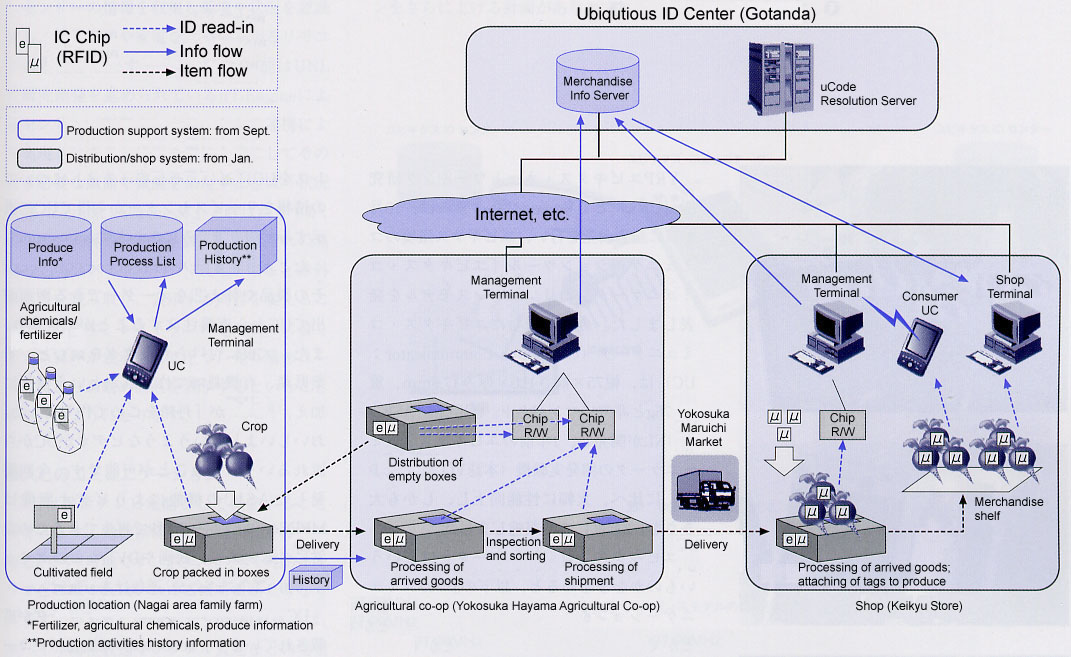
It looks more like this:

Sensors, rifd chips and software to trace it from "farm to fork". Industrial agriculture's piece de resistance for control of the food supply. And we can guess who's involved.

But I ask you! Do we want sterility or health? Are we soley concerned about pathogens, or are transgenic hazards and nanoscale toxins important too?
Bioregional small farms and householders gardens will ensure a localized healthy bioecology, where healthy organisms flourish in symbiotic dynamism, pathogens face resistence and health prevents unbalance. Like a good healthy garden.
Ecological and local; know from where your food comes!
It looks more like this:

Sensors, rifd chips and software to trace it from "farm to fork". Industrial agriculture's piece de resistance for control of the food supply. And we can guess who's involved.

But I ask you! Do we want sterility or health? Are we soley concerned about pathogens, or are transgenic hazards and nanoscale toxins important too?
Bioregional small farms and householders gardens will ensure a localized healthy bioecology, where healthy organisms flourish in symbiotic dynamism, pathogens face resistence and health prevents unbalance. Like a good healthy garden.
Ecological and local; know from where your food comes!
Subscribe to:
Posts (Atom)