May 27, 2010

Spring farm photos


Lil bud shaking dirt off the grass clods, peas in background.


he has lots of sticks to choose from as I have a scrap fence in progress


Notice Bud's skill on path walking, here garlic and onions sets visible, seeds just up. Jumping over beds is still a work in progress as exemplified below (broad beans).


Click the pic to enlarge the spinach, salads, turnip and radish under the row cover.


the early starts are out and transplanted from the hoophouse and its now planted to basil.

May 6, 2010

A look at the Land Grab

Found a very valuable surce of information on the corporate octopus's consumption of land in a collection of daily stories from a range of sources. Food Crisis and Global Land Grab is worth checking out.
This week an article from Grain on the World Banks stalling and readying seven principles for “socially responsible” land grabs, and another on the double punch to Africa: From bleeding Africa to grabbing the land.

April 28, 2010

"The battle over genetically modified crops is being waged before the U.S. Supreme Court -- the first time the nation’s highest court is specifically weighing in on genetically modified organisms and the federal approval process that allows them to roll out from the laboratory to the nation’s farm fields.

The fight is between seed giant Monsanto Co. and Geertson Seed Farm, a far smaller Idaho-based rival, and the case revolves around whether Monsanto should be prevented from selling its genetically engineered Roundup Ready alfalfa seeds.

The biotech behind the seeds was reviewed by the U.S. Food and Drug Administration, and later approved by the U.S. Department of Agriculture prior to the company’s product launch in 2005.

Geertson has argued that such seeds should not be allowed to be sold, because of concerns that they can cross-contaminate nearby fields planted with organically produced alfalfa. They also argue that because these GMO seeds have been engineered to resist a commonly used herbicide that Monsanto makes, killing off such unwanted plants would be extremely difficult.

Monsanto argues that such fears are far-fetched and that such cross-pollination is unlikely. Instead, the company contends that using its seeds helps the environment because farmers don’t have to use as much weed killer on their fields. (Monsanto said in court filings that alfalfa, which is used to feed livestock, is grown on about 22 million acres across the nation.)

In addition, “the plaintiffs in the case have not demonstrated that continued planting of the crop was likely to cause irreparable harm to other alfalfa growers,” the company said in a statement posted on its website Tuesday. (The italics were an emphasis that Monsanto used.)

A lower court sided with Geertson and, since 2007, Monsanto has been barred from selling these seeds nationwide. So the issue now before the Supreme Court is whether the lower court had the authority to order such a far-reaching ruling under the National Environmental Policy Act.

Both sides faced off before the court on Tuesday. A ruling is expected later in the year.

But here’s the real question that farmers and environmentalist are asking: Considering the USDA is slated to wrap up an environmental study on this and other issues next year, and the agency reportedly is expected to approve sales of such seeds, will the court’s ruling matter in the long run?

-- P

Monsanto moves up the food chain claiming meat.

"The global coalition "No Patents on Seeds" has issued an alert. It pertains to the latest patent filed by Monsanto. In a pending patent application (filed on Jan 29, 2009) from Monsanto even bacon and steaks are claimed: Patent application WO2009097403 is claiming meat stemming from pigs being fed with the patented genetically engineered plants of Monsanto.

I looked at the patent claim, and found it to be simply absurd. The patent is filed for an invention: "Method for Feeding Pigs and Products comprising Beneficial Fatty Acids." To me, this looks to be a simple improvement in the feeding process, but if you read the claims carefully you realise how cleverly Monsanto has drafted it to include almost everything under the sun. Which means, Monsanto (which already has a patent on pig breeding) actually now lays claim over the entire production cycle of pig rearing -- from what goes into the feed, to pig breeding processes and finally to the production of pork."

Read more from Devinder Sharma at Ground Reality; Understanding the politics of food, agriculture and hunger

The "No Patents on Seeds" alert where you can link to the absurd patent.

April 26, 2010

food inflation

This is not loaves and fishes inflating:

U.S. Food Inflation Spiraling Out of Control. From here

The Bureau of Labor Statistics (BLS) today released their Producer Price Index (PPI) report for March 2010 and the latest numbers are shocking. Food prices for the month rose by 2.4%, its sixth consecutive monthly increase and the largest jump in over 26 years. NIA believes that a major breakout in food inflation could be imminent, similar to what is currently being experienced in India.

Some of the startling food price increases on a year-over-year basis include, fresh and dry vegetables up 56.1%, fresh fruits and melons up 28.8%, eggs for fresh use up 33.6%, pork up 19.1%, beef and veal up 10.7% and dairy products up 9.7%. On October 30th, 2009, NIA predicted that inflation would appear next in food and agriculture, but we never anticipated that it would spiral so far out of control this quickly.

The PPI foreshadows price increases that will later occur in the retail sector. With U-6 unemployment rising last month to 16.9%, many retailers are currently reluctant to pass along rising prices to consumers, but they will soon be forced to do so if they want to avoid reporting huge losses to shareholders.

Food stamp usage in the U.S. has now increased for 14 consecutive months. There are now 39.4 million Americans on food stamps, up 22.4% from one year ago. The U.S. government is now paying out more to Americans in benefits than it collects in taxes. As food inflation continues to surge, our country will soon have no choice but to cut back on food stamps and other entitlement programs.

Most financial experts in the mainstream media are proclaiming that the recession is over and inflation is not a problem in the U.S. Unfortunately, they fail to realize that rising food and gasoline prices accounted for 58% of February's year-over-year 3.85% rise in retail sales. NIA believes price inflation is beginning to accelerate in many areas of the economy besides food and energy, and all increases in U.S. retail sales this year will be entirely due to inflation.

March 25, 2010

Budley

The lil Bud won't sit still for an honest pic,,,I'll see if I can improve on these today and capture some visuals of this (after the rain came, now frozen, windy but the sun is out) buddin place.


March 22, 2010

reduced tillage and dryland farming

We've had no rain to speak of for a few weeks and word is it'll be a dry year; Eric and Anne Nordell have powerful and well developed tools to produce healthy soil and crops in dry conditions. Here is a good video that, although modeled with horses, could be applied to any power regime. Also worth watching to check out Eric's swell beard.

March 19, 2010

GE Seed controls

Time to act!
Because of our voices there is a chance Bill C-474 can pass: Next debate March 29!


Take Action on CBAN

small men big women: gloves!

Is it just me or is it pretty hard to find good work gloves for these big woman hands? I expect its a small man's size too. The small brands are minuscule; the medium are ridiculously roomy. The inbetween, the regular, they are hard to come by.

February 25, 2010

Crop Mob

"The Crop Mob, a monthly word-of-mouth (and -Web) event in which landless farmers and the agricurious descend on a farm for an afternoon, has taken its traveling work party to 15 small, sustainable farms. Together, volunteers have contributed more than 2,000 person-hours, doing tasks like mulching, building greenhouses and pulling rocks out of fields".

Read about this spontainous happening in the New York Times. Great new word: agricurious!
Although the snow is still deep here and the wind biting, I'm always open for a crop mob.

February 22, 2010

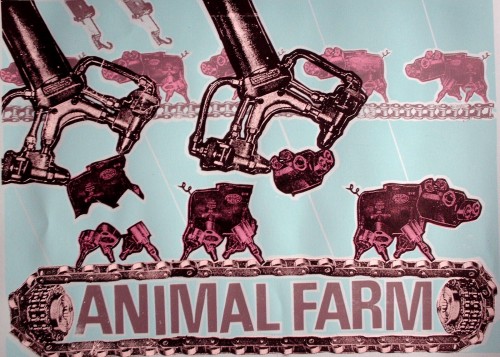
Post-humus porker

The Enviropig, the freakin franken porker that should only be a cartoon character, appears to be close to government approval, a Canwest News Service reported on Friday and confirmed here.

"The technology is simple, if you know how to raise pigs, you know how to raise Enviropigs!"
uh...depends on how ya raise a pig.
I'd compost that phosphorousy manure, feed the crops - let the oinkers have a bit of grass even.
But Enviropig is engineered to shit minimal phosphorous so the waste can get flushed (and not pollute waterways). Factory farming steps out of the circle of the farm.

From a 1999 Globe story on the lab chops: "After they get a handle on phosphorus, the scientists want to take a look at nitrogen, the other major pollutant found in pig manure and the one associated with its rank odour."

This kind of treason to our farm animal genome meets with so little pause, alarm or resistance because there are too many other distractions: wars, earthquakes, famine, olympics. We have no ethical roadmaps drawn out for the designers of our food. We as consumers and farmers need to start excercising our rights to choose what we eat.
The pig might help us do it. Who wants to eat it? 10-30% of Canadians? That isn't enough stakeholder to excite profits to the lifescience pioneers.


artist Nathan Meltz


A perfect factory pig is no surprise and has been talked about for awhile now. Water pollution and stink are the sticky bits in public interfaces and so the genes spliced in Ecopig are logical. But what else are they up to? Monsanto lurks in the wings and has patents on pigs. With declining numbers of small farms and pig breeds fewer and further between, the road ahead could look like porkicide.

Have we lost the right to eat food as god/goddess/motherearth made it, or shall we ride this ugly piggy to the courts before it goes to market?

We need to mobilize and take to the Supreme Court, the right to choose what we eat (labeling) as a matter of conscience and religion.

February 7, 2010

Sungayka

When I was 11 or 12, in the early 70s, a dozen kids and I blocked a rough road in the woods, it was our special place. Excavators and dump trucks were pushing up a new subdivision. Although we had found burial mounds in "our woods", the knowledge that this place was the ancient (4,000 year) home of the Samas people (Songhees- Chekonein) wasn't the motivation for our activism. It was an indignity to nature and our sweet experience of it that had us dragging boulders and logs to voice our injury . It is 40 years later, and a narrow forest corridor is all that is left of "our woods". There is no such courtesy for the village of Sungayka, for which this woods was adjacent. The longhouses, the peninsular fortification, the house posts...all obliterated. Whilst a treaty intended a corridor (a means to access culture and place), the agreement was lost in the imperialist moments, a beach hotel was built for the amusement of Victorians, and the place was eviscerated, subdivided and overlain with new cultures. The Hudson Bay put in a large farm above. A people of long sustenance on a piece of land disappeared, no photo exists, no marker reminds.

The new peoples of Cadboro Bay don't seem live with an ecosystem, but on or over it. It is now hundred sailboats, cement playground creatures, a bustling University corner village. A starbucks. The beach and sea, the eroding stones, the middens in the gardens, the sacred pool, the cultural stones in foundations and walls are underfoot everywhere.

The ancient village site at Cadboro Bay will be surveyed as required by the Chekonein treaty, somehow, eventually. Until the treaty (one of the Douglas treaties) is honoured or compensation for its violation is agreed upon, all those occupying territory in Cadboro Bay are advised to note and honour the features a careful walk can reveal.

Sustainable cultures that lived here before

I've been returning to my roots, family and the ecosystems of my youth and facing the connections and significance my past has to my life right now.

One of my favorite place of old is a remarkable spit with a gary oak and arbutus hook and a grassy trombolo on Saltspring Island called Walker's Hook. It is an ancient Salish sacred village Syuhe'mun, whose significance was trounced 5 years ago with the leasing of the (private) land to a Sablefish (black cod) "farm".

The trombolo drains the effluent from the fish farm above and pushes through an estimated 700 ancestors of Kuper Island Penelakut. The excavation for wells and pipes dug up 13 skeletons.

In my new home, on a lower oxbow of the Annapolis river, the Mi'kmaq, the black loyalists and former slaves, and the Acadians have been almost completely erased from the physical and cultural landscape.

The inhabitants of Africville who were removed from their community received an apology today and the land to rebuild a church and cultural center. This is a good beginning toward reconciliation to the Black loyalist settlers and descendants of Nova Scotia's first slaves. It comes in a week there is some discourse on the racism that surfaces on a regular basis for people of colour (and diversity in general) among some "long" rooted people (ancestors of the British/Scottish, planters and loyalists settlers) In the Black Heritage month it has erupted again with a cross burning on a multiracial couple's lawn in the Windsor area.

I believe it is essential to recognize the history of slavery, expulsion and genocide of this place in Nova Scotia. Without wide eyed open reconciliation, racism has a place to root. I am reflecting on how best to acknowledge, honour and celebrate Acadian and Mi'kmaq and black settler presence in my neighbourhood in the lower Annapolis River. Whether this cultural renewel can be aided by writing, archeology, memorial stones and fences, multi racial immigration , I'm unsure. What can I do to remember the people who lived gently on the land ...is a question I have to ask.