Brrr. Its cold and windy and wet. The cows are bellowing to go out to pasture but I am reluctant to open up the gate; the ground is soft and they'll sink, slip and break the sod up into an unruly mess. They'll have to be patient in their paddock with their barn and last year's hay.
There are mice and wire worms making haste with the lettuce I transplanted into a hoophouse bed. Now its an empty row with little lettuce bits the mouse was too sloppy or full to finish. The beets in the same bed have been nibbled, I see... but the mouse prefers the brunia lettuce.
The beds I've planted in the field are swollen and heavy, the seeds sit in the cold and wet soil, their genes waiting for that warm signal.
We are all waiting for a warm signal.
I might just be the hobo poet on the road before long, if the mice. the wet and the wind keep it up.
April 23, 2009

April 22, 2009
how can I not find room for potatoes

After moving the huge pile of compost closer to the garden (and turning it in the process) and pushing over the new mountain of compost from the wintered cows, I have found a new spot for vegies -now I have room for potatoes. I can control them a little easier in new ground (weeds). I may be too late to locate really interesting varieties, we'll see, but I have grown an eclectic assortment of spuds, from rosy to bumpy to blue.
There is an excellent photo essay of potato varieties that have come out of the exceptional garden at subsistence patterns food garden. Check it out.
April 21, 2009
Resistant weeds; opportunity in a crisis

pigweed
Nature has found a way past the deadly toxin associated with round-up, and from a plant with great diversity and dominance - pigweed has come out in full glory. Its an amazingly hardy plant and some can set 10,000 seeds. Horseweed/Canada fleabane is another resistant weed.
The superweeds are so bad some places they have had to hire hand weeders, or abandon land! And 2-4-D is being used... mixed with round-up, another deadly chemical cocktail. Great.
Monsanto knew that the round-up/gene trait gig would only last so long: it is a short sighted scheme. I can imagine and hope that farmers of GE crops are now furious, file suit and tumble the giant.
Resistance was predicted by scientist and activist alike - a super weed community explosion was inevitable.
Now what? More chemicals, this time deadlier.
We'll be back to good rotations, covercrops and mechanical weeding equipment, as well as small and labour intensive community and urban gardens eventually...why not stimulate that now.
the France24 article: Superweed Explosion threaten monsanto heartland
Stop Terminator/Suicide Seeds - Support the Bill to Ban them!
From C-Ban
Bill to Ban Terminator Re-introduced! Ask the Prime Minister to support Bill C-353 "Terminator Seed Ban Act"
Send an instant email http://www.cban.ca/terminatoraction
--- See below for a full list of actions you can take.
What is Terminator? Terminator Technology genetically engineers plants to produce sterile seeds at harvest. It was developed by the multinational seed/agrochemical industry and the US government to prevent farmers from re-planting harvested seed and force farmers to buy seed each season instead. Terminator seeds have not yet been field-tested or commercialized. In 2006, Monsanto bought the company (Delta & Pine Land) that owned Terminator. Terminator is sometimes called Genetic Use Restriction Technology (GURTs) - the broad term that refers to the use of an external chemical inducer to control the expression of a plant’s genetic traits.
Member of Parliament Alex Atamanenko (NDP) has reintroduced his Private Members Bill (C-343) to ban the release, sale, importation and use of Terminator technology.
Actions you can take:
1. Send an instant email at http://www.cban.ca/terminatoraction
2. Organizations can endorse the call for a ban: go to http://www.banterminator.org/endorse
3. Write a personalized letter. Remember: postage is free to your elected officials! You can use your postal code to search for your MP athttp://www.parl.gc.ca (Note: The New Democratic Party and the Bloc Québécois already support a Ban on Terminator in Canada.) For more information see http://www.cban.ca/terminator
4. Distribute Ban Terminator postcards in your community! To order postcards email btpostcards@usc-canada.org
5. Donate to support the campaign - the Canadian Biotechnology Action Network implements the Canadian strategy of the International Ban Terminator Campaign http://www.cban.ca/donate
6. Sign up to Ban Terminator news http://www.banterminator.org/subscribe
For more information: http://www.cban.ca/terminator or http://www.banterminator.org
Bill to Ban Terminator Re-introduced! Ask the Prime Minister to support Bill C-353 "Terminator Seed Ban Act"
Send an instant email http://www.cban.ca/terminatoraction
--- See below for a full list of actions you can take.
What is Terminator? Terminator Technology genetically engineers plants to produce sterile seeds at harvest. It was developed by the multinational seed/agrochemical industry and the US government to prevent farmers from re-planting harvested seed and force farmers to buy seed each season instead. Terminator seeds have not yet been field-tested or commercialized. In 2006, Monsanto bought the company (Delta & Pine Land) that owned Terminator. Terminator is sometimes called Genetic Use Restriction Technology (GURTs) - the broad term that refers to the use of an external chemical inducer to control the expression of a plant’s genetic traits.
Member of Parliament Alex Atamanenko (NDP) has reintroduced his Private Members Bill (C-343) to ban the release, sale, importation and use of Terminator technology.
Actions you can take:
1. Send an instant email at http://www.cban.ca/terminatoraction
2. Organizations can endorse the call for a ban: go to http://www.banterminator.org/endorse
3. Write a personalized letter. Remember: postage is free to your elected officials! You can use your postal code to search for your MP athttp://www.parl.gc.ca (Note: The New Democratic Party and the Bloc Québécois already support a Ban on Terminator in Canada.) For more information see http://www.cban.ca/terminator
4. Distribute Ban Terminator postcards in your community! To order postcards email btpostcards@usc-canada.org
5. Donate to support the campaign - the Canadian Biotechnology Action Network implements the Canadian strategy of the International Ban Terminator Campaign http://www.cban.ca/donate
6. Sign up to Ban Terminator news http://www.banterminator.org/subscribe
For more information: http://www.cban.ca/terminator or http://www.banterminator.org
compost and row cover

Gorgeous warm weather enabled me to get in and till over the fall rye in the garden and start spreading the compost. Last fall a neighbour gave me her huge pile of year old horse manure which took 14 truck loads to bring home! After turning twice it shrunk again to a 1/3 its size and its now beautiful, black, complex and sweet smelling.
The soil here is really silty, and I'm happy to provide organic matter in many ways: 3 cover crops (2 times buckwheat and fall rye, my neighbours nice compost, and soon my new compost from the cows bedding, manure,garden scraps, house compost and the remains of the cow's old, now moldy, turnips; I should be able to use this next compost for later plantings.
I planted the drier beds where the rye has dissicated and raked off the live rye clumps in the way of my seeder. I have an earthway seeder with some extra plates. Having 2 small seed plates saves some thinning. I like to beet/chard plates as well as this seed size is quite variable. I like to have one with every other hole duck taped off. I will cover some of the new beds with row cover: salad, salad turnip, and radish (tri-colour) when the wind dies down, but aye, its cold and blustery today. If you have ever tried to lay a 12 foot foot row of remay (row cover) down over 3 beds, in the wind, single-handed, you will know why I shall not attempt it.
Years ago, on my old farm, I was coming home from the market in the delivery truck, I saw our farm and its 15 acre vegetable fields below. There was a nasty wind with the little wild twisters and it had picked up the end of a sheet of remay and swung it up 50 feet into the air and was tugging for more. My partner was racing around in the tractor, its loader full of rocks, while wwoofers struggled to lay the sheet back down over tender, trampled, remay whipped salad.
Better wait for a calm day.
In this wind, I am glad to have the seeds in a little furrow and the soil to be a wee bit course. I have seen the remay rub out the seedlings in fine, silty dry soil.
Remay warms things about a degree or 3 and keeps insects like flea beetle, carrot fly, cabbage maggot fly, etc, off the plant.
pics coming.
One of the myths about Haiti
Myth
Haitians caused the floods and mudslides because they deforested the hillside for charcol.
"Over the centuries, the colonial powers cleared millions of acres of virgin tropical forests to make room for coffee, and millions more were degraded by erosion, damage to waterways and other secondary effects of production. In heavily deforested Haiti, about 80 percent of the loss of tree cover came from coffee production..." source and cacao, sugarcane and mango.
Some comparisons that indicate the difference in colonial and socialist care of its culture.
Average life expectancy cuba 76/80, Haiti 56/59
Average number of children per mother cuba 1.5, Haiti 3.7
Maternal deaths per 100,000 live births: cuba 45 , Haiti 670
Infant deaths per 1,000 births: cuba 7, Haiti 80
Adults HIV/Aids rate: cuba 0.1%, Haiti 3.8%
Doctors per 1,000 head of population: cuba 5.9, Haiti 0.3
Adult literacy rate: cuba 99.8% Haiti 52.9%
Unemployment rate: cuba 1.8%, Haiti 66%
Infant deaths per 1,000 births: 80
HIV/Aids rate: 3.8%
Doctors per 1,000 head of population: 0.3
Adult literacy rate: 52.9% (m 54.8%/f 51.2%)
Economic outlook: Not encouraging. After some slow progress, riots were sparked in 2008 by food price rises. UN officials admit Haiti is facing a job creation crisis, and depends on remittances and aid.
Main industries: Sugar refining, flour milling, textiles, cement, light manufacturing
Key crops/livestock: Coffee, mangoes, sugarcane, rice, corn, sorghum
Key exports: Clothing, oils, cocoa, mangoes, coffee
GDP: £2,541m (131st)
GDP per head: £269
Unemployment rate: 66% without formal jobs
Proportion of global carbon emissions: 0.01%
Haitians caused the floods and mudslides because they deforested the hillside for charcol.
"Over the centuries, the colonial powers cleared millions of acres of virgin tropical forests to make room for coffee, and millions more were degraded by erosion, damage to waterways and other secondary effects of production. In heavily deforested Haiti, about 80 percent of the loss of tree cover came from coffee production..." source and cacao, sugarcane and mango.
Some comparisons that indicate the difference in colonial and socialist care of its culture.
Average life expectancy cuba 76/80, Haiti 56/59
Average number of children per mother cuba 1.5, Haiti 3.7
Maternal deaths per 100,000 live births: cuba 45 , Haiti 670
Infant deaths per 1,000 births: cuba 7, Haiti 80
Adults HIV/Aids rate: cuba 0.1%, Haiti 3.8%
Doctors per 1,000 head of population: cuba 5.9, Haiti 0.3
Adult literacy rate: cuba 99.8% Haiti 52.9%
Unemployment rate: cuba 1.8%, Haiti 66%
Infant deaths per 1,000 births: 80
HIV/Aids rate: 3.8%
Doctors per 1,000 head of population: 0.3
Adult literacy rate: 52.9% (m 54.8%/f 51.2%)
Economic outlook: Not encouraging. After some slow progress, riots were sparked in 2008 by food price rises. UN officials admit Haiti is facing a job creation crisis, and depends on remittances and aid.
Main industries: Sugar refining, flour milling, textiles, cement, light manufacturing
Key crops/livestock: Coffee, mangoes, sugarcane, rice, corn, sorghum
Key exports: Clothing, oils, cocoa, mangoes, coffee
GDP: £2,541m (131st)
GDP per head: £269
Unemployment rate: 66% without formal jobs
Proportion of global carbon emissions: 0.01%
the old tangled kitchen garden
The robins are back, preening themselves up on the power line and poking around for worms in my house garden, the kitchen garden: the old multi-layered archaeological site around the house, where generations of people have grown food, buried scraps, and lost trinkets. which unearth with my fork as I shake loose couch grass root and loosen up soil.
When I moved here in May last year, I had my hands full with plowing and cover cropping the soil, which was old sod, for this year's garden; dozens of other projects (new waterline, repairing old rooves, fencing for the cows, etc) kept me from much work in the kitchen garden. Having a season to observe whats happening in a very old, ovegrown garden is a good thing; there are many treasures there like four variety of grapes, including a very tasty, small, rosy coloured mystery, which have propagated themselves copiously. There are egyptian onions, iris, chives, oregano, lavender, spearmint and gooseberries and a catoniaster that has entwined itself with loganberry in a into a huge tight ball of tangle. Raspberries have forged ahead everywhere, as has queen Anne's lace and yarrow.
I've pruned the grapes well back and am rebuilding the trellis. I composted and mulched, clipped, cleaned and mowed the 20 by 8' intof raspberries into semblances of order. Its raining today after three days of sunshine and its a good day to untangle the catonia-disaster.
I did manage to lay compost down in a third of my new garden (about an acre) and planted: mizuna, tatsoi and arugula, tri-coloured radish, japanese salad turnip and spinach. Beets and ruby chard are up in a bed in the hoophouse. I'll post pictures and write about my main garden later today.
When I moved here in May last year, I had my hands full with plowing and cover cropping the soil, which was old sod, for this year's garden; dozens of other projects (new waterline, repairing old rooves, fencing for the cows, etc) kept me from much work in the kitchen garden. Having a season to observe whats happening in a very old, ovegrown garden is a good thing; there are many treasures there like four variety of grapes, including a very tasty, small, rosy coloured mystery, which have propagated themselves copiously. There are egyptian onions, iris, chives, oregano, lavender, spearmint and gooseberries and a catoniaster that has entwined itself with loganberry in a into a huge tight ball of tangle. Raspberries have forged ahead everywhere, as has queen Anne's lace and yarrow.
I've pruned the grapes well back and am rebuilding the trellis. I composted and mulched, clipped, cleaned and mowed the 20 by 8' intof raspberries into semblances of order. Its raining today after three days of sunshine and its a good day to untangle the catonia-disaster.
I did manage to lay compost down in a third of my new garden (about an acre) and planted: mizuna, tatsoi and arugula, tri-coloured radish, japanese salad turnip and spinach. Beets and ruby chard are up in a bed in the hoophouse. I'll post pictures and write about my main garden later today.
April 17, 2009
Ecuador opens door to terminator seeds?
I'm exhausted from the day's work but this makes me take note...a thing worth precious vigilence.
ETC Group press release, April 17:
Terminating Food Sovereignty in Ecuador?
President opens door to Terminator seeds
On February 18, 2009, the Ecuadorian Congress approved a new Law on Food Sovereignty, which, among other important points, declared the country “free of transgenic crops and seeds.” However, in spite of vocal popular opposition, the legislation left the door open to approvals of genetically modified organisms (GMOs) in “exceptional” cases. Now, President Rafael Correa has proposed several changes to the legislation – in what is known in Ecuador as a partial-veto – and sent it back to the Congress. The president's changes dangerously weaken the law and open the door to Terminator seeds.
read more
ETC Group press release, April 17:
Terminating Food Sovereignty in Ecuador?
President opens door to Terminator seeds
On February 18, 2009, the Ecuadorian Congress approved a new Law on Food Sovereignty, which, among other important points, declared the country “free of transgenic crops and seeds.” However, in spite of vocal popular opposition, the legislation left the door open to approvals of genetically modified organisms (GMOs) in “exceptional” cases. Now, President Rafael Correa has proposed several changes to the legislation – in what is known in Ecuador as a partial-veto – and sent it back to the Congress. The president's changes dangerously weaken the law and open the door to Terminator seeds.
read more
April 16, 2009
Farmers march for pig genes
Deutsche welle
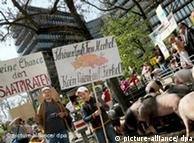
"German farmers have marched on the offices of the European Patent Office to block a patent application connected to the genes of their prized livestock
In a rare show of solidarity, German farmers and environmentalists staged a protest to block a genetic patent application from getting the green light. The patent would protect the breeding of pigs that possess a naturally occurring gene linked to rapid growth.
Some 400 protesters parked tractors and herded pigs outside the European Patent Office in the German city of Munich on Wednesday. They also filed an appeal seeking to overturn a 2005 patent application (Patent EP 1651777) filed by US biotech giant Monsanto, and now owned by Newsham Choice Genetics".
Read more.
Watch the video Patent for a Pig.
"German farmers have marched on the offices of the European Patent Office to block a patent application connected to the genes of their prized livestock
In a rare show of solidarity, German farmers and environmentalists staged a protest to block a genetic patent application from getting the green light. The patent would protect the breeding of pigs that possess a naturally occurring gene linked to rapid growth.
Some 400 protesters parked tractors and herded pigs outside the European Patent Office in the German city of Munich on Wednesday. They also filed an appeal seeking to overturn a 2005 patent application (Patent EP 1651777) filed by US biotech giant Monsanto, and now owned by Newsham Choice Genetics".
Read more.
Watch the video Patent for a Pig.
April 15, 2009
bt corn banned in Germany
From a great site for gmo news Planet Diversity
Monsanto Uprooted: Germany bans cultivation of MON810 GM corn
Germany has banned the cultivation of GM corn, claiming that MON 810 is dangerous for the environment. But that argument might not stand up in court and Berlin could face fines totalling millions of euros if American multinational Monsanto decides to challenge the prohibition on its seed. The sowing season may be just around the corner, but this year German farmers will not be planting gentically modified crops: German Agriculture Minister Ilse Aigner announced Tuesday she was banning the cultivation of GM corn in Germany.
Monsanto Uprooted: Germany bans cultivation of MON810 GM corn
Germany has banned the cultivation of GM corn, claiming that MON 810 is dangerous for the environment. But that argument might not stand up in court and Berlin could face fines totalling millions of euros if American multinational Monsanto decides to challenge the prohibition on its seed. The sowing season may be just around the corner, but this year German farmers will not be planting gentically modified crops: German Agriculture Minister Ilse Aigner announced Tuesday she was banning the cultivation of GM corn in Germany.
April 14, 2009
degradation ....take new root!
Stephen McFadden at The Call of the Land, has a post that is symbiotic to the current theme and comments, here on agrariangrrl - its nasty out there but we don't have to start from scratch and we are and will be the food pheonix rising! Great models and systems already exist, in this case urban gardens - I saw this so magnificiently when I was in Cuba.
"The existing and emerging agrarian models are oases of environmental health and stability. They bear potential to radiate out widely across the land as they are emulated, improved upon, and refined into networks.
Stories about these keystone agrarian models continue to appear in US and Canadian media, as well as internationally. These are not just good ideas and projects, they are essential."
Check his great post, As land and climate degrade, urban farms take root
Now I'm off to work on my great food sovereignty project (shovel in hand today to help move along water, clear drain pipes and think about new ditches.
"The existing and emerging agrarian models are oases of environmental health and stability. They bear potential to radiate out widely across the land as they are emulated, improved upon, and refined into networks.
Stories about these keystone agrarian models continue to appear in US and Canadian media, as well as internationally. These are not just good ideas and projects, they are essential."
Check his great post, As land and climate degrade, urban farms take root
Now I'm off to work on my great food sovereignty project (shovel in hand today to help move along water, clear drain pipes and think about new ditches.
Anne and Eric Nordell

Photo from New Rodale Institiute : A truley regenerative farming
These people are my hereos:
"Beech Grove Farm is located on 90 acres in north-central Pennsylvania. The Nordells
operate their diversifi ed vegetable farm using their own hands and four draft
horses. They grow the bulk of their cash crops on a well drained six-acre fi eld that
is divided into a dozen half-acre lots. At any one time in the growing season,
half the cropping area is in cash crops and the other half is fallow. A field of springplanted crops next has a year of fallow,
then summer-planted crops. On the fallow sections, they use two cover crops and
a bare fallow to control weeds. With this rotation sequence, they build their soil and eliminate weeds."
From Attra:
A Whole Farm Approach to Managing Weeds in Onions,
Eric and Anne Nordell’s Beech Grove Farm, Pennsylvania:
April 13, 2009
A Farm for the Future
This is a pretty amazing film. I found it at the Post Carbon Institute
"Filmmaker Rebecca Hosking investigates how to transform her family's farm in Devon (U.K.) into a low-energy farm for the future. This video features excerpts from an interview with Post Carbon Senior Fellow Richard Heinberg".
One of Heinberg's quotes " Our energy dependence is equivalent to 22 billion slaves".
I`ll be looking forward to a part 2 of this in a few years time: I sure hope there is one, and that feeding people is one of the top 3 achievements: carbon neutrality and ecological health, being the other 2.
Permaculture gardens and tree farms are lovely and if one is lucky enough to have the land to feed yourself, is the best way to do that ecologically - But they can't feed the biilions on the planet, unless complete global redistribution of land, infastructure costs and somehow skill aquision is transfered to 10 - 50% of the population. I don`t see that happening before the real food-fuel crises. Permaculture takes long, laborious, minimal return, years of work and money (trees/shrubs are not cheap) to get established. While many incredible examples of permaculture design thrive, very few can feed more than a few families. Harvesting is particulary laborious. Most people could not afford to farm like this.
I believe plowing has a place in food production and but it can be reduced to once in a long while with long rotations, cover crops and diversity, with pastures brought into the rotation with grains and vegetables. This does requires power.
I think its folly to dismiss the horse. I`d suggest finding Eric and Anne Nordell`s excellent series of articles in the Small Farmers Journal on sustainable large market horse gardening. You`ll have to buy the back issues, but you can, and you won`t be disapointed!
As well there are electric tractors, conversions and new ones and I think they deserve far more attention.

On market gardens a biodiesel walk behind tractors may be an option for transition if materials are available for making the fuel locally without competeing for food or land resources (waste grease, for e.g.)
In Canada we have a lot of large beef farms too and the acreage for is vast and the hay making energy intensive, as is the grain production that goes into fattening up the steers at feedlots. I propose the government purchase these large acreages, close to towns and cities across the country and redistribute this land in 5 - 100 acre lots (depending upon the farming proposal) to farming potentates. We`ll need organic agriculture departments not threatened with closure, and mentoring with farmers and, yes, permaculture designers.
you have a 500 acre farm endowed with hedgerows and woodlot, a small scale intensive agriculture could thrive - each independent, yet interconnected. Trade becomes real goods - use of my horses to plow in exchange for grazing on the harvested market garden...or I grow you mangles and you give me the wool. What a lovely world!
But it won;t come to that until....it comes to that (when there are no more desk jobs, or waitress or call centers. We`d have to give people land, say title is earned after proving production of so much food with said amount of carbon debt.
That is what I think Rebecca Hosking should do to transform her family's farm in Devon into a low-energy farm for the future. Bring in the community of people it would take to do just that.
"Filmmaker Rebecca Hosking investigates how to transform her family's farm in Devon (U.K.) into a low-energy farm for the future. This video features excerpts from an interview with Post Carbon Senior Fellow Richard Heinberg".
One of Heinberg's quotes " Our energy dependence is equivalent to 22 billion slaves".
I`ll be looking forward to a part 2 of this in a few years time: I sure hope there is one, and that feeding people is one of the top 3 achievements: carbon neutrality and ecological health, being the other 2.
Permaculture gardens and tree farms are lovely and if one is lucky enough to have the land to feed yourself, is the best way to do that ecologically - But they can't feed the biilions on the planet, unless complete global redistribution of land, infastructure costs and somehow skill aquision is transfered to 10 - 50% of the population. I don`t see that happening before the real food-fuel crises. Permaculture takes long, laborious, minimal return, years of work and money (trees/shrubs are not cheap) to get established. While many incredible examples of permaculture design thrive, very few can feed more than a few families. Harvesting is particulary laborious. Most people could not afford to farm like this.
I believe plowing has a place in food production and but it can be reduced to once in a long while with long rotations, cover crops and diversity, with pastures brought into the rotation with grains and vegetables. This does requires power.
I think its folly to dismiss the horse. I`d suggest finding Eric and Anne Nordell`s excellent series of articles in the Small Farmers Journal on sustainable large market horse gardening. You`ll have to buy the back issues, but you can, and you won`t be disapointed!
As well there are electric tractors, conversions and new ones and I think they deserve far more attention.
On market gardens a biodiesel walk behind tractors may be an option for transition if materials are available for making the fuel locally without competeing for food or land resources (waste grease, for e.g.)
In Canada we have a lot of large beef farms too and the acreage for is vast and the hay making energy intensive, as is the grain production that goes into fattening up the steers at feedlots. I propose the government purchase these large acreages, close to towns and cities across the country and redistribute this land in 5 - 100 acre lots (depending upon the farming proposal) to farming potentates. We`ll need organic agriculture departments not threatened with closure, and mentoring with farmers and, yes, permaculture designers.
you have a 500 acre farm endowed with hedgerows and woodlot, a small scale intensive agriculture could thrive - each independent, yet interconnected. Trade becomes real goods - use of my horses to plow in exchange for grazing on the harvested market garden...or I grow you mangles and you give me the wool. What a lovely world!
But it won;t come to that until....it comes to that (when there are no more desk jobs, or waitress or call centers. We`d have to give people land, say title is earned after proving production of so much food with said amount of carbon debt.
That is what I think Rebecca Hosking should do to transform her family's farm in Devon into a low-energy farm for the future. Bring in the community of people it would take to do just that.
April 12, 2009
Snowing at Easter; but not in the hoophouse

The wind is howling and gusting from several directions, throwing a wet mess of snow every which way. A red soup in low spots and green vivid patches of grass through the snow is my walk to the barn.
The cows are closed up in the barn because Alex has a cold. And its nasty out there.
My hoophouse is full of tomatoes, peepers and basil among the other cooler weather seedling that can handle the cold. It is closed up tight too.
but the warm stuff is tucked under row cover and is on top of the manure pits I sunk in a few spots in the center of the house.

They survived last night's cold.

Here are some tomatoes and basil I was midway through transplanting.

Lettuce starts surviving

Here is lovely combination that seems to thrive together. Now I need to prick them out!

Subscribe to:
Posts (Atom)