Showing posts with label my farm. Show all posts
Showing posts with label my farm. Show all posts
December 11, 2011
North Mountain woods
The mountain to the north of the farm has lost most of its autumn leaves. The orange clad hunters have abandoned the woods so it is safe to venture in. We go up looking for the fire and orbital agate veins that sudden chunks along leaf choked streams tease up. Or black crystal magnetite that sticks to a magnet and will get you lost as the compass needle swings a jig. The deer are still hiding out, but there are grouse and white rabbits and wild apples rotting in hidden vales. The walks and a few good books by the fire distract me from the work left undone, which can wait till spring; the fields are tucked in with a flush of fall rye, the garlic is rooted and the chickens are in the freezer. It has been my strategy since living in Nova Scotia to leave the farm to enjoy rest and perspective for the winter (while working in some remote camp). This year we will brave the Atlantic storms in this old house that my sweetheart has made into a warm and exciting home, Joy and gratitude spring up every day at the miracle of love in its beautifully unexpected permutations. I found an old lapidary unit, a gem maker of unknown vintage but solid character, and I am learning to cut the magical stones that cross my path, find pleasing patterns and grind out their potential. I have ground out a fingernail or two in the learning curve and have found a strategy for not getting soaked in an icy cold shop. The colours of the north mountain woods are in the stones whose patterns swirl and fuse some ancient stories that I am humbled by and hope to be present for with fingers intact. The stonework is a welcome transition from the laborious and often thankless work of market gardening to a creative process that while a new unexplored medium, feels like a comfortable old friend

December 9, 2011
Prayer for Snow

let our weary bodies rest
let it snow deep and long
have the north wind give her best
whirl and sweep an icy song
with us in warm and grateful lifts
reflect upon three fruitful seasons
with bluegrass lullabies in time to drifts
larders full and no laborious reasons
to rise or strain or bend or task
just dance that amber dormant glow
until the earth warms and lifts the wintry mask
oh please just please let it snow
January 22, 2011
local sweet potatoes from the peanut man
Under deep hay in the insulated pumphouse in my big barn back home is a treasure of sweet potatoes that I grew last year. They are massive, well coloured and delicious and have been growing in the valley for over 30 years. This is how I found them:
I stopped for smokes at a small store in a town down the valley last spring and an aged man with big dirty hands and a cheeky grin was hanging out the front. He looked me up and down and asked me "do you want to see my peanuts". The word was incongruous and I wasn't sure I heard him right, so I excused myself to hear again that indeed it was "peanuts" he wanted to show me (the "T" was obscured in his valley accent) I wavered a moment and then agreed, because he was ancient I guess, and off we went behind the store to a series of small sheds. He insisted I come in, as there was a double door and he didn't want his "peanuts" to get cold. His cheeky grin became diabolical. It was then I noticed the sweet potato slips in pots under lights through a grimy window and I went in with him. Hundreds of peanuts green and a smaller number of sweet potato slips. He has been growing peanuts in the Annapolis Valley for over 70 years, having started them in a school science project and planting them thereafter faithfully every year. The sweet potatoes he had started from tubers he found at a store 30 years ago and it was these massive beauties that interested me. I left laden with a dozen slips. I hope he is still around, because for sure I will be going to see his peanuts this spring. And if the mice or rot have got my sweet spuds lets hope his dirty hands and cheeky grin are still preserving something special indeed.
I stopped for smokes at a small store in a town down the valley last spring and an aged man with big dirty hands and a cheeky grin was hanging out the front. He looked me up and down and asked me "do you want to see my peanuts". The word was incongruous and I wasn't sure I heard him right, so I excused myself to hear again that indeed it was "peanuts" he wanted to show me (the "T" was obscured in his valley accent) I wavered a moment and then agreed, because he was ancient I guess, and off we went behind the store to a series of small sheds. He insisted I come in, as there was a double door and he didn't want his "peanuts" to get cold. His cheeky grin became diabolical. It was then I noticed the sweet potato slips in pots under lights through a grimy window and I went in with him. Hundreds of peanuts green and a smaller number of sweet potato slips. He has been growing peanuts in the Annapolis Valley for over 70 years, having started them in a school science project and planting them thereafter faithfully every year. The sweet potatoes he had started from tubers he found at a store 30 years ago and it was these massive beauties that interested me. I left laden with a dozen slips. I hope he is still around, because for sure I will be going to see his peanuts this spring. And if the mice or rot have got my sweet spuds lets hope his dirty hands and cheeky grin are still preserving something special indeed.
November 11, 2010
traces of the past
"I haven’t seen that much of the world honestly, but from what I have seen, this area strikes me as being particularly beautiful but also haunted by its history. History that most of us are completely ignorant of – including the expulsion of the Acadians, the Micmac who were pushed out of parts of the Annapolis Valley, and the history of slavery, since the Planters brought slaves with them from New England and Rhode Island and South Carolina and that needs to be thought through or remembered. So, there’s a lot there. That landscape, as beautiful as it may seem to the naked, untrained eye, is also a landscape which hides and shrouds an awful lot of, in some cases, very negative history. And in fact, I find that one of the most compelling aspects of the Valley, in that, here again is this great beautiful landscape, but behind it or beneath it, is this incredible history of sometimes great pain and tragedy"
George Elliott Clarke, from an 2001 interview in the Gaspereau Press

I live on the lower Annapolis River. The oxbows and river inlets are still discernable on the river that was called the Dolphine then, and apart from the odd unfortunate whale nothing gets past the tidal generating station at the mouth of the river at Annapolis Royal. Click on the map from the early 1700s of the Acadian villages on the lower river. The oxbow where my old farm lies is between the names Broussard and Beaulieu, just up river from the Chapel of St. Laurent.
Joseph Broussard dit Beausoleil probably grew up near here, learning Mi'kmaq, growing food, hunting, discovering and modifying the lay of a land where battles raged. Bloody creek is just up river. Beau Pre is directly across from this Oxbow. A burial ground exists on the old paper deeds but a road now goes over it, and a subdivision's common area overlays the bones which are unmarked except for marsh grass, wild plum, apple and giant ancient oak.
And then there is Beaulieu! It appears that the only record of the Acadian Beaulieu is Louis Fontaine dit Beaulieu. He was married to Mary Magdelene Roy who was Mi'kmaq and possibly African, her father being La Liberte Roy a free man born in St. Malo, on the Cape Sable census in 1681 (La Liberte la neigre) and later Port Royal.
Who were they? How did they live? Why have they been erased from the cultural and (almost from the) physical landscape on the lower oxbows of the river? Was it their interracial cooperation that threatened? Or the gentle sustainable interaction with the landscape? Or their independence? Cultural genocide is a story told in oaks with ancient limbs, in old stone wells, and pathes past old foundations to citrine laced streams. The story is yet told, waiting to get past the dam of cultural bias.
George Elliott Clarke, from an 2001 interview in the Gaspereau Press
I live on the lower Annapolis River. The oxbows and river inlets are still discernable on the river that was called the Dolphine then, and apart from the odd unfortunate whale nothing gets past the tidal generating station at the mouth of the river at Annapolis Royal. Click on the map from the early 1700s of the Acadian villages on the lower river. The oxbow where my old farm lies is between the names Broussard and Beaulieu, just up river from the Chapel of St. Laurent.
Joseph Broussard dit Beausoleil probably grew up near here, learning Mi'kmaq, growing food, hunting, discovering and modifying the lay of a land where battles raged. Bloody creek is just up river. Beau Pre is directly across from this Oxbow. A burial ground exists on the old paper deeds but a road now goes over it, and a subdivision's common area overlays the bones which are unmarked except for marsh grass, wild plum, apple and giant ancient oak.
And then there is Beaulieu! It appears that the only record of the Acadian Beaulieu is Louis Fontaine dit Beaulieu. He was married to Mary Magdelene Roy who was Mi'kmaq and possibly African, her father being La Liberte Roy a free man born in St. Malo, on the Cape Sable census in 1681 (La Liberte la neigre) and later Port Royal.
Who were they? How did they live? Why have they been erased from the cultural and (almost from the) physical landscape on the lower oxbows of the river? Was it their interracial cooperation that threatened? Or the gentle sustainable interaction with the landscape? Or their independence? Cultural genocide is a story told in oaks with ancient limbs, in old stone wells, and pathes past old foundations to citrine laced streams. The story is yet told, waiting to get past the dam of cultural bias.
July 3, 2010
a good market...
I love a good market. The crowd is full on and happy, the sun is shining and the plump lush piles of vegetables disappear in record time. After the rush I set back up quickly, in those sweet slower intervals, when conversation is possible. Until its inundation again: the pyramid of bagged peas and fluffy basil, the romaine towers, the glistening organized carrots...everything attacked lovingly and whisked away leaving a tablecloth to cover in bounty again. Then that last lonely dill bunch or radicchio hit the road and the wallet is plump. Tuck away the cash box, tidy up all the empty lugs, and go visit with happy people.
June 16, 2010
Lilbuddy Macteeth gets a flock
I picked up four orphan lambs day before yesterday, almost weaned but I found an old goat to keep them company and provide a bit of refreshment. When they are done I'll have a bit of milk for my tea and possibly collect up enough to make cheese, which I haven't done for a very long time. Giving the lambs a bit of diluted milk twice a day is building intimacy between the lambs, the goat and I but Lilbuddy was nowhere to be seen this morning for chores. He hit the wire yesterday and I think he associates that pain with those creatures. This evening he joined us, trembling, then barking then whimpering as I milked the goat and fed the lambs. I think he understands we all belong and the little farm is a full circle now that we have some critters again.
Here they are!


Here they are!


June 11, 2010
remay tales
I had a tragic comedy here last night on the farm involving remay, or agricultural fabric...for non-gardeners that is a lightweight woven fabric that covers crop to prevent insect from landing and feasting or spreading disease and is an organic farmer's standby for salad greens and other sensitive things (carrots if rust fly is troublesome, for eg). It also speeds growth.
The remay on my old farm came in the long roll of 500 feet and we had these length of beds. One day coming home from market I witnessed a small wind tunnel that had grabbed an end and sucked it high (100 feet) into the air. I had a good view on the road above the valley where the fields lay as the tractor with loader full of rocks raced to the scene and helpers jumped and ran and tugged to get the long white sheet out of the wee tornado and constrained from whipping out the wee seedings.
Wind plays havoc here too, but have yet to see a tornado (just hurricane remnants), and yesterday's show was just my own damn fault: I was in hurry, it was late and I hungry and little Buddy was barking at the birds down in the creek - poised for trouble. It was time for dinner and the evening dog excursion...but I had one last task to do and I was rushing. I had weeded all day and the last task task was to till up the old salad and spinach beds to free up some space to plant. The garden is getting tight now for the tractor, so I eased into position, let down the tiller and set the pto in gear. I was focused on steering my old rig clear of the dill and beets in the beds on either side of the wheels, but I misjudged where the tiller dropped - I caught the remay end of the adjacent bed. I didn't notice for a good 20 feet. It had yanked the fabric off the turnips, lifting the little roots with it and rolled up neat on the shaft of the tiller. Amazing it rolled up clean and even and only tore where the tines ripped it the first few turns.
The turnips (Hakurai japanese salad)were ready to pick and were surprisingly undamaged. Buddy had to wait whilst I cussed and laughed and unrolled remay from the tiller (and then dealt with the turnips). On retrospect designing a tool that winds up a roll could be inspired here. Ditto with harvesting.
The remay on my old farm came in the long roll of 500 feet and we had these length of beds. One day coming home from market I witnessed a small wind tunnel that had grabbed an end and sucked it high (100 feet) into the air. I had a good view on the road above the valley where the fields lay as the tractor with loader full of rocks raced to the scene and helpers jumped and ran and tugged to get the long white sheet out of the wee tornado and constrained from whipping out the wee seedings.
Wind plays havoc here too, but have yet to see a tornado (just hurricane remnants), and yesterday's show was just my own damn fault: I was in hurry, it was late and I hungry and little Buddy was barking at the birds down in the creek - poised for trouble. It was time for dinner and the evening dog excursion...but I had one last task to do and I was rushing. I had weeded all day and the last task task was to till up the old salad and spinach beds to free up some space to plant. The garden is getting tight now for the tractor, so I eased into position, let down the tiller and set the pto in gear. I was focused on steering my old rig clear of the dill and beets in the beds on either side of the wheels, but I misjudged where the tiller dropped - I caught the remay end of the adjacent bed. I didn't notice for a good 20 feet. It had yanked the fabric off the turnips, lifting the little roots with it and rolled up neat on the shaft of the tiller. Amazing it rolled up clean and even and only tore where the tines ripped it the first few turns.
The turnips (Hakurai japanese salad)were ready to pick and were surprisingly undamaged. Buddy had to wait whilst I cussed and laughed and unrolled remay from the tiller (and then dealt with the turnips). On retrospect designing a tool that winds up a roll could be inspired here. Ditto with harvesting.
June 2, 2010
farmers are old
I can no longer think of my self as an exception: the young farmer! I am now part of the depressing statistic - farmers are old
See also The Greying of Farmers
I'm 50 tomorrow; Its neither old nor young but it is a half century.
My get cold quick feet may be the harbinger of a slow accumulation of creaks and complaints. I see the suffering of others I know and love and wonder when and if it will change. Can I slog on until....its sustainable bodily, socially.
Irony is, these pockets of fertility and bounty dotted everywhere in rural Canada seem to be ever more hitting the button of "safe haven" for local communities come some immanent disaster, market collapse, corporate crop failures, etc.
Its the wisdom of the land's perspective that keep these ancients hugged close, hanging on for dear life to these small farms knowing it will inevitably, tragically have to change.
See also The Greying of Farmers
I'm 50 tomorrow; Its neither old nor young but it is a half century.
My get cold quick feet may be the harbinger of a slow accumulation of creaks and complaints. I see the suffering of others I know and love and wonder when and if it will change. Can I slog on until....its sustainable bodily, socially.
Irony is, these pockets of fertility and bounty dotted everywhere in rural Canada seem to be ever more hitting the button of "safe haven" for local communities come some immanent disaster, market collapse, corporate crop failures, etc.
Its the wisdom of the land's perspective that keep these ancients hugged close, hanging on for dear life to these small farms knowing it will inevitably, tragically have to change.
May 28, 2010
"sheet" compost
I've got two styles of compost going this year, one of which I've never done and I'm excited by it.
My compost is the heart of the farm, in a lovely interface between the plants and animals and soil organisms; potent elements come together and weave me nostalgic and at ease...perhaps its the beneficial organisms and the atmospheres they create.
Anyway, I pile layers of materials intuiting balances of texture, nitrogen, carbon, moisture and I turn it with the bucket of my tractor every so ofte...it gets hot and turns a lovely black.

This year I decided to use some of my neighbours free horse manure and am sheet composting down the center of a new field that is in buckwheat and oats (not interplanted). I layered manure, sawdust from a woodworking friend's shop and ditch muck which was beside this new field. Let it sit and I confess, ran the rototiller to incorporate the material. I guess its not true sheet composting. I may incorporate it when I disk in the buckwheat( the oats I hope to harvest) but its tempting to plant bush squash in it now and indeed I may do that.

My compost is the heart of the farm, in a lovely interface between the plants and animals and soil organisms; potent elements come together and weave me nostalgic and at ease...perhaps its the beneficial organisms and the atmospheres they create.
Anyway, I pile layers of materials intuiting balances of texture, nitrogen, carbon, moisture and I turn it with the bucket of my tractor every so ofte...it gets hot and turns a lovely black.

This year I decided to use some of my neighbours free horse manure and am sheet composting down the center of a new field that is in buckwheat and oats (not interplanted). I layered manure, sawdust from a woodworking friend's shop and ditch muck which was beside this new field. Let it sit and I confess, ran the rototiller to incorporate the material. I guess its not true sheet composting. I may incorporate it when I disk in the buckwheat( the oats I hope to harvest) but its tempting to plant bush squash in it now and indeed I may do that.
May 27, 2010
Spring farm photos


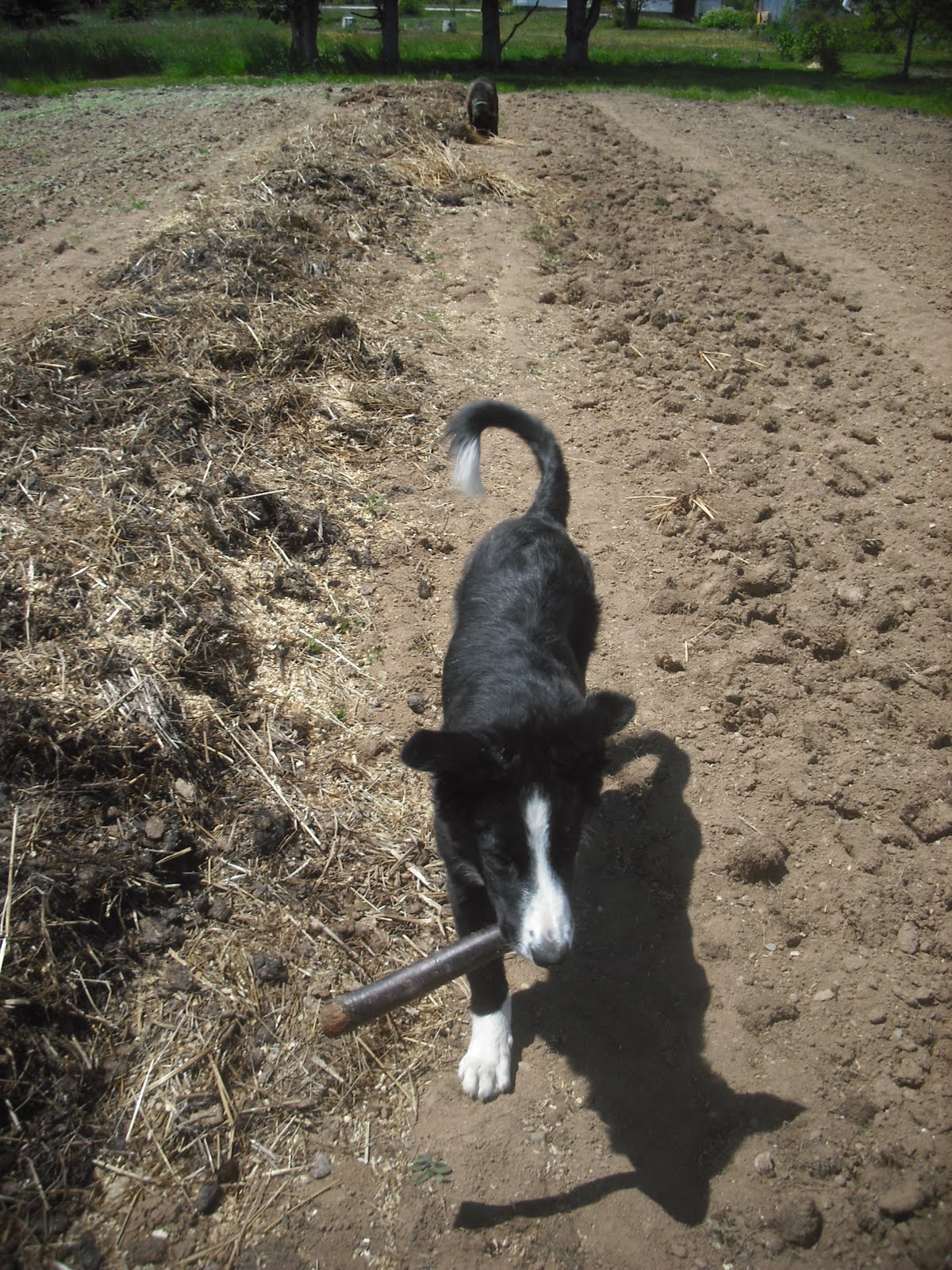
Lil bud shaking dirt off the grass clods, peas in background.

he has lots of sticks to choose from as I have a scrap fence in progress


Notice Bud's skill on path walking, here garlic and onions sets visible, seeds just up. Jumping over beds is still a work in progress as exemplified below (broad beans).


Click the pic to enlarge the spinach, salads, turnip and radish under the row cover.


the early starts are out and transplanted from the hoophouse and its now planted to basil.
March 25, 2010
Budley
The lil Bud won't sit still for an honest pic,,,I'll see if I can improve on these today and capture some visuals of this (after the rain came, now frozen, windy but the sun is out) buddin place.


March 19, 2010
small men big women: gloves!
Is it just me or is it pretty hard to find good work gloves for these big woman hands? I expect its a small man's size too. The small brands are minuscule; the medium are ridiculously roomy. The inbetween, the regular, they are hard to come by.
October 20, 2009
Thinking about fencing

archaeological evidence of ancient woven willow
My garden needs a fence. Its a matter of privacy, wind break and particle block as a major road and a snoopy neighbour invade upon my sense of bucholic. I have planted some trees (pines, poplar) but I have decided to put up a fence as well to hasten my peace of mind.
I built a fence on my last farm in the Kootenays with the curvaceous cedar slabs dripping bark, that the mill was going to burn, and dropped off to the farm for free. I wove them when they were wet between sturdier pieces of cedar that came in the load. It was funky and each panel was different. It was free with the exception of the posts, which in the Kootenays were 4 bucks each.
I built a woven willow fence this spring that really looks beautiful...but the maintenance and weed control needed for a stretch along the road next to my garden is far to long; woven willow there is too much work for me to take on.
I'm going to build a wattlish fence. I was inspired by the Acadian fence I saw at the village in Pubnico to keep in chickens. My friend down the road has a hundred acre wood and is open to trades....there is plenty of wood to thin and I love that work. I daydream about this fence, how I will weave, add windows and sculpt features along the length of her. A tall wattle fence that will become apart of the living shelterbelt as the trees grow in time. It will need to be anchored with substantial posts to carry the weight of the wattle with our winds, and have enough room for the wind to whistle through. It will have plenty of surface for honeysuckle, sweet peas, climbing curcurbit and the likes.
October 10, 2009
a.g. update
I am still in Edmonton waiting for my job to start on Monday, staying with an elderly woman who grew up on a farm in Scotland and who has laboured since a young woman on ships, trains and camps as a cook for the boys. I am the nextgen female resource cook for the winter, staying with her between postings up North; I have been here 2 winters before. Her home is an oasis of sustenance, laughter and canine furred friends for dispossessed across this country...farmers and natives and "foreign" workers who pound the pavement briefly in this boomtown. She is a toughened survivor on the exterior and a frightened little girl elsewhere as the effects of dementia play mischief. Her life is a miracle.
My garden back home is producing salads galore which my friends are harvesting for market. Its hard at this moment to really miss the frost bitten hands in the early morning fall dew. I've donned a groovy jacket and have burrowed in the library, coffee house or dance floor these days and am having those gloriously serendipitous city adventures- when I'm not homemaking with the darling Scottish lass. I'm hoping she'll come back with me to the farm come springtime, when the energies for such awesome work reinvigorates. Perhaps she will sow some miracles there.
My garden back home is producing salads galore which my friends are harvesting for market. Its hard at this moment to really miss the frost bitten hands in the early morning fall dew. I've donned a groovy jacket and have burrowed in the library, coffee house or dance floor these days and am having those gloriously serendipitous city adventures- when I'm not homemaking with the darling Scottish lass. I'm hoping she'll come back with me to the farm come springtime, when the energies for such awesome work reinvigorates. Perhaps she will sow some miracles there.
September 21, 2009
grateful for good beef and the life they lived
I went to the slaughterhouse today to pick up the offals from my dear cows, whose carcasses are now hanging in a meat cooler and today I cut up livers and hearts and delivered to those willing and able to eat such essential parts of the animal. I have a big pot of stock from the tails; Jigs the dog is happy this afternoon.
When I went into the office at the slaughterhouse, the receptionist said "the meat inspector wants to talk with you"
"...uh oh", I thought!
When I called him and he proceded to tell me what fine animals they were and what a good job I done on the finishing, how the meat was marbled so nicely. When I told him they were on pasture and finished on pears, carrots and garden "weeds" (plantain, clover) he was a little taken back. "No GE corn that's the secret", I said. I wanted to tell him they had been happy cattle.
It was sad to see them off and there were tears in the truck driving down the road away from the farm, the 2 bulls and their young Moms, my comrades in the circle of the farm. It was their first and last ride in a trailer. It is not my experience to slaughter 2 year old cows, but their ligaments were prone to tearing and I'm leaving for the winter for work, so it is an expedient and lucrative choice - We are going to sell most of the meat in Halifax.
I am making good head way on my TO DO list, but I ran out of garlic and need to locate more to finish my bed. The barn is cleaned out so the truck and tractor can be locked up, and I have rye growing in almost half the garden with more in today.
There is lots of food for my neighbours to pick (they are doing the market) especially salad and cabbage. I'll get some pics up before I fly out on Friday.
When I went into the office at the slaughterhouse, the receptionist said "the meat inspector wants to talk with you"
"...uh oh", I thought!
When I called him and he proceded to tell me what fine animals they were and what a good job I done on the finishing, how the meat was marbled so nicely. When I told him they were on pasture and finished on pears, carrots and garden "weeds" (plantain, clover) he was a little taken back. "No GE corn that's the secret", I said. I wanted to tell him they had been happy cattle.
It was sad to see them off and there were tears in the truck driving down the road away from the farm, the 2 bulls and their young Moms, my comrades in the circle of the farm. It was their first and last ride in a trailer. It is not my experience to slaughter 2 year old cows, but their ligaments were prone to tearing and I'm leaving for the winter for work, so it is an expedient and lucrative choice - We are going to sell most of the meat in Halifax.
I am making good head way on my TO DO list, but I ran out of garlic and need to locate more to finish my bed. The barn is cleaned out so the truck and tractor can be locked up, and I have rye growing in almost half the garden with more in today.
There is lots of food for my neighbours to pick (they are doing the market) especially salad and cabbage. I'll get some pics up before I fly out on Friday.
September 12, 2009
My last market today
I have some fabulous salad for the fall markets, carrots, leeks and cabbage too and a mess of this and that. I have passed over the last of the harvests and the market to neighbours in exchange for their attention to the last of the fall jobs: the plastic down, the water off, some more fall rye. I am soon to be unbound from the farm - for the winter. Is it possible?
The TO DO list before I go is daunting but I'm fiesty for it: tuck in a few more beds with fall rye and dare to plant garlic this early, see the first of the cows off and organize delivery into designated freezers. There is also a big hole that water seeps into the basement, and I have the cement mixer out.... and there is a cat to find a home for. Jigs, the boxer bulldog, which was given to me 3 monthes ago (to intimidate the greenhouse thief - she's too cute for that) is going to a friend, and I'll be able to get her back when I return in Febuary. I'm glad for that.
I said goodbye to my great customers today, it was a little sad, to be leaving before thanksgiving, but overall I'm excitement for the adventure. I need to get out, pass on the work like a baton in a endurance race. I need perspective. I don't want to do this alone. I am grateful for folks willing and able to step up to cooperate this fall.
I'll share more of the details later...but my adventure involve a train, dancing, visiting loved ones... and finally (after the feet out and about... a job. Just for the winter mind you because I'm already excited about next year's garden and what can happen there.
The TO DO list before I go is daunting but I'm fiesty for it: tuck in a few more beds with fall rye and dare to plant garlic this early, see the first of the cows off and organize delivery into designated freezers. There is also a big hole that water seeps into the basement, and I have the cement mixer out.... and there is a cat to find a home for. Jigs, the boxer bulldog, which was given to me 3 monthes ago (to intimidate the greenhouse thief - she's too cute for that) is going to a friend, and I'll be able to get her back when I return in Febuary. I'm glad for that.
I said goodbye to my great customers today, it was a little sad, to be leaving before thanksgiving, but overall I'm excitement for the adventure. I need to get out, pass on the work like a baton in a endurance race. I need perspective. I don't want to do this alone. I am grateful for folks willing and able to step up to cooperate this fall.
I'll share more of the details later...but my adventure involve a train, dancing, visiting loved ones... and finally (after the feet out and about... a job. Just for the winter mind you because I'm already excited about next year's garden and what can happen there.
September 1, 2009
Bon Adventure, here for now
Somehow the realities of smallholder community-based sustainable farming, that struggle, that anomaly - the thing that urban ethical types champion sporadically, some suck off of, and many obliterate with consumption choices...is (almost) too complexly bizarre for my pen these days.
Sometimes the irony is beyond belief..the facts spin like fiction and I feel naked looking at the specter of how local farming is composing and the choices some find necessary to survive.
a) serve the elite; obama arugula salad.
b) grow maryjane in the bushes on the side
c) resale conventional fare or otherwise cheat and fraud
d) be miserably poor somehow independent of the banks toiling to finger bone until old and sick and then sell the farm, or whats left of it.
e) be lucky/connected/entertaining and or compelling enough to become a celebrity farmer
f) join the designate, nextgen agribiz style, selling your soul to the banks and the multi-nationals to pilot self-regulated, dangerous, wildwest style agri future.
While we watch:
a) complacent people not standing up to stop imports flooding markets at local food intervals.
b) consumers not question the value of labour and the notion of "fair trade" in the local sense.
c) the educated stop listening about GE, Nanotech and Synthetic Biology in our world and notable in our food.
d) popular culture accept class and designate those working the soil as the lowest, along with other honourable professions such as early childhod care.
e) regulators and their lobby discredit and silence open dialogue concerning the status quo (including organic regulators).
f) our colleagues farms threatened by damns, droughts, fires, trade dumping orgies, marketing boards, burn-out and or poverty.
etc
I'm in my garden, tending salad, harvesting for market, preparing slaughter of cattle, looking for winter work and dumbfounded at the work necessary for that. I'm gettin it done. But I'm also watching out for toads and observing the history around me. The unmarked, mysterious buriel ground next door, that is marked on a deed but lost to time and land activities, the black cemetary next door (loyalist free folks or slaves?) the village of Beaulieu close somewhere and the home of Beausoeil, and ancient further the Maritime Archaic; Its the fabulous history that picks me up this time, grounds me. I think then of sacred things and it helps me carry on.
Take care, stay strong; and have a bon adventure!
Blessings to the farmers
Sometimes the irony is beyond belief..the facts spin like fiction and I feel naked looking at the specter of how local farming is composing and the choices some find necessary to survive.
a) serve the elite; obama arugula salad.
b) grow maryjane in the bushes on the side
c) resale conventional fare or otherwise cheat and fraud
d) be miserably poor somehow independent of the banks toiling to finger bone until old and sick and then sell the farm, or whats left of it.
e) be lucky/connected/entertaining and or compelling enough to become a celebrity farmer
f) join the designate, nextgen agribiz style, selling your soul to the banks and the multi-nationals to pilot self-regulated, dangerous, wildwest style agri future.
While we watch:
a) complacent people not standing up to stop imports flooding markets at local food intervals.
b) consumers not question the value of labour and the notion of "fair trade" in the local sense.
c) the educated stop listening about GE, Nanotech and Synthetic Biology in our world and notable in our food.
d) popular culture accept class and designate those working the soil as the lowest, along with other honourable professions such as early childhod care.
e) regulators and their lobby discredit and silence open dialogue concerning the status quo (including organic regulators).
f) our colleagues farms threatened by damns, droughts, fires, trade dumping orgies, marketing boards, burn-out and or poverty.
etc
I'm in my garden, tending salad, harvesting for market, preparing slaughter of cattle, looking for winter work and dumbfounded at the work necessary for that. I'm gettin it done. But I'm also watching out for toads and observing the history around me. The unmarked, mysterious buriel ground next door, that is marked on a deed but lost to time and land activities, the black cemetary next door (loyalist free folks or slaves?) the village of Beaulieu close somewhere and the home of Beausoeil, and ancient further the Maritime Archaic; Its the fabulous history that picks me up this time, grounds me. I think then of sacred things and it helps me carry on.
Take care, stay strong; and have a bon adventure!
Blessings to the farmers
August 16, 2009
farm update
The fog has been substantial in the mornings these days, obscuring the red sun rise, and the grass is soaked from atmospheric moisture; the soil is bone dry and the fog burns off by 10:00. My peas are drying on the old brown vines, as I have left the last pick for seed and a few pots of soup peas for the winter. I've left some favorite lettuce to seed as well.
The markets have been fabulous - I'm still going to town twice a week, and although the curcurbit crops are pathetic (cucumber beetle) and cabbage crops very slow I've had very good yield and variety from my new 1 1/2 acre garden for a receptive crowd. I have lineups for my salad, and the tomatoes are the best I have ever grown. The calves are catching up in size to their Moms. I'll get some photos up of the farm soon.
The late summer automatic butt-drag has set in some- the list of fall jobs start niggling at my full late august days. I look forward to the tucking in of the garden and splitting firewood. "A change is as good as a rest" but today I'm taking to the woods and lake.
The markets have been fabulous - I'm still going to town twice a week, and although the curcurbit crops are pathetic (cucumber beetle) and cabbage crops very slow I've had very good yield and variety from my new 1 1/2 acre garden for a receptive crowd. I have lineups for my salad, and the tomatoes are the best I have ever grown. The calves are catching up in size to their Moms. I'll get some photos up of the farm soon.
The late summer automatic butt-drag has set in some- the list of fall jobs start niggling at my full late august days. I look forward to the tucking in of the garden and splitting firewood. "A change is as good as a rest" but today I'm taking to the woods and lake.
July 27, 2009
a day off on the farm

I took a day off today- the first in several weeks. I restrung my guitar, sat by the river, painted a picture and took some photos, some of which I share with you here.

I have two markets to pick for, several CSA customers, the cows to move around a limited pasture, hay to get in... and we've had more rain than a duck would appreciate. So it was very good to catch my breath and look up at the very beautiful place in which I live.
There were indeed many agrarians, and gatherers here previously on this land and I can sense the hands that came before me.

And this history gives me courage to carry on.


Tomorrow, its back to it: picking for the wednesday market, seeding more salad and stuff now that the the rain has held off for a couple of days.
Ah but it was good to have a day off.
July 12, 2009
hoof prints in the soft soil

I spent a few hours shoring up the pasture fencing, putting up a third wire on the electric fence and whacking down tall grasses weakening the charge, because these little fellows have been exiting their green fields to frollic and munch in the lusher patch - ie my market garden. They let themselves out and back in a few times now.
Subscribe to:
Posts (Atom)