December 22, 2010
The Common Interest vs Big Ag
Consulting with the people for a roadmap to sustainable development; this is what all the fuss is over.
"We’ve been saying for years that the United States government is joined at the hip with Monsanto and pushing GMOs as part of Monsanto’s agenda on the rest of the world. This lays bare the mechanics of that effort. We have Craig Stapleton, the former ambassador to France, specifically asking the U.S. government to retaliate and cause some harm throughout the European Union."
Jeffery Smith in Democracy Now interview
From the Wikileak cable
Subject: France and the WTO AG BIOTECT CASE
1. (C) Summary: Mission Paris recommends that that the USG reinforce
our negotiating position with the EU on agricultural biotechnology by
publishing a retaliation list when the extend "Reasonable Time
Period" expires. In our view, Europe is moving backwards not
forwards on this issue with France playing a leading role, along with
Austria, Italy and even the Commission. In France, the "Grenelle"
environment process is being implemented to circumvent science-based
decisions in favor of an assessment of the "common interest."
Combined with the precautionary principle, this is a precedent with
implications far beyond MON-810 BT corn cultivation. Moving to
retaliation will make clear that the current path has real costs to
EU interests and could help strengthen European pro-biotech voices.
In fact, the pro-biotech side in France -- including within the farm
union -- have told us retaliation is the only way to begin to begin
to turn this issue in France. End Summary.
More

November 30, 2010
Can't argue with this apple?

photo of the cisgenic apple from: Researcher bites into forbidden fruit
Also see here for background story
A central theme of biotech public relations is, in their words to " placate the misinformed public opinion by using clever technologies to circumvent traditional unfounded criticisms of biotechnology."
Enter Cisgenics, where the industry contends that
" most of their (the public's) weak arguments are disabled via these techniques. Unfortunately, the end product is the same, maybe even less effective, than if traditional transgenic approaches were used, and it takes a lot more time and money to make it happen.
This is just one example of how scientists are cleverly working around warped public perception problems to solve real issues, and enhance sustainable production. Cisgenics will be at least a stop-gap solution in the European Union until public education and perception refocus real problems in sustainable agriculture. For now, the practices of cisgenics may be the central means of introducing traits to plants that can benefit the consumer and environment without the lengthy breeding process, and most of all without raising the ire of those that seek to stop transgenic technology.".
quoted from cisgenics-transgenics without the transgene
November 15, 2010
symbiosis in the garden

I love growing covercrops, and have experimented with several over the years. I like to interplant clover in tomatoes and peppers, and have grown asparagus in a permaculture system with dutch clover. I have used field peas and austrian winter peas in a mix with oats for a summer green manure, but apart from those examples, I have not been very adventurous with legumous cover crops.
Rhizobium bacteria live in the cells of legume root nodules of and are estimated to carry out 50-70% of the world's biological nitrogen fixation.
"The nodulation process is a series of events in which rhizobia interact with the roots of legume plants to form a specialised structure called a root nodule.
The process involves complicated signals between the bacteria and the roots. In the first stages, the bacteria multiply near the root and then adhere to it. Next, the small hairs on the root's surface curl around the bacteria and they enter the root. Alternatively, the bacteria may enter directly through points on the root surface. The method of entry of the bacteria into the root depends on the type of plant. Once inside the root, the bacteria multiply within thin threads. Signals stimulate cell multiplication of both the plant's cells and the bacteria and this repeated division results in a mass of root cells containing many bacterial cells. Some of these bacteria then change into a form that is able to convert gaseous nitrogen into ammonium nitrogen (that is, they can "fix" nitrogen). These bacteria are then called bacteroids." source
In return, the microbes get high-energy carbohydrates produced by photosynthesis in the host plant. There are different species of rhizobia and they are associated with different plants: the soil bacteria that is a symbiont of clover is different than the species engaged with lupines, for example.
I have many nitrogen fixers growing wild in the pasture, and expect that soil conditions for these are better suited for my soil and climate conditions; there is vetch, red clover, white clovers and lupine for example, but no alfalfa. I expect that because these plants are thriving there is a healthy community of the soil bacteria that each of these plants require to provide the symbiotic relationship necessary to fix nitrogen in the plant. I value these natural precedents and try to take my cue from the pasture ecosystem in my garden.
Blue Lupin is good plant for nitrogen, phosphorus and deep soil
penetration. It is a very good at extracting and concentrating minerals in the soil so when the plant material decomposes it made available for the next generation of plants. Hairy and common vetch are excellent for nitrogen fixation, although they won't produce as much biomass as clover,so seeding with a mix of rye or oats will add this bulk.
White dutch clover, once established provides an excellent hardy cover for paths in the garden and will withstand foot and even tractor traffic down the beds.
Here are some great resources
Organic Ag Center; Green Manure Options
Attra Overview of Cover Crops and Green Manures
November 11, 2010
traces of the past
"I haven’t seen that much of the world honestly, but from what I have seen, this area strikes me as being particularly beautiful but also haunted by its history. History that most of us are completely ignorant of – including the expulsion of the Acadians, the Micmac who were pushed out of parts of the Annapolis Valley, and the history of slavery, since the Planters brought slaves with them from New England and Rhode Island and South Carolina and that needs to be thought through or remembered. So, there’s a lot there. That landscape, as beautiful as it may seem to the naked, untrained eye, is also a landscape which hides and shrouds an awful lot of, in some cases, very negative history. And in fact, I find that one of the most compelling aspects of the Valley, in that, here again is this great beautiful landscape, but behind it or beneath it, is this incredible history of sometimes great pain and tragedy"
George Elliott Clarke, from an 2001 interview in the Gaspereau Press

I live on the lower Annapolis River. The oxbows and river inlets are still discernable on the river that was called the Dolphine then, and apart from the odd unfortunate whale nothing gets past the tidal generating station at the mouth of the river at Annapolis Royal. Click on the map from the early 1700s of the Acadian villages on the lower river. The oxbow where my old farm lies is between the names Broussard and Beaulieu, just up river from the Chapel of St. Laurent.
Joseph Broussard dit Beausoleil probably grew up near here, learning Mi'kmaq, growing food, hunting, discovering and modifying the lay of a land where battles raged. Bloody creek is just up river. Beau Pre is directly across from this Oxbow. A burial ground exists on the old paper deeds but a road now goes over it, and a subdivision's common area overlays the bones which are unmarked except for marsh grass, wild plum, apple and giant ancient oak.
And then there is Beaulieu! It appears that the only record of the Acadian Beaulieu is Louis Fontaine dit Beaulieu. He was married to Mary Magdelene Roy who was Mi'kmaq and possibly African, her father being La Liberte Roy a free man born in St. Malo, on the Cape Sable census in 1681 (La Liberte la neigre) and later Port Royal.
Who were they? How did they live? Why have they been erased from the cultural and (almost from the) physical landscape on the lower oxbows of the river? Was it their interracial cooperation that threatened? Or the gentle sustainable interaction with the landscape? Or their independence? Cultural genocide is a story told in oaks with ancient limbs, in old stone wells, and pathes past old foundations to citrine laced streams. The story is yet told, waiting to get past the dam of cultural bias.
George Elliott Clarke, from an 2001 interview in the Gaspereau Press
I live on the lower Annapolis River. The oxbows and river inlets are still discernable on the river that was called the Dolphine then, and apart from the odd unfortunate whale nothing gets past the tidal generating station at the mouth of the river at Annapolis Royal. Click on the map from the early 1700s of the Acadian villages on the lower river. The oxbow where my old farm lies is between the names Broussard and Beaulieu, just up river from the Chapel of St. Laurent.
Joseph Broussard dit Beausoleil probably grew up near here, learning Mi'kmaq, growing food, hunting, discovering and modifying the lay of a land where battles raged. Bloody creek is just up river. Beau Pre is directly across from this Oxbow. A burial ground exists on the old paper deeds but a road now goes over it, and a subdivision's common area overlays the bones which are unmarked except for marsh grass, wild plum, apple and giant ancient oak.
And then there is Beaulieu! It appears that the only record of the Acadian Beaulieu is Louis Fontaine dit Beaulieu. He was married to Mary Magdelene Roy who was Mi'kmaq and possibly African, her father being La Liberte Roy a free man born in St. Malo, on the Cape Sable census in 1681 (La Liberte la neigre) and later Port Royal.
Who were they? How did they live? Why have they been erased from the cultural and (almost from the) physical landscape on the lower oxbows of the river? Was it their interracial cooperation that threatened? Or the gentle sustainable interaction with the landscape? Or their independence? Cultural genocide is a story told in oaks with ancient limbs, in old stone wells, and pathes past old foundations to citrine laced streams. The story is yet told, waiting to get past the dam of cultural bias.
October 20, 2010
small and underreported
Project Censored top 25 underreported stories includes:
Nanotech Particles Pose Serious DNA Risks to Humans and the Environment
Story links to a number of studies indicating genetic damage caused by atom sized nanoparticles.
Nanotech Particles Pose Serious DNA Risks to Humans and the Environment
Story links to a number of studies indicating genetic damage caused by atom sized nanoparticles.
October 16, 2010
Yet another attempt to snuff out local food security
National Farmers Union Oct 14 Press Release:
Campaign Against Canada–EU Trade Agreement
SASKATOON, Sask.─ “Today, the National Farmers Union is launching a national
campaign against the threat to the democratic rights of farmers and citizens posed
by the proposed Canada – European Union (EU) Comprehensive Economic and
Trade Agreement (CETA). The NFU’s campaign objective is to inform farmers and
citizens of what is being bargained away, and to have the agreement scrapped”, said
Terry Boehm, President of the National Farmers Union.
The National Farmers Union obtained a draft of the secret text of the agreement this
spring. The fifth round of negotiations will occur in Ottawa next week, and the
Canadian Government has announced that it will ratify the deal in 2011. Canadians
are largely unaware of the agreement and what is being ceded to the demands of
the European Union. Canada has very little to gain in the agreement as European
Union tariffs average only 2%.
Canadian farmers will lose a great deal and be subject to draconian intellectual
property rights enforcement measures. CETA could virtually eliminate the age-old
practice of farmer’s saving, reusing, exchanging, and selling seed from their crops.
“Using farm saved seed could cost you and your farm. The farmer’s land,
equipment, and crops can be seized for an alleged infringement of intellectual
property rights attached to plant varieties owned by global seed corporations
such as Monsanto, Bayer and Syngenta”, said Boehm. “Canada’s dairy, poultry,
and egg supply management will also be at risk”, added Boehm.
“The National Farmers Union has joined social justice organizations to raise the
alarm over the inability, under CETA, of our elected governments to favour locally
procured goods and services. All levels of government including municipalities and
our cities will be prohibited from giving preference to local food and locally owned
businesses and services. Product and food safety will be at risk as Canadian
standards cannot exceed international technical standards. Imported products and
food cannot be inspected until after a problem has occurred. Canada must accept
any of the European Union’s 27 member countries’ certificates. If one province or
territory accepts a European Union product, all provinces and territories are banned
from refusing the product”, said Boehm.
One only has to look at the results of Canada’s slavish support of liberalized global
trade over the last twenty years, to see the results. Canada’s farmers have tripled
exports, but farm debt has tripled as well reaching $64 billion. Moreover, realized
net farm income from the markets has been negative since 2002.
“Today, the National Farmers Union calls on all farmers and citizens to stop this
march over the next cliff, by informing their elected officials at all levels, that the
losses under CETA, a global corporate bill of rights, will not be tolerated”, concluded
National Farmers Union President, Terry Boehm.
more
Campaign Against Canada–EU Trade Agreement
SASKATOON, Sask.─ “Today, the National Farmers Union is launching a national
campaign against the threat to the democratic rights of farmers and citizens posed
by the proposed Canada – European Union (EU) Comprehensive Economic and
Trade Agreement (CETA). The NFU’s campaign objective is to inform farmers and
citizens of what is being bargained away, and to have the agreement scrapped”, said
Terry Boehm, President of the National Farmers Union.
The National Farmers Union obtained a draft of the secret text of the agreement this
spring. The fifth round of negotiations will occur in Ottawa next week, and the
Canadian Government has announced that it will ratify the deal in 2011. Canadians
are largely unaware of the agreement and what is being ceded to the demands of
the European Union. Canada has very little to gain in the agreement as European
Union tariffs average only 2%.
Canadian farmers will lose a great deal and be subject to draconian intellectual
property rights enforcement measures. CETA could virtually eliminate the age-old
practice of farmer’s saving, reusing, exchanging, and selling seed from their crops.
“Using farm saved seed could cost you and your farm. The farmer’s land,
equipment, and crops can be seized for an alleged infringement of intellectual
property rights attached to plant varieties owned by global seed corporations
such as Monsanto, Bayer and Syngenta”, said Boehm. “Canada’s dairy, poultry,
and egg supply management will also be at risk”, added Boehm.
“The National Farmers Union has joined social justice organizations to raise the
alarm over the inability, under CETA, of our elected governments to favour locally
procured goods and services. All levels of government including municipalities and
our cities will be prohibited from giving preference to local food and locally owned
businesses and services. Product and food safety will be at risk as Canadian
standards cannot exceed international technical standards. Imported products and
food cannot be inspected until after a problem has occurred. Canada must accept
any of the European Union’s 27 member countries’ certificates. If one province or
territory accepts a European Union product, all provinces and territories are banned
from refusing the product”, said Boehm.
One only has to look at the results of Canada’s slavish support of liberalized global
trade over the last twenty years, to see the results. Canada’s farmers have tripled
exports, but farm debt has tripled as well reaching $64 billion. Moreover, realized
net farm income from the markets has been negative since 2002.
“Today, the National Farmers Union calls on all farmers and citizens to stop this
march over the next cliff, by informing their elected officials at all levels, that the
losses under CETA, a global corporate bill of rights, will not be tolerated”, concluded
National Farmers Union President, Terry Boehm.
more
September 29, 2010
Canadian Constitution Foundation champions food freedom

Karen Selick litigation director of the CCF
"Michael and I will be asking the court to rule that the Charter right to “life, liberty and security of the person” includes your right to make independent decisions about your health and the food you eat."
read more about this here and at Michael Schmidt's site the Bovine
Is my excitement justified in thinking this could be about a larger issue of food choice freedoms (labeling of cloned meat, transgenics), shall I get out the celebratory beverage?
dairy farmer's drink it
In a recent survey of 2,185 milk producers published in Preventive Veterinary Medicine, 88.7 per cent “reported that they or their families consume unpasteurized milk from their bulk milk tanks.”
here
here
September 24, 2010
More people weigh in on global agriculture
"I have now been 20 years in a multilateral organisation which tries to develop guidance and codes for good agricultural practice, but the real, true issues are not being addressed by the political process because of the influence of lobbyists, of the true powerful entities," said Dr Samuel Jutzi, a director of the United Nations' Food and Agriculture Organisation at a summit in London this week.
Here
Here
Mama comes on a Tractor

from Gallery of Chinese Propaganda Posters (1925-2006)
200 Highlights from the collections of the International Institute of Social History, Amsterdam, and Stefan R. Landsberger (University of Amsterdam, Leiden University).
here
U.S. getting more 'local" as a response to regulatory gap(ing holes) in nano regulation?
"the nanotechnology industry played a central role in driving states toward taking on nanotechnology oversight, because industry's principal stance on the issue has been to urge the federal government to "slow-walk" nanotechnology regulation. Denison presents examples of industry blocking or slowing down even modest proposals by the U.S. Environmental Protection Agency (EPA) to obtain better information about nanomaterials over the last several years, and how it continues to do so, even though no EPA action to date would actually regulate, or place any restriction on the production, or use of, any nanomaterial."
Richard Denison
Environmental Defense Fund.
Richard Denison
Environmental Defense Fund.
July 23, 2010
War Era Food Posters Exhibit
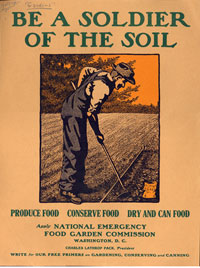
A fascinating exhibit of posters from the National Agricultural Library:
When Beans Were Bullets is available online with its physical version at the National Agricultural Library, Maryland, June 21 to August 30, 2010.
July 8, 2010
label genetically engineered food cause we are what we eat
In May of 2011 Codex meets in Quebec and labeling is still very alive on the table: "The federal policy on labelling foods derived from biotechnology remains under discussion with Canadians and international standards organizations such as Codex Alimentarius", Health Canada states. In fact at the Codex meeting this spring a significant Canadian retreat from the overt backing of the US position that GE food is substantially equivalent, was evident. No wonder ...its become clear that is both incorrect and only a piece of the problematic puzzle. We have 10 months to think about, talk, coalesce our strategies and ensure we get mandatory labeling of genetically engineered foods established next year in Canada.
Keep an eye on CBAN to help their ongoing campaign, which targets the pressuring of Health Canada.
But I think plural is best (strategieS) the debate must reach wider than the issues of toxicity and oontamination/transgene pollution to include the freedom of choice to live morally, a conscientious or religious objection.
It is amazing to me that this has never been challenged as a Charter issue, its not as if people aren't writing about it for eg. Could we mount a campaign that encompasses all of us who understand life has deep complexity, mystery, organization to engage in devotion and service to the sanctity of life one should be free to not eat transgenic, engineered food. Could we motivate spiritual communities to proclaim and demand that? the Council of Churches, Buddhist Sangas, Indigenous Councils, Muslim , Jew, Hindu, Pagan Urban dwellers and small lesbian farmers? I think so!
My brain today has been offering up quotes from sunday school lessons a very long time ago:
I am the bread of life
By the fruits shall ye know them
In the beginning was the Word, and the Word was with God, and the Word was God. It was in the beginning with God. All things were made through it and without it was not any thing made that was made.
Keep an eye on CBAN to help their ongoing campaign, which targets the pressuring of Health Canada.
But I think plural is best (strategieS) the debate must reach wider than the issues of toxicity and oontamination/transgene pollution to include the freedom of choice to live morally, a conscientious or religious objection.
It is amazing to me that this has never been challenged as a Charter issue, its not as if people aren't writing about it for eg. Could we mount a campaign that encompasses all of us who understand life has deep complexity, mystery, organization to engage in devotion and service to the sanctity of life one should be free to not eat transgenic, engineered food. Could we motivate spiritual communities to proclaim and demand that? the Council of Churches, Buddhist Sangas, Indigenous Councils, Muslim , Jew, Hindu, Pagan Urban dwellers and small lesbian farmers? I think so!
My brain today has been offering up quotes from sunday school lessons a very long time ago:
I am the bread of life
By the fruits shall ye know them
In the beginning was the Word, and the Word was with God, and the Word was God. It was in the beginning with God. All things were made through it and without it was not any thing made that was made.
Labeling GMOs closer: "Substantial Equivalence" faltering
From CBAN Press release
Canada & Codex: GM labeling – US Increasingly Isolated
May 12, 2010
Canada at the UN Codex meeting on GM food labeling: Negotiations continue, U.S. increasingly isolated
Your actions worked – again!
Thanks to your letters, the Canadian government delegation to the UN
Codex meeting last week did not boldly ally itself with the U.S.
position against GM food labeling. The U.S. failed in their attempts
to stop the negotiations.
The Canadian government did not speak up to support the nonsensical
position from the U.S. that GM foods are no different from foods
produced through conventional methods. Though not yet actively
supporting a positive position on GM labeling, Canada did not obstruct
the meeting and the U.S. was not able to put an end to the
negotiations. Out of the over 50 countries at the negotiations, the
U.S. was only supported in its position by Mexico, Costa Rica, and
Argentina.
Codex recommendations on GM labeling could protect developing
countries from challenges brought through the World Trade Organization.
The U.S. was trying to put an end to the UN Codex negotiations on GM
labeling but the negotiations will continue. There will be an
important Codex meeting in May 2011 in Quebec City – and we must
continue to pressure the Minister of Health. The Canadian
Biotechnology Action Network (CBAN) will continue to take action and
monitor this issue, as well as collaborate with U.S. groups. Please
see below from Consumers Union in the U.S.
For updates and more information: Cban
Canada & Codex: GM labeling – US Increasingly Isolated
May 12, 2010
Canada at the UN Codex meeting on GM food labeling: Negotiations continue, U.S. increasingly isolated
Your actions worked – again!
Thanks to your letters, the Canadian government delegation to the UN
Codex meeting last week did not boldly ally itself with the U.S.
position against GM food labeling. The U.S. failed in their attempts
to stop the negotiations.
The Canadian government did not speak up to support the nonsensical
position from the U.S. that GM foods are no different from foods
produced through conventional methods. Though not yet actively
supporting a positive position on GM labeling, Canada did not obstruct
the meeting and the U.S. was not able to put an end to the
negotiations. Out of the over 50 countries at the negotiations, the
U.S. was only supported in its position by Mexico, Costa Rica, and
Argentina.
Codex recommendations on GM labeling could protect developing
countries from challenges brought through the World Trade Organization.
The U.S. was trying to put an end to the UN Codex negotiations on GM
labeling but the negotiations will continue. There will be an
important Codex meeting in May 2011 in Quebec City – and we must
continue to pressure the Minister of Health. The Canadian
Biotechnology Action Network (CBAN) will continue to take action and
monitor this issue, as well as collaborate with U.S. groups. Please
see below from Consumers Union in the U.S.
For updates and more information: Cban
Subscribe to:
Posts (Atom)