March 25, 2010

Budley
The lil Bud won't sit still for an honest pic,,,I'll see if I can improve on these today and capture some visuals of this (after the rain came, now frozen, windy but the sun is out) buddin place.


March 22, 2010
reduced tillage and dryland farming
We've had no rain to speak of for a few weeks and word is it'll be a dry year; Eric and Anne Nordell have powerful and well developed tools to produce healthy soil and crops in dry conditions. Here is a good video that, although modeled with horses, could be applied to any power regime. Also worth watching to check out Eric's swell beard.
March 19, 2010
GE Seed controls
Time to act!
Because of our voices there is a chance Bill C-474 can pass: Next debate March 29!

Take Action on CBAN
Because of our voices there is a chance Bill C-474 can pass: Next debate March 29!
Take Action on CBAN
small men big women: gloves!
Is it just me or is it pretty hard to find good work gloves for these big woman hands? I expect its a small man's size too. The small brands are minuscule; the medium are ridiculously roomy. The inbetween, the regular, they are hard to come by.
February 25, 2010
Crop Mob
"The Crop Mob, a monthly word-of-mouth (and -Web) event in which landless farmers and the agricurious descend on a farm for an afternoon, has taken its traveling work party to 15 small, sustainable farms. Together, volunteers have contributed more than 2,000 person-hours, doing tasks like mulching, building greenhouses and pulling rocks out of fields".
Read about this spontainous happening in the New York Times. Great new word: agricurious!
Although the snow is still deep here and the wind biting, I'm always open for a crop mob.
Read about this spontainous happening in the New York Times. Great new word: agricurious!
Although the snow is still deep here and the wind biting, I'm always open for a crop mob.
February 22, 2010
Post-humus porker
The Enviropig, the freakin franken porker that should only be a cartoon character, appears to be close to government approval, a Canwest News Service reported on Friday and confirmed here.
"The technology is simple, if you know how to raise pigs, you know how to raise Enviropigs!"
uh...depends on how ya raise a pig.
I'd compost that phosphorousy manure, feed the crops - let the oinkers have a bit of grass even.
But Enviropig is engineered to shit minimal phosphorous so the waste can get flushed (and not pollute waterways). Factory farming steps out of the circle of the farm.
From a 1999 Globe story on the lab chops: "After they get a handle on phosphorus, the scientists want to take a look at nitrogen, the other major pollutant found in pig manure and the one associated with its rank odour."
This kind of treason to our farm animal genome meets with so little pause, alarm or resistance because there are too many other distractions: wars, earthquakes, famine, olympics. We have no ethical roadmaps drawn out for the designers of our food. We as consumers and farmers need to start excercising our rights to choose what we eat.
The pig might help us do it. Who wants to eat it? 10-30% of Canadians? That isn't enough stakeholder to excite profits to the lifescience pioneers.
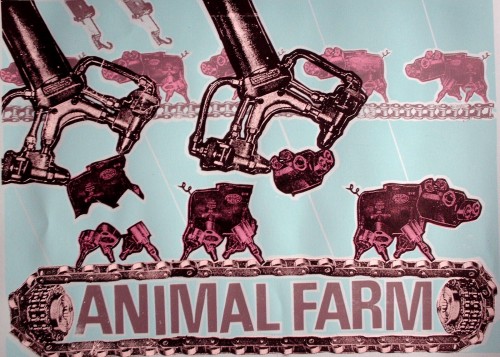
artist Nathan Meltz
A perfect factory pig is no surprise and has been talked about for awhile now. Water pollution and stink are the sticky bits in public interfaces and so the genes spliced in Ecopig are logical. But what else are they up to? Monsanto lurks in the wings and has patents on pigs. With declining numbers of small farms and pig breeds fewer and further between, the road ahead could look like porkicide.
Have we lost the right to eat food as god/goddess/motherearth made it, or shall we ride this ugly piggy to the courts before it goes to market?
We need to mobilize and take to the Supreme Court, the right to choose what we eat (labeling) as a matter of conscience and religion.
"The technology is simple, if you know how to raise pigs, you know how to raise Enviropigs!"
uh...depends on how ya raise a pig.
I'd compost that phosphorousy manure, feed the crops - let the oinkers have a bit of grass even.
But Enviropig is engineered to shit minimal phosphorous so the waste can get flushed (and not pollute waterways). Factory farming steps out of the circle of the farm.
From a 1999 Globe story on the lab chops: "After they get a handle on phosphorus, the scientists want to take a look at nitrogen, the other major pollutant found in pig manure and the one associated with its rank odour."
This kind of treason to our farm animal genome meets with so little pause, alarm or resistance because there are too many other distractions: wars, earthquakes, famine, olympics. We have no ethical roadmaps drawn out for the designers of our food. We as consumers and farmers need to start excercising our rights to choose what we eat.
The pig might help us do it. Who wants to eat it? 10-30% of Canadians? That isn't enough stakeholder to excite profits to the lifescience pioneers.
artist Nathan Meltz
A perfect factory pig is no surprise and has been talked about for awhile now. Water pollution and stink are the sticky bits in public interfaces and so the genes spliced in Ecopig are logical. But what else are they up to? Monsanto lurks in the wings and has patents on pigs. With declining numbers of small farms and pig breeds fewer and further between, the road ahead could look like porkicide.
Have we lost the right to eat food as god/goddess/motherearth made it, or shall we ride this ugly piggy to the courts before it goes to market?
We need to mobilize and take to the Supreme Court, the right to choose what we eat (labeling) as a matter of conscience and religion.
February 7, 2010
Sungayka
When I was 11 or 12, in the early 70s, a dozen kids and I blocked a rough road in the woods, it was our special place. Excavators and dump trucks were pushing up a new subdivision. Although we had found burial mounds in "our woods", the knowledge that this place was the ancient (4,000 year) home of the Samas people (Songhees- Chekonein) wasn't the motivation for our activism. It was an indignity to nature and our sweet experience of it that had us dragging boulders and logs to voice our injury . It is 40 years later, and a narrow forest corridor is all that is left of "our woods". There is no such courtesy for the village of Sungayka, for which this woods was adjacent. The longhouses, the peninsular fortification, the house posts...all obliterated. Whilst a treaty intended a corridor (a means to access culture and place), the agreement was lost in the imperialist moments, a beach hotel was built for the amusement of Victorians, and the place was eviscerated, subdivided and overlain with new cultures. The Hudson Bay put in a large farm above. A people of long sustenance on a piece of land disappeared, no photo exists, no marker reminds.
The new peoples of Cadboro Bay don't seem live with an ecosystem, but on or over it. It is now hundred sailboats, cement playground creatures, a bustling University corner village. A starbucks. The beach and sea, the eroding stones, the middens in the gardens, the sacred pool, the cultural stones in foundations and walls are underfoot everywhere.
The ancient village site at Cadboro Bay will be surveyed as required by the Chekonein treaty, somehow, eventually. Until the treaty (one of the Douglas treaties) is honoured or compensation for its violation is agreed upon, all those occupying territory in Cadboro Bay are advised to note and honour the features a careful walk can reveal.
The new peoples of Cadboro Bay don't seem live with an ecosystem, but on or over it. It is now hundred sailboats, cement playground creatures, a bustling University corner village. A starbucks. The beach and sea, the eroding stones, the middens in the gardens, the sacred pool, the cultural stones in foundations and walls are underfoot everywhere.
The ancient village site at Cadboro Bay will be surveyed as required by the Chekonein treaty, somehow, eventually. Until the treaty (one of the Douglas treaties) is honoured or compensation for its violation is agreed upon, all those occupying territory in Cadboro Bay are advised to note and honour the features a careful walk can reveal.
Sustainable cultures that lived here before
I've been returning to my roots, family and the ecosystems of my youth and facing the connections and significance my past has to my life right now.
One of my favorite place of old is a remarkable spit with a gary oak and arbutus hook and a grassy trombolo on Saltspring Island called Walker's Hook. It is an ancient Salish sacred village Syuhe'mun, whose significance was trounced 5 years ago with the leasing of the (private) land to a Sablefish (black cod) "farm".

The trombolo drains the effluent from the fish farm above and pushes through an estimated 700 ancestors of Kuper Island Penelakut. The excavation for wells and pipes dug up 13 skeletons.
In my new home, on a lower oxbow of the Annapolis river, the Mi'kmaq, the black loyalists and former slaves, and the Acadians have been almost completely erased from the physical and cultural landscape.
The inhabitants of Africville who were removed from their community received an apology today and the land to rebuild a church and cultural center. This is a good beginning toward reconciliation to the Black loyalist settlers and descendants of Nova Scotia's first slaves. It comes in a week there is some discourse on the racism that surfaces on a regular basis for people of colour (and diversity in general) among some "long" rooted people (ancestors of the British/Scottish, planters and loyalists settlers) In the Black Heritage month it has erupted again with a cross burning on a multiracial couple's lawn in the Windsor area.
I believe it is essential to recognize the history of slavery, expulsion and genocide of this place in Nova Scotia. Without wide eyed open reconciliation, racism has a place to root. I am reflecting on how best to acknowledge, honour and celebrate Acadian and Mi'kmaq and black settler presence in my neighbourhood in the lower Annapolis River. Whether this cultural renewel can be aided by writing, archeology, memorial stones and fences, multi racial immigration , I'm unsure. What can I do to remember the people who lived gently on the land ...is a question I have to ask.
One of my favorite place of old is a remarkable spit with a gary oak and arbutus hook and a grassy trombolo on Saltspring Island called Walker's Hook. It is an ancient Salish sacred village Syuhe'mun, whose significance was trounced 5 years ago with the leasing of the (private) land to a Sablefish (black cod) "farm".
The trombolo drains the effluent from the fish farm above and pushes through an estimated 700 ancestors of Kuper Island Penelakut. The excavation for wells and pipes dug up 13 skeletons.
In my new home, on a lower oxbow of the Annapolis river, the Mi'kmaq, the black loyalists and former slaves, and the Acadians have been almost completely erased from the physical and cultural landscape.
The inhabitants of Africville who were removed from their community received an apology today and the land to rebuild a church and cultural center. This is a good beginning toward reconciliation to the Black loyalist settlers and descendants of Nova Scotia's first slaves. It comes in a week there is some discourse on the racism that surfaces on a regular basis for people of colour (and diversity in general) among some "long" rooted people (ancestors of the British/Scottish, planters and loyalists settlers) In the Black Heritage month it has erupted again with a cross burning on a multiracial couple's lawn in the Windsor area.
I believe it is essential to recognize the history of slavery, expulsion and genocide of this place in Nova Scotia. Without wide eyed open reconciliation, racism has a place to root. I am reflecting on how best to acknowledge, honour and celebrate Acadian and Mi'kmaq and black settler presence in my neighbourhood in the lower Annapolis River. Whether this cultural renewel can be aided by writing, archeology, memorial stones and fences, multi racial immigration , I'm unsure. What can I do to remember the people who lived gently on the land ...is a question I have to ask.
January 30, 2010
rice politics
Published on Saturday, January 30, 2010 by The Nation
'New Haiti,' Same Corporate Interests
by Isabel Macdonald
In the wake of the earthquake that has killed more than 100,000 people in Haiti, the foreign ministers of several countries calling themselves the "Friends of Haiti" met on Monday in Montreal to discuss plans for "building a new Haiti." Participants in the Ministerial Preparatory Conference on Haiti, who included Secretary of State Hillary Clinton; representatives of international financial institutions including the World Bank and the International Monetary Fund; and Haitian Prime Minister Jean-Max Bellerive came to what Canadian Foreign Affairs Minister Lawrence Cannon, the conference chair, referred to as a "road map towards Haiti's reconstruction and development." However, the Latin American countries of ALBA--the Bolivarian Alliance for the Americas--who held a counter-conference, and several grassroots Haiti solidarity organizations, who organized protests outside the conference, expressed skepticism that the "Friends of Haiti" and the international financial institutions would work to further the interests of ordinary Haitians.
keep reading
The West Indies Free Zone "tax-exempt plants assembling for export, which are known as maquiladoras in Spanish. "The investment climate [in Haiti] is much warmer than the temperature in this room," Canadian ambassador Gilles Rivard remarked at a conference, with North American apparel firms—Gap, Levi Strauss and American Eagle Outfitters and from Citibank and Scotiabank. The New York Times correspondent noted that "Haiti's extremely low labor costs, comparable to those in Bangladesh," are what "make it so appealing." (NYT, Oct. 5)"
Interest in Haiti's maquiladora sector seems to have grown after the government turned back efforts earlier this year to raise the minimum wage in the industry to 200 gourdes a day (about $4.97)".
from here
'New Haiti,' Same Corporate Interests
by Isabel Macdonald
In the wake of the earthquake that has killed more than 100,000 people in Haiti, the foreign ministers of several countries calling themselves the "Friends of Haiti" met on Monday in Montreal to discuss plans for "building a new Haiti." Participants in the Ministerial Preparatory Conference on Haiti, who included Secretary of State Hillary Clinton; representatives of international financial institutions including the World Bank and the International Monetary Fund; and Haitian Prime Minister Jean-Max Bellerive came to what Canadian Foreign Affairs Minister Lawrence Cannon, the conference chair, referred to as a "road map towards Haiti's reconstruction and development." However, the Latin American countries of ALBA--the Bolivarian Alliance for the Americas--who held a counter-conference, and several grassroots Haiti solidarity organizations, who organized protests outside the conference, expressed skepticism that the "Friends of Haiti" and the international financial institutions would work to further the interests of ordinary Haitians.
keep reading
The West Indies Free Zone "tax-exempt plants assembling for export, which are known as maquiladoras in Spanish. "The investment climate [in Haiti] is much warmer than the temperature in this room," Canadian ambassador Gilles Rivard remarked at a conference, with North American apparel firms—Gap, Levi Strauss and American Eagle Outfitters and from Citibank and Scotiabank. The New York Times correspondent noted that "Haiti's extremely low labor costs, comparable to those in Bangladesh," are what "make it so appealing." (NYT, Oct. 5)"
Interest in Haiti's maquiladora sector seems to have grown after the government turned back efforts earlier this year to raise the minimum wage in the industry to 200 gourdes a day (about $4.97)".
from here
January 21, 2010
Trails of the Triffid
"If you're going to play around with [genetically modified] crops, once the genie's out of the bottle, once it's in the environment, you can't control it,"
"Mysteriously, Triffid has reappeared in commercial crops".
Flax is mainly self-pollinated but around five percent of pollination occurs through insects. There are no prolific wild relatives in Canada that cross with flax.
Yet it spreading through the prairies and ending up overweight in the inspector's samples, and in organic fields? Like transgenic corn in Mexico, flax has been prohibited and yet contamination is widespread and significant in both countries, both crops. Is this a covert policy to slip in genes in the genome and win compliance with inevitability of its spread?
Alan McHughen (read about him in Brewster's Kneen's book Farmageddon, which if you cannot find in your library is available here www.ramshorn.ca. McHughen is the designer of the GMO flax and apparently promoted his book with a big mail out of packages of Triffid flax.
And then there is this:
GRAIN COMPANIES EXPLOIT FLAX SITUATION TO
TIGHTEN VISE ON FARMER SEED SAVING
SASKATOON, SK—Grain company Viterra wants to force all farmers wishing to grow flax in 2010 to purchase certified seed. A Viterra spokesman delivered that message in a presentation on January 11 at the Crop Production Show in Saskatoon.
Viterra and others are pushing the requirement for certified seed as a purported solution to the problem of the Triffid contamination in flax shipments to Europe. Triffid is a genetically modified variety not approved in Europe. But the NFU believes that the proposed certified seed cure is the wrong one, and that there will be long-lasting and negative side effects.
“The best solution is to test the seed supply, both farm-saved seed and certified seed,” said NFU President and flax producer Terry Boehm. He continued: “It is false to simply assume that certified seed is safer than farm-saved. For one thing, it is almost certain that the certified seed system is the source of the Triffid contamination farmers are now facing. Furthermore, it has now been determined that two varieties of flax are contaminated with Triffid at the breeder seed level".
More from the NFU
"Mysteriously, Triffid has reappeared in commercial crops".
Flax is mainly self-pollinated but around five percent of pollination occurs through insects. There are no prolific wild relatives in Canada that cross with flax.
Yet it spreading through the prairies and ending up overweight in the inspector's samples, and in organic fields? Like transgenic corn in Mexico, flax has been prohibited and yet contamination is widespread and significant in both countries, both crops. Is this a covert policy to slip in genes in the genome and win compliance with inevitability of its spread?
Alan McHughen (read about him in Brewster's Kneen's book Farmageddon, which if you cannot find in your library is available here www.ramshorn.ca. McHughen is the designer of the GMO flax and apparently promoted his book with a big mail out of packages of Triffid flax.
And then there is this:
GRAIN COMPANIES EXPLOIT FLAX SITUATION TO
TIGHTEN VISE ON FARMER SEED SAVING
SASKATOON, SK—Grain company Viterra wants to force all farmers wishing to grow flax in 2010 to purchase certified seed. A Viterra spokesman delivered that message in a presentation on January 11 at the Crop Production Show in Saskatoon.
Viterra and others are pushing the requirement for certified seed as a purported solution to the problem of the Triffid contamination in flax shipments to Europe. Triffid is a genetically modified variety not approved in Europe. But the NFU believes that the proposed certified seed cure is the wrong one, and that there will be long-lasting and negative side effects.
“The best solution is to test the seed supply, both farm-saved seed and certified seed,” said NFU President and flax producer Terry Boehm. He continued: “It is false to simply assume that certified seed is safer than farm-saved. For one thing, it is almost certain that the certified seed system is the source of the Triffid contamination farmers are now facing. Furthermore, it has now been determined that two varieties of flax are contaminated with Triffid at the breeder seed level".
More from the NFU
here's to the right to choose raw milk

Dairy farmer Michael Schmidt walks out of a Newmarket courthouse not guilty of bovine milky mischief.
"The judgment is the culmination of a three-year legal battle that has made Mr. Schmidt a star in a growing international food-rights movement fuelled by mistrust of the industrial food system.
Today's ruling means that raw, or unpasteurized, milk produced by Mr. Schmidt's cows – heritage Canadiennes bred near the town of Durham, Ont. – can legally be distributed to the small network of consumers who have bought “cow shares” in exchange for access to the animals' unprocessed milk". Globe story
And Michael Schmidt’s blog.
December 10, 2009
Transgenic Organics?
Watch as the rationalizations for violating the simple ethics of the precautionary principle erodes into the organic industry. Surely we are brighter than this.
http://www.metrofarm.com/mf_Food_Chain_Radio.php
http://www.metrofarm.com/mf_Food_Chain_Radio.php
December 7, 2009
regulating the nanoelephant in the room
Whether you've transported them up into Pacific Coast glaciers on your moisture wicking nanosilver ski pants, or are unwittingly participating in nanoencapsulation studies on a populous scale...the consequences will be fodder for future thesis and peer review. We are the field trials.
“Nobody Told Me I was a Nano-Consumer:” How Nanotechnologies Might Challenge the Notion of Consumer Rights
"Regarding nanotechnologies and the consumer, a central paradox is the absence of a regulatory framework while more than 1,000 nano-enabled products are already available on the consumer markets. This represents a serious challenge for the consumer interest".
read it here
“Nobody Told Me I was a Nano-Consumer:” How Nanotechnologies Might Challenge the Notion of Consumer Rights
"Regarding nanotechnologies and the consumer, a central paradox is the absence of a regulatory framework while more than 1,000 nano-enabled products are already available on the consumer markets. This represents a serious challenge for the consumer interest".
read it here
Subscribe to:
Posts (Atom)